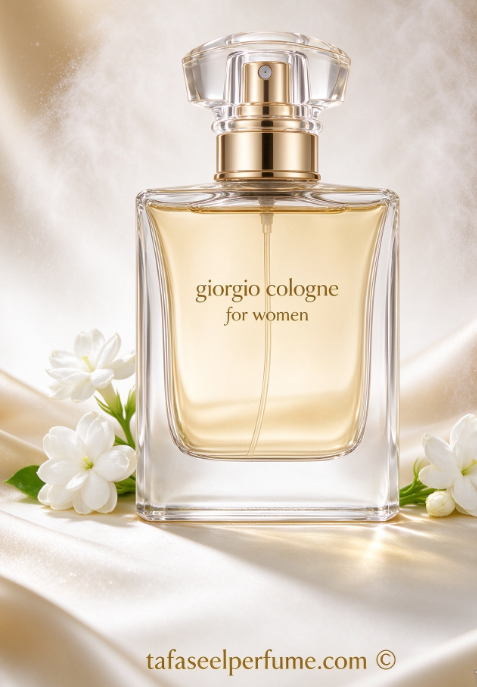
- Giorgio Cologne for Women: The Unapologetic Beverly Hills Powerhouse That Redefined Floral Scent: Giorgio cologne for women is not a quiet perfume. It is the 1981 white floral detonation from Giorgio Beverly Hills—a tuberose-forward, peach-and-orange-blossom statement that once filled restaurants, divided rooms, and became the olfactory shorthand for 1980s American glamour. This guide examines its architecture, its notorious reputation, its reformulations, and why this “shoulder-padded” floral still matters to anyone who loves perfume with a pulse.
When people search for Giorgio cologne for women, they are usually looking for one of two things: a half-remembered bottle from a mother’s vanity, or a deliberate pursuit of an era when fragrance was allowed to be enormous. Giorgio Beverly Hills, the yellow-and-white-striped boutique on Rodeo Drive, launched its first perfume in 1981, and it did not whisper. Created by Bob Aliano, Giorgio arrived as a creamy, fruity, indolic white floral with a chypre skeleton—peach, apricot, orange blossom, and bergamot pouring into a heart of tuberose, gardenia, jasmine, ylang-ylang, rose, and orchid, all resting on sandalwood, patchouli, oakmoss, amber, vanilla, and musk. It was the first perfume to run a scented strip advertisement in Vogue, and according to fragrance lore, it was so powerful that some restaurants refused to seat patrons who wore it. That reputation—half marketing, half genuine olfactory force—turned Giorgio into a cultural marker. It was not merely a perfume; it was a type of woman: big hair, broad shoulders, unabashed presence. Today, the formula has been softened by reformulation, but the original architecture remains legible, and the current Elizabeth Arden version is widely considered one of the better-maintained reformulations of an 1980s powerhouse. Whether you are a vintage collector, a white-floral devotee, or simply Giorgio-curious, understanding this scent means understanding the moment when American perfume decided that restraint was optional.
1. From Rodeo Drive Boutique to Global Scent Marker: The Birth of Giorgio
2. The Architecture of Excess: What Giorgio Cologne for Women Actually Smells Like
3. The “Banned from Restaurants” Reputation: Power Perfume and Public Space
4. Performance and Presence: Longevity, Sillage, and the Question of Over-Application
5. Giorgio Beverly Hills vs. Giorgio Armani: The Confusion That Refuses to Die
6. Vintage, “G,” Red, and Current Formulation: A Version Guide
7. How to Wear Giorgio Cologne for Women Without Becoming a Warning Label
8. Collecting and Buying Giorgio: What to Look For, What to Avoid
1. From Rodeo Drive Boutique to Global Scent Marker: The Birth of Giorgio
Giorgio was never a stand-alone perfume idea. It was the bottled translation of a retail fantasy—the yellow-striped awning, the California sun, the promise of Beverly Hills luxury made available in a spray.
The story begins not with a perfumer but with a storefront. In 1961, Giorgio Beverly Hills opened on Rodeo Drive, dressed in those unmistakable yellow and white stripes, and set out to become the everyday luxury destination for a newly image-conscious Los Angeles. By the time the fragrance launched in 1981, the boutique had already accumulated the kind of social capital that most brands spend decades manufacturing. The perfume was designed to extend that capital into the home and onto the skin. Its box repeated the awning; its name repeated the address. But the liquid inside did something the boutique could not: it allowed anyone, anywhere, to smell as if they had just stepped out of a convertible on Rodeo Drive. That is the essential context for understanding Giorgio cologne for women. It was not composed as a neutral floral; it was composed as a social signal. And because it was a signal, it was designed to be received—clearly, unmistakably, across a room. This extroverted intention explains both its triumph and its later notoriety. If you enjoy tracing how fashion and fragrance collude, the same era produced other bottle-as-identity objects, from the aldehydic polish of Vintage Imari Perfume to the architectural statement of Ungaro. Giorgio belongs to that lineage: perfume as wearable confidence, not merely scent.
2. The Architecture of Excess: What Giorgio Cologne for Women Actually Smells Like
The opening is a fruit bowl; the heart is a hothouse; the base is a warm, mossy cashmere. Giorgio is less a linear progression than a controlled detonation with a surprisingly soft landing.
The first spray of Giorgio is often described as “peachy,” and that is accurate, but incomplete. The peach and apricot in the top are not polite stone-fruit accents—they are syrupy and saturated, lifted by a sharp bergamot and a high-pitched orange blossom that gives the opening a slightly soapy, solar brightness. Within minutes, the heart arrives, and it is the heart that has made Giorgio both beloved and feared. Tuberose is the dominant voice: creamy, slightly rubbery, and indolic. Gardenia and jasmine add a buttery, narcotic thickness; ylang-ylang contributes a yellow floral sweetness that can tip toward bubblegum on some skin; rose and orchid round out the bouquet with a powdery softness. This is a white floral in the grand manner, and it does not fade quietly. The base is where Giorgio reveals its chypre ancestry. Oakmoss and patchouli give the drydown a mossy, earthy bite; sandalwood and cedar provide structure; amber and vanilla soften the edges into something almost edible. The result is a fragrance that smells expensive in the specific way of 1980s American luxury: abundant, polished, and slightly overripe. If you respond to the creamy-indolic tension of modern white florals, the curated selection of Best Perfumes for Women This Year will make an instructive comparison, but Giorgio remains the reference point against which many of them are measured, whether they admit it or not.
3. The “Banned from Restaurants” Reputation: Power Perfume and Public Space
The story that Giorgio was banned from restaurants is repeated so often that it has become folklore. The truth is more nuanced—and more revealing about how fragrance was worn in the 1980s.
Multiple fragrance histories and retail descriptions repeat the claim that Giorgio was “often banned from restaurants due to its intensity” in the 1980s. The precise documentary record is murky—this was not a coordinated municipal ban—but the anecdote persists because it captures a real dynamic. In the early 1980s, fragrance application was not governed by the minimalist etiquette that dominates contemporary wear. Giorgio arrived with a sillage that could colonize an elevator and a persistence that survived hand-washing. When combined with the era’s tendency toward generous application, the result was a scent that announced its wearer before she entered and lingered after she left. This is the context in which “powerhouse” is not an insult but a category. Giorgio was one of the “monster perfumes” of the 1980s, alongside Dior Poison, YSL Opium, and Mugler Angel—fragrances that were structurally designed to project. The restaurant anecdote is less about a specific legal prohibition and more about a cultural negotiation: how much olfactory space is one person entitled to occupy? Giorgio sits at the extreme end of that question. Its later reformulation, beginning in the 1990s, has muted the effect considerably, and most contemporary wearers find the current version far more manageable than its reputation suggests. But the legend remains, and it is useful: it reminds us that Giorgio cologne for women was never intended to be a skin scent. It was intended to be an event.
4. Performance and Presence: Longevity, Sillage, and the Question of Over-Application
Even in its softened modern form, Giorgio outlasts most contemporary eaux de toilette. The question is not whether it performs, but whether you are prepared for it to perform.
On the performance spectrum, Giorgio remains an outlier. Parfumo’s aggregate data describes projection and longevity as “above-average” even for the current eau de toilette. User reviews routinely note that one or two sprays are sufficient for a full day, and that the scent remains detectable on fabric long after the initial drydown. This is partly a function of concentration and partly a function of materials: the resinous, mossy, vanillic base clings to skin and cloth with unusual tenacity. The practical implication is straightforward. If you are accustomed to three-to-five sprays of a modern eau de parfum, do not transfer that habit to Giorgio. Start with one spray at the sternum or the back of the neck, and allow the opening to settle before deciding whether more is needed. The first ten to fifteen minutes can be the most demanding, especially in warm weather; the tuberose and orange blossom are at their most extroverted, and the scent has not yet acquired the creamy, mossy softness that defines its later hours. Once it settles, Giorgio becomes a warm, almost comforting floral with a vintage powderiness that sits close to the skin without disappearing. For anyone building a collection around statement scents, this is a useful calibration exercise. It sits comfortably alongside the kind of Haramain Amber Oud Ruby Edition in terms of sheer presence, though the registers—white floral versus saffron-amber—could hardly be more different. The lesson is the same: presence is a design choice, and Giorgio chose maximum.
5. Giorgio Beverly Hills vs. Giorgio Armani: The Confusion That Refuses to Die
The shared first name has caused decades of mistaken purchases and forum arguments. Giorgio Beverly Hills and Giorgio Armani are entirely separate houses, separate aesthetics, and separate histories.
It is a confusion worth addressing directly, because it surfaces in nearly every discussion of Giorgio cologne for women. Giorgio Beverly Hills is the Rodeo Drive boutique and fragrance house behind the 1981 white floral powerhouse. Giorgio Armani is the Italian fashion house founded by Giorgio Armani, whose fragrance line began with Armani for women in 1982 and later produced Acqua di Gio and countless other releases. The two are not related, not licensed through the same parent, and not stylistically adjacent. Giorgio Beverly Hills is lush, indolic, and unapologetically American in its excess. Giorgio Armani’s feminine releases tend toward cleaner, more tailored, often aquatically inflected compositions. The confusion is compounded by the fact that both houses have released fragrances called “Red” and both have used the name “Gio,” but the similarity ends at the label. If you are searching for the tuberose-heavy 1981 scent, you are looking for Giorgio Beverly Hills, usually identifiable by the yellow box and the “Giorgio” name without an Armani surname. If you are looking for the more recent, streamlined Armani feminine, the guide to Gio Women’s Perfume will point you in the right direction. Keeping these two lineages distinct is not pedantry; it is the difference between buying the perfume you actually want and buying a bottle that smells nothing like the memory you were chasing.
6. Vintage, “G,” Red, and Current Formulation: A Version Guide
Giorgio is not one bottle. It is a small family of releases, reformulations, and flankers, and the differences between them matter enormously to collectors and casual buyers alike.
The core Giorgio cologne for women has passed through several distinct phases. The original 1981 formula, now found only in vintage bottles, is remembered for its real oakmoss, real sandalwood, and a mossier, brighter, more “savage” character than the modern version. The current Elizabeth Arden reformulation, often made in Spain, is widely regarded as one of the more faithful mainstream reformulations of an 1980s powerhouse: it retains the fruity-floral architecture and the indolic heart, but the base is less complex, the moss is quieter, and the overall volume has been reduced from “radioactive” to “assertive”. Between these poles sit two important relatives. “G” by Giorgio, launched in 1999, is a different fragrance entirely: a fruity floral built around melon, pineapple, and grape, with orchid, peony, peach, ginger, sandalwood, and vetiver. It is fresher, sweeter, and far less controversial—useful for anyone who finds the original too much but enjoys the Giorgio name. “Red” for women, launched in 1989, is an oriental floral with cherry, osmanthus, ylang-ylang, orange blossom, carnation, rose, patchouli, and oakmoss; it is a separate composition with its own devoted following. For collectors, vintage Giorgio and vintage Red are the most sought-after, while “G” occupies a quieter niche. If you are exploring vintage formulations more broadly, the collector’s notes on Perfume Avon offer a useful parallel study in how mass-market houses managed reformulation and nostalgia across decades.
7. How to Wear Giorgio Cologne for Women Without Becoming a Warning Label
The modern wearer can enjoy Giorgio’s opulence without recreating the over-application that gave it its reputation. The key is dosage, placement, and season.
Giorgio is not a fragrance that rewards abandon. The most successful contemporary approach is to treat it as an extrait in spirit even when wearing the eau de toilette. One spray, applied to clothing rather than pulse points, allows the tuberose and peach to unfurl gradually while the base anchors the scent for hours. Two sprays—one at the nape of the neck, one at the hem of a sleeve—is the practical maximum for most indoor settings. In warm weather, the opening can feel syrupier and more demanding; in cool weather, the mossy-vanillic base comes forward and the fragrance becomes almost cozy. This seasonality is worth respecting. Giorgio is often described as an “all-season” scent, but it behaves differently in heat and cold, and the wearer who adjusts dosage accordingly will find it far more versatile than its reputation suggests. Layering is another option: a single spray of Giorgio under a lighter, drier floral or a woody-musk base can extend the drydown while softening the opening. The goal is not to tame Giorgio into something it is not. The goal is to let its abundance read as intentional rather than accidental. For those who enjoy the ritual of matching scent to mood and occasion, the curated approach in the Best Perfumes for Women guide provides a useful framework: Giorgio is a “statement” slot, not an “everyday” slot, and wearing it with that distinction in mind transforms it from a relic into a choice.
8. Collecting and Buying Giorgio: What to Look For, What to Avoid
Vintage Giorgio bottles are plentiful and often affordable, but the secondary market has pitfalls. Knowing the packaging, the manufacturer, and the likely condition of the juice will save you money and disappointment.
The first rule of buying vintage Giorgio is to distinguish between the original Giorgio Beverly Hills manufacture and later licensed or reformulated bottles. Early bottles, especially those with a removable sprayer and “Giorgio Beverly Hills” prominently displayed, are more likely to contain the richer, mossier original composition. Later bottles produced under Elizabeth Arden and made in Spain are still perfectly wearable, but they represent a different olfactory experience. The second rule is to ask about storage. A vintage floral with a high indolic content can turn if exposed to heat or light; a dark, cool storage history is more important than an unopened box. The third rule is to sample before committing to a full bottle, especially if you have never smelled the vintage version. Decanted samples and minis are widely available and allow you to compare the vintage and current formulations side by side. For collectors who enjoy the chase, the Witchy Perfume Brands article offers a useful contrast in collecting philosophies: some houses reward the pursuit of the obscure, while Giorgio rewards the pursuit of the well-preserved. The broader Women’s Perfume category is a good place to contextualize Giorgio within the wider landscape of feminine releases, and the Perfume Ranking section can help you gauge how it is positioned relative to other classics. Giorgio is not a rare perfume, but it is a specific one, and buying it with attention to version and condition is the difference between a time capsule and a cautionary tale.
Frequently Asked Questions About Giorgio Cologne for Women
Why was Giorgio perfume supposedly banned from restaurants?
Giorgio was not subject to an official legal ban, but during the 1980s its enormous sillage and the era’s generous application habits led some restaurants and public spaces to informally discourage it. The scent was so powerful that it could be perceived as disruptive to other diners, and the anecdote became part of its legend. In practice, the “ban” was a cultural reaction to a fragrance that was designed to project, not a formal prohibition.
Does Giorgio cologne for women smell like tuberose?
Yes, tuberose is the dominant floral note, but it is not a soliflore. Giorgio pairs tuberose with gardenia, jasmine, ylang-ylang, rose, and orchid, and the effect is a creamy, indolic white floral bouquet rather than a single-note tuberose. The peach and apricot opening and the mossy, vanillic base further distinguish it from a straightforward tuberose scent.
Is Giorgio Beverly Hills the same as Giorgio Armani?
No. Giorgio Beverly Hills is the fragrance house born from the Rodeo Drive boutique, and its 1981 Giorgio is the white floral powerhouse discussed here. Giorgio Armani is the Italian fashion house founded by Giorgio Armani, with a separate fragrance line that includes Armani for women, Acqua di Gio, and many other releases. The two houses are unrelated and stylistically distinct.
Is the current formulation of Giorgio worth buying, or should I only look for vintage?
The current Elizabeth Arden formulation is widely regarded as one of the better-maintained reformulations of an 1980s powerhouse. It preserves the fruity-floral architecture and the indolic heart, though the base is less complex and the overall projection is reduced. If you want the full vintage experience—mossier, brighter, more forceful—seek out an early bottle, but the current version is a legitimate and far more affordable entry point.
How many sprays of Giorgio should I use?
Start with one spray, ideally on clothing or at the nape of the neck, and wait at least fifteen minutes before considering a second. The opening is the most intense phase, and the drydown is significantly softer. Many experienced wearers find that one or two sprays provide a full day of scent. Over-application is the primary reason Giorgio developed its intimidating reputation.
What is the difference between Giorgio and “G” by Giorgio?
“G” by Giorgio, launched in 1999, is a separate fruity-floral fragrance built around melon, pineapple, and grape, with orchid, peony, peach, ginger, sandalwood, and vetiver. It is fresher, sweeter, and much lighter than the original Giorgio. “G” is a different perfume, not a flanker in the modern sense, and it appeals to wearers who find the 1981 original too heavy.
Does Giorgio still come in the yellow striped box?
The yellow-and-white striped packaging, inspired by the original Rodeo Drive boutique awning, remains the visual signature of Giorgio Beverly Hills. Current retail bottles generally continue this design, though vintage packaging can vary by era and manufacturer. The striped box is one of the most recognizable in perfume history and is a useful starting point for authentication when buying from secondary sellers.
Is Giorgio suitable for men, or is it strictly a women’s fragrance?
Giorgio was marketed as a women’s fragrance, and its white-floral structure—tuberose, gardenia, jasmine, ylang-ylang—places it firmly in the feminine tradition. However, fragrance has no inherent gender, and some men who enjoy bold white florals wear it successfully. The more relevant consideration is dosage and context: Giorgio is a high-impact scent, and anyone wearing it, regardless of gender, should apply it with restraint.
Unisex Perfume · Women’s Perfume · Perfume Gift Sets · Mini Size & Gift Sets · Perfume Articles and Reviews · Perfume Brands


