- Ungaro: Sculpted in Scent, Worn as Fashion: Small Introduction: Ungaro is a French house where the couturier’s obsession with color, drape, and sensuality does not stop at the garment. From the aldehydic grandeur of Diva to the fruity provocation of Apparition, its perfumes carry the same rule-breaking elegance that defined Emanuel Ungaro’s runway.
Large Introduction: Emanuel Ungaro arrived in Paris from the south of France and learned discipline under Cristobal Balenciaga before launching his own house in 1965. He described himself as a “sensual obsessive,” and the phrase fits both his fashion and his fragrances: bold clashes of print and color, a respect for technique, and an insistence that a woman should not merely wear a creation but live in it. The first Ungaro fragrance, Diva, arrived in 1983 and quickly became a reference point for floral-oriental luxury. Later chapters—Apparition, the Ungaro pour L’Homme line, and the more recent Cosmic and Moon releases—show a house that keeps returning to the same core tension: classical French perfumery discipline charged with a pop-inflected, unapologetically sensual appetite. Whether you are exploring Women’s Perfume or looking for a shared signature in Unisex Perfume, Ungaro’s catalogue offers a lesson in how couture sensibility translates into scent.
In this article: Ungaro Origins: Balenciaga Rigor, Parisian Provocation · Diva (1983): The Aldehydic Statement That Defined a House · Apparition and the Fruity-Chypre Turn · Ungaro pour L’Homme: Old-School Structure, Sensual Edge · The Noses Behind Ungaro · Cosmic, Moon, and the Contemporary Ungaro Scent Wardrobe
Ungaro Origins: Balenciaga Rigor, Parisian Provocation
The DNA of every Ungaro perfume begins with a contradiction. Emanuel Ungaro trained under Cristobal Balenciaga, where he absorbed what his house later called “rigor and perfectionism”. But he also came of age alongside André Courrèges, and from that pairing emerged a style that mixed classical couture technique with a pop-inflected appetite for color and movement. When he opened on Avenue Montaigne in 1967, the house became known for flamboyant prints, pure silhouettes, and an unmistakable femininity that felt both disciplined and free.
That same duality shaped the fragrance direction. Ungaro did not treat perfume as a decorative afterthought. It was an extension of the garment’s emotional work—what the house calls “transcending the garment by emotion”. The boldness of a print or the sensuality of a drape had to be matched by a scent that could hold its own in a room. For readers browsing Perfume Gift Sets, this history matters: an Ungaro fragrance is not a neutral accessory but a piece of the house’s couture argument, bottled.
Diva (1983): The Aldehydic Statement That Defined a House
Diva is the founding text of Ungaro perfumery. Launched in 1983, it announced the house’s arrival in fragrance with a composition built on Bulgarian rose, aldehydes, and patchouli—a structure that reads as classical French luxury but carries a distinctly Ungaro confidence. The top is bright and soapy-clean in the grand tradition: aldehydes, bergamot, cardamom, coriander, mandarin, and tuberose. The heart expands into carnation, jasmine, narcissus, rose, and ylang-ylang. The base is deep and persistent: amber, honey, iris, musk, oakmoss, patchouli, sandalwood, vanilla, and vetiver.
What makes Diva endure is not just its richness but its posture. It is a floral-oriental with the shoulders of a couture jacket—structured, deliberate, and impossible to ignore. In the 1980s and 1990s, the house was at the height of its visibility, and Diva became one of the scents that carried Ungaro’s name into dressing tables far beyond Paris. For anyone exploring Perfume Gift Sets as a way into a house’s heritage, Diva remains the most direct point of entry. It is also a reminder that Ungaro’s sensuality was never soft-focus; it was architectural.
Apparition and the Fruity-Chypre Turn
Two decades after Diva, Ungaro showed that its perfume language could bend without breaking. Apparition, launched in 2004 and composed by Francis Kurkdjian and Françoise Caron, moved away from the aldehydic grandeur of Diva toward a “scandalous floral” built on raspberry liqueur, cayenne pepper, passion flower, rose, heliotrope, patchouli, tonka bean, amber, and vanilla. It was fruitier, more direct, and more playful, but it retained the house’s appetite for contrast: sweet against spice, floral against patchouli, polish against provocation.
The Apparition line expanded into flankers—Pink, Sky, Sun, Cobalt—that broadened Ungaro’s reach into a more contemporary, retail-facing audience. This is where the house’s couture instinct meets the logic of a modern fragrance wardrobe. A Diva woman and an Apparition woman may share the same appetite for presence, but they arrive through different doors. For those who prefer to discover houses through editorial context, the Perfume Articles and Reviews section offers a useful way to trace how a single house can hold both classical and contemporary codes without losing its center.
Ungaro pour L’Homme: Old-School Structure, Sensual Edge
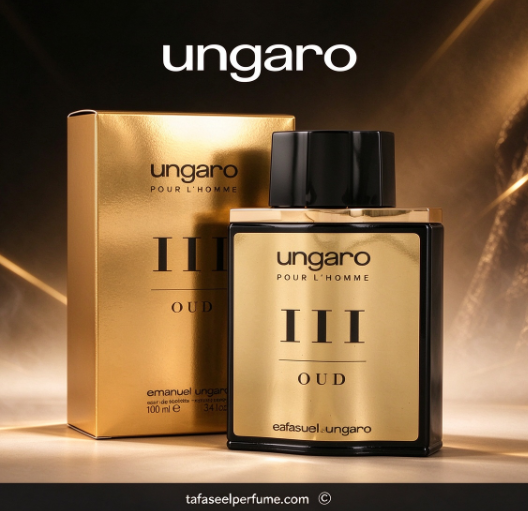
Ungaro’s masculine line is often overlooked in discussions of the house, but it deserves attention—especially for anyone who values structure. Ungaro pour L’Homme, launched in 1991, was composed by Jacques Polge and François Demachy, two perfumers closely associated with Chanel. The result is an old-school construction: assertive, perhaps a little too rough-edged for the polished Chanel universe, but all the more interesting for it. Subsequent iterations—Pour L’Homme II and III—refined the formula, with the third edition becoming a reference point for fans of aromatic, woody, and oud-adjacent masculines.
The house’s masculine releases do not chase trends. They carry the same Balenciaga-trained sense of line that defines Ungaro’s tailoring: nothing excess, but nothing timid either. In a market where many masculine launches blur into sweetness, Ungaro’s men’s scents retain a welcome firmness. They also pair naturally with the broader Men’s Perfume category, where structure and sensuality are not treated as opposites.
The Noses Behind Ungaro
Across its fragrance history, Ungaro has worked with a remarkably broad range of perfumers. Fragrantica’s database lists more than seventy-eight Ungaro scents created between 1977 and 2025, with contributors including Jacques Polge, François Demachy, Francis Kurkdjian, Olivier Polge, Nathalie Lorson, Olivier Cresp, and Marie Salamagne, among many others. That range explains why the house’s perfume catalogue does not feel like a single formula repeated. Diva’s aldehydic grandeur, Apparition’s fruity-chypre provocation, and the more recent fougère-inflected releases each carry a different authorial fingerprint while remaining recognizably Ungaro.
For collectors and curious noses, this is one of the pleasures of the house: it offers multiple entry points without diluting its identity. A first encounter might come through a classic women’s release, a masculine aromatic, or a newer pillar. The Brands index is a useful way to compare Ungaro’s trajectory with other couture houses that moved into fragrance, and to see where its balance of discipline and sensuality sits in a wider context.
Cosmic, Moon, and the Contemporary Ungaro Scent Wardrobe
Ungaro’s fragrance activity did not stop with its twentieth-century classics. In 2021 the house entered a ten-year exclusive global licensing agreement with Interparfums, and the first major pillar of that new chapter, Cosmic, arrived in 2024. Cosmic was followed by Moon in 2025, a fougère-woody feminine that continues the house’s dialogue between classical structure and a more contemporary, atmospheric sensibility. These releases sit alongside the ongoing presence of Diva, Apparition, and the men’s line, forming a multi-generational wardrobe rather than a single flagship.
That is the most accurate way to understand Ungaro today: not a house frozen in its 1980s peak, but one that keeps reopening the same question—how much rigor can sensuality tolerate before it becomes something else? Diva answers with aldehydes and patchouli. Apparition answers with raspberry and pepper. Cosmic and Moon answer with fougère and atmosphere. For anyone building a fragrance collection across Unisex Perfume and Women’s Perfume, Ungaro is less a single signature than a conversation worth following from one decade to the next.
Closing note: Ungaro’s perfumes are best understood as couture objects in liquid form—structured, sensual, and unafraid of contrast. Whether the entry point is the aldehydic authority of Diva, the fruity provocation of Apparition, or the newer fougère accents of Moon, the house rewards a wearer who wants presence without performance.


