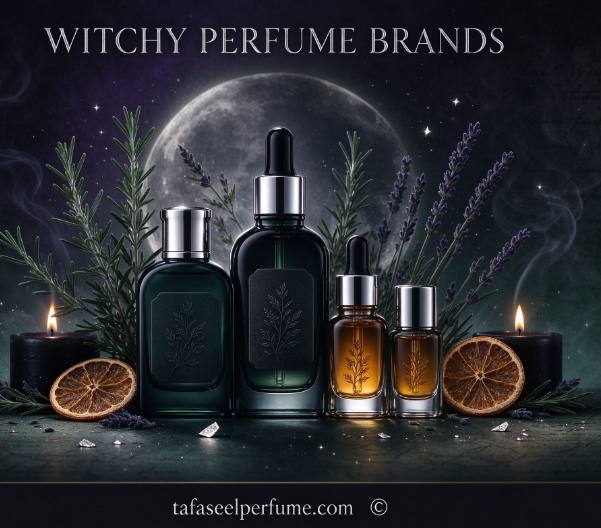
- Witchy Perfume Brands: 6 Scent Houses That Bottle Soil, Resin, and Ritual: Witchy perfume brands are not selling a simple note list. They are selling atmosphere, intention, and the feeling of something ancient being opened in a room. This guide looks at six houses that treat fragrance as a ritual object rather than a polite accessory.
The category sits at the intersection of herbalism, occult aesthetics, and fine fragrance craft. The best witchy perfume brands do not simply add patchouli and call it a day; they build scents that smell damp, resinous, rooty, smoky, or quietly charged. Some are Icelandic and mineral, some are San Francisco astrological, and some are family-run apothecary projects. What unites them is a refusal to make fragrance feel sterile. The six houses below represent different paths into the same forest: earth, smoke, herb, and spell.
1. Andrea Maack Coven — Soil, Moss, and the Smell of a Disturbed Forest Floor — A benchmark earthy witchy scent built on galbanum, moss, clove, and vanilla.
2. Vyrao Witchy Woo — Patchouli, Black Pepper, and Energetic Frequency — A charged, hazy patchouli fragrance with a soft musk-ambrette landing.
3. Lush Lord of Misrule — A Patchouli-Vanilla Bomb With Mischievous Magic — Earthy, spicy, sweet, and deliberately chaotic.
4. Planets Perfumery — Astrology, Archetypes, and Perfume as Spellwork — A three-scent project that maps planetary energy onto olfactory ritual.
5. Arcana Wildcraft — Herbalism, Astrology, and Family-Run Witchcraft — A world-building house of forests, cathedrals, and hidden lagoons.
6. Black Phoenix Alchemy Lab — The Cult Apothecary of Atmospheric Witchy Perfume — A vast, literary, oil-based catalogue that treats scent as narrative magic.
1. Andrea Maack Coven — Soil, Moss, and the Smell of a Disturbed Forest Floor
If there is a single fragrance that functions as the benchmark for witchy perfume brands, it is Andrea Maack Coven. The Icelandic-born, Milan-based perfumer built Coven from a memory of picking potatoes from wet dirt at a family cabin in the rain. That origin story sounds almost too plain for a fragrance this atmospheric, but it explains exactly why Coven works: it smells like contact with the ground, not like a fantasy of the ground. Galbanum opens green and slightly bitter, then the composition settles into a loamy, moss-driven heart that wearers consistently describe as damp forest floor, wet bark, and the underside of a log. Clove and vanilla keep it from tipping into pure rot; there is a primal sensuality underneath the earth. It is the fragrance people reach for when they want to smell like they have been doing something in the woods, not simply walking through them. For a different but equally deliberate treatment of woods and femininity, Serge Lutens Féminité du Bois offers a useful contrast: where Coven is soil, Féminité is carved cedar and stewed plum, the witch’s library rather than her clearing.
2. Vyrao Witchy Woo — Patchouli, Black Pepper, and Energetic Frequency
Vyrao approaches witchy perfume from a place of energetic charge. Witchy Woo is built around patchouli, black pepper, ambrette, and orris, a combination that reads as hazy, opulent, and faintly medicinal in the best apothecary sense. What separates Vyrao from the purely atmospheric witchy houses is its explicit claim to neuroscience-backed formulation — the idea that the scent is designed not only to evoke a mood but to shift one. Whether or not a wearer buys the neuroscience, the olfactory result is a patchouli that feels lit from within. Black pepper adds a dry heat, ambrette creates a soft musk-skin blur, and orris contributes a powdered rootiness that keeps the composition from becoming a headshop cliché. Witchy Woo is witchy in the way a candlelit intention-setting session is witchy: controlled, focused, and quietly charged. It is also one of the easiest entry points into the category because the patchouli is grounded rather than left bare.
3. Lush Lord of Misrule — A Patchouli-Vanilla Bomb With Mischievous Magic
Lush is not a niche house, but Lord of Misrule earns its place among witchy perfume brands because it does something most mainstream releases are afraid to do: it lets patchouli and vanilla collide without apology. The result is a bold, witchy patchouli-vanilla bomb that opens earthy and resinous before mellowing into something sweet, spicy, and unmistakably mischievous. Reviewers describe it as spiced magic, warm and witchy, and — most tellingly — what a witch dancing around a fire in the forest would smell like. Lord of Misrule is witchy perfume for people who do not want to smell serious about it. It is the chaos-bringer of the category, the fragrance equivalent of a spell that works precisely because it refuses to follow the grimoire. If you want a darker, more gourmand-adjacent take on forbidden fruit, Tom Ford Lost Cherry occupies adjacent territory with black cherry and bitter almond, but Lord of Misrule remains the more overtly ritualistic of the two.
4. Planets Perfumery — Astrology, Archetypes, and Perfume as Spellwork
San Francisco–based Planets Perfumery is a three-person project that translates archetypal astrology into scent, and the result is less a conventional fragrance line than a ritualistic olfactory spell. The debut trio — Mars, Venus, and Mercury — maps onto the first three zodiac signs and a sequence of creation. Mars is blood orange and ginger with an accord of molten sparks; Venus is champagne foam, bergamot, Anatolian rose, and oakmoss; Mercury is a wild fougère of lavender, papyrus, jasmine, and moss, explicitly androgynous. Perfumer Mauricio Garcia, a certified aromatherapist and occult practitioner, describes the fragrances as spells meant to serve as familiars. The brand’s witchiness is not in the note list — it is in the framework. Planets Perfumery asks you to choose a scent based on what you need to manifest, not just what you want to smell like, and that is a fundamentally different relationship between wearer and perfume. It is a house for people who want their fragrance to do something, not merely say something.
5. Arcana Wildcraft — Herbalism, Astrology, and Family-Run Witchcraft
Arcana Wildcraft has been family-owned since 2003, and its formula is disarmingly literal: ancient perfumery techniques, herbalism, astrology, and witchcraft. The brand’s catalogue runs from medieval beasts to magick underwater havens, and the founders explicitly invite wearers to treat the scents as portals to old-growth forests, crumbling cathedrals, vampire mansions, and hidden lagoons. This is witchy perfume in the world-building mode. Where Coven is a single, devastatingly focused atmospheric, Arcana Wildcraft offers an entire multiverse of ritual settings. A scent such as Daydreams of Trees — fir, lavender, iris, spruce, and sap — functions as a hyperrealistic invocation of an enchanted wood, cool and moss-draped, the olfactory equivalent of stepping through a doorway that was not there a moment ago. The house also works well for wearers who prefer unisex perfume because many of its forest, resin, and incense compositions refuse to sit neatly on one side of the gender divide.
6. Black Phoenix Alchemy Lab — The Cult Apothecary of Atmospheric Witchy Perfume
Black Phoenix Alchemy Lab is the cult apothecary of the witchy perfume world, and its influence is difficult to overstate. The house works primarily in perfume oils, and its catalogue is vast enough to feel like a grimoire with too many pages: literary references, mythological figures, dark fairy tales, ritual oils, and limited-edition collections that appear and vanish like seasonal spells. What makes Black Phoenix essential to the witchy perfume brands conversation is its narrative density. These are not fragrances designed to be universally pleasing; they are fragrances designed to evoke a specific character, place, or moment, and wearers often describe them as transporting, strange, and deeply personal. The oil format also changes the ritual: application is slower, more deliberate, and closer to anointing than spraying. For anyone who wants witchy perfume to feel like a practice rather than a purchase, Black Phoenix Alchemy Lab remains one of the most complete expressions of the idea.
FAQ 1: What actually makes a perfume smell witchy?
It is not one note but a cluster of materials that signal earth, smoke, resin, and unprocessed plant matter. The recurring cast includes patchouli, myrrh, labdanum, oakmoss, galbanum, black pepper, clove, and incense. Witchy perfumes tend to avoid the high polish of mainstream designer compositions; they are allowed to smell damp, bitter, or slightly off in a way that reads as intentional rather than flawed. The through-line is materiality: witchy perfume smells like something that came out of the ground or off a fire, not out of a lab.
FAQ 2: Are witchy perfume brands only for people who practice witchcraft?
No. The category is defined by olfactory aesthetics and intentionality, not religious or spiritual affiliation. Many wearers are drawn to the atmosphere — the forest-floor, candle-smoke, apothecary-drawer feeling — without engaging in any practice. Conversely, practitioners may choose witchy scents precisely because they support ritual focus. The brands themselves span the spectrum: some are explicit about the occult framework, while others simply make perfumes that happen to fit the brief. The only entry requirement is a willingness to smell less like a department store and more like a place.
FAQ 3: What is the difference between witchy and gothic perfume?
The categories overlap but are not identical. Gothic perfume often leans on dark rose, leather, violet, and incense — a cathedral-and-crypt palette that is sensual and sometimes vampiric. Witchy perfume is more likely to smell green, damp, rooty, or herbal, with an emphasis on soil and plant matter rather than stone and velvet. A fragrance can be both: Andrea Maack Coven reads as witchy and gothic at once. But the witchy pole is closer to the forest floor, while the gothic pole is closer to the cathedral interior. If you want leather and rose, look gothic; if you want moss and galbanum, look witchy.
FAQ 4: Can witchy perfumes be worn every day, or are they too intense?
It depends on the fragrance and the concentration. Planets Perfumery Mercury is a fougère with lavender and moss that wears like a textured, slightly strange everyday scent; Lush Lord of Misrule is bold, but many wearers treat it as a signature. The more challenging end of the category — heavy galbanum, wet soil accords, animalic resins — is better suited to evenings, cold weather, or situations where you want the fragrance to function as a deliberate statement. A useful rule: the more green and bitter the opening, the more likely the fragrance is making a demand of the room; the more vanilla, ambrette, or tonka in the base, the more it will settle into something wearable for longer stretches.
FAQ 5: Where should someone start with witchy perfume brands?
Start with a patchouli-forward fragrance that has a soft landing — something where the patchouli is grounded by vanilla, ambrette, or a clean musk rather than left bare. Vyrao Witchy Woo is a strong entry point because black pepper and orris keep the patchouli lifted and legible without sanding off its character. From there, move toward the damp-earthy end with Coven or Arcana Wildcraft’s forest scents, or toward the astrological-ritual end with Planets Perfumery, depending on whether you are drawn to the material or the framework. Samples are essential because witchy perfume is a category where a small vial will tell you more than a hundred reviews.
FAQ 6: Are witchy perfumes a good gift, or are they too personal?
They can be excellent gifts, but they are more personal than a mainstream designer scent, so sampling or a discovery set is usually wiser than committing to a full bottle. A witchy perfume is often chosen for atmosphere rather than broad appeal, which means the recipient’s taste in resin, moss, smoke, and patchouli matters more than usual. If you are buying for someone new to the category, look for a perfume gift set or a sample bundle that lets them test several moods before choosing a signature. The best gift in this category is not the boldest bottle; it is the one that gives the wearer permission to smell like the place they want to return to.


