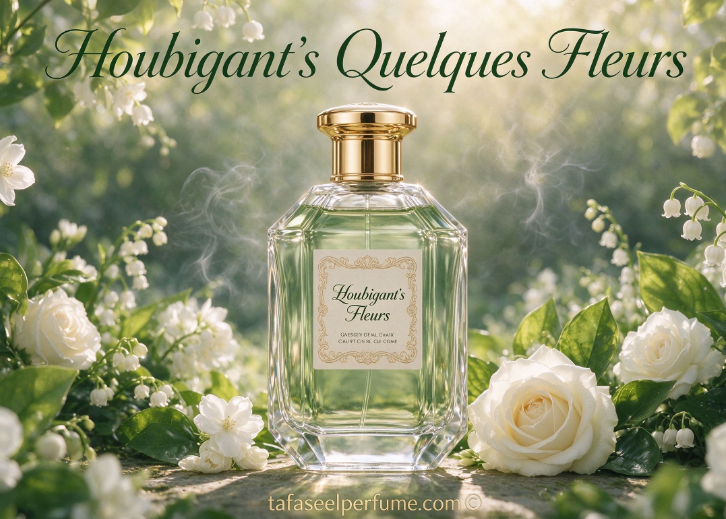
- Houbigant’s Quelques Fleurs: The 1912 Multi-Floral Revolution That Still Defines Modern Perfumery: Quelques Fleurs is not merely a perfume. It is the moment the idea of “a bouquet” entered the language of modern fragrance. Before 1912, floral perfumes were largely soliflores—single flowers, or simple blends tethered to herbs and essences. Then Robert Bienaimé, working for the House of Houbigant, composed something different: a multi-floral abstraction that did not imitate one flower but imagined an entire garden in bloom.
Quelques Fleurs is not merely a perfume. It is the moment the idea of “a bouquet” entered the language of modern fragrance. Before 1912, floral perfumes were largely soliflores—single flowers, or simple blends tethered to herbs and essences. Then Robert Bienaimé, working for the House of Houbigant, composed something different: a multi-floral abstraction that did not imitate one flower but imagined an entire garden in bloom. More than a century later, Quelques Fleurs remains the reference point for what a green, mossy, floral chypre can be—and a reminder that innovation in perfumery is not always loud. Sometimes it is a whisper that lasts a hundred years.
1. The Birth of the Multi-Floral Bouquet: 1912 and the Bienaimé Blueprint
To understand Quelques Fleurs, you must first understand what did not exist before it. In the early twentieth century, the dominant floral fragrances were built around a single hero note—rose, jasmine, violet—or they leaned on the emerging fougère and oriental structures that houses like Houbigant itself had helped pioneer. When Robert Bienaimé unveiled Quelques Fleurs in 1912, he did not simply add more flowers. He built a democratic architecture of scent, in which tuberose, jasmine, rose, ylang-ylang, violet, carnation, orange blossom, and lily of the valley were not layered as a pyramid of dominance but woven into a single, seamless fabric. The Genealogy of Perfumes later cited it as an innovation that established a new fragrance classification and influenced compositions for decades. That classification—floral chypre, or green floral bouquet—is the direct ancestor of countless fragrances that followed. The formula was famously extravagant: the house maintains that a single ounce of the original composition could require up to 15,000 flowers and 250 raw materials, a scale that speaks to the ambition behind the quiet elegance. For anyone tracing the lineage of modern feminine perfumery, Quelques Fleurs sits at the source, not as a relic but as a working blueprint.
2. The Architecture of the Scent: Green Opening, Floral Heart, Mossy Base
What makes Quelques Fleurs feel unlike a conventional floral is the tension between its bitter green opening and its opulent floral heart. The top notes announce themselves with bergamot, galbanum, tarragon, and lemon—a quartet that reads sharp, sappy, and almost medicinal to some noses, like crushed stems and cold morning air. This is not a pretty beginning. It is a structural one, preparing the skin for what follows. The heart is where the multi-floral idea becomes tangible: jasmine, tuberose, rose, violet, ylang-ylang, carnation, broom flower, orange blossom, and clove are packed into a density that never quite resolves into a single identifiable flower. You smell flowers, plural, but you cannot point to one. The base settles into the chypre signature that gives the fragrance its vintage gravity: oakmoss, sandalwood, civet, cedarwood, musk, orris, and tonka bean. The oakmoss is especially important—it lends the earthy, slightly bitter, forest-floor quality that separates Quelques Fleurs from the sweet florals of later decades. Reviewers consistently describe the overall effect as soapy, mossy, and classically chypre, with a civet note in the base that adds a subtle animalic warmth without tipping into dirtiness. It is a fragrance that smells “finished” in the way a tailored garment does: every seam is intentional.
If you are exploring this style for the first time, the fresh floral category offers a gentler entry point, but Quelques Fleurs remains the architectural reference: the fragrance that proved a floral bouquet could be abstract, structured, and enduring.
3. L’Original, Royale, and Jardin Secret: One Name, Three Distinct Personalities
The Quelques Fleurs name is not a single formula. It is a family, and understanding the differences is essential before committing to a bottle. Quelques Fleurs L’Original is the 1912 bienaimé composition as it is known today: the green, mossy, multi-floral chypre described above. It is the historical anchor. Quelques Fleurs Royale, by contrast, was composed for Princess Adélaïde d’Orléans and takes the DNA in a more oriental and honeyed direction. Its opening is fruitier—blackcurrant and grapefruit—and its heart leans on jasmine absolute, rose absolute, violet, tuberose absolute, and beeswax absolute, which gives it a plush, golden warmth that L’Original deliberately avoids. Quelques Fleurs Jardin Secret, introduced much later, is a modern reinterpretation: bergamot, yellow mandarin, and neroli on top; magnolia, narcissus, rose centifolia, orange blossom, jasmine, orris, and ylang-ylang in the heart; and a base of white amber, musk, sandalwood, and ambrette that feels softer and more contemporary than the mossy chypre foundation of the original. None of these is a “flanker” in the dismissive sense. They are distinct olfactory arguments built from the same premise: that flowers, when composed with intelligence, can say something larger than themselves. For those who prefer a more unisex or gender-fluid approach to floral wearing, the unisex edit is a useful companion, but the Quelques Fleurs line remains historically and olfactively a feminine project—one that nonetheless welcomes any wearer willing to meet it on its own terms.
4. Vintage Mustiness vs. Modern Precision: The Reformulation Conversation
No discussion of Quelques Fleurs is complete without addressing the vintage-versus-modern divide, because the two are genuinely different experiences. Longtime wearers describe the older juice as possessing a pronounced waxy, slightly musty character, with a heavier civet presence and an opening that feels more typically “vintage”—herbal, almost sour in its first minutes. The modern formulation, by contrast, is often described as “getting straight to the point”: the green opening is cleaner, the floral heart more immediately legible, and the base less animalic. This is not a case of one being objectively superior. The vintage version offers a textural, almost archival pleasure—the sensation of smelling a preserved aesthetic. The modern version offers wearability and clarity, and many reviewers argue that the reformulation has been handled with unusual care, preserving the Bienaimé architecture while removing the “musty” edges that made the original difficult for contemporary noses. If you are drawn to vintage-style chypres but want something you can wear without feeling costumed, the current L’Original Eau de Parfum is the pragmatic choice. If you are a collector or a student of formulation history, sampling a vintage extrait or an older EDP is worthwhile—just expect a different animal.
5. Performance, Longevity, and the Honest Wearability Question
Quelques Fleurs is not a crowd-pleaser in the contemporary sense. It does not project with the sugary intensity of a modern gourmand, and its sillage is best described as intimate-to-moderate, depending on concentration and skin chemistry. A detailed review of the Extrait notes a longevity rating of 8/10 and a sillage of 7/10, with the fragrance lasting through a full day on skin and leaving a soft, mossy trail. The Eau de Parfum is more variable: some wearers report excellent tenacity and a persistent green-floral aura, while others find it closer to the skin and shorter-lived than expected. This inconsistency is not necessarily a flaw. Quelques Fleurs is a chypre, and chypres are structurally different from modern ambers and musks—they do not rely on heavy, diffusive base materials to announce themselves across a room. The reward is proximity: the fragrance is best appreciated within a personal bubble, where the interplay of galbanum, clove, and oakmoss can be read without interference. If you are accustomed to body sprays and lightweight layering formats, the body spray ritual may feel like a different universe. Quelques Fleurs asks for a different kind of attention—slower, closer, more patient. For many wearers, that is precisely the point.
6. Why a 1912 Fragrance Still Matters in 2026
It would be easy to file Quelques Fleurs under “historical interest” and move on. But the fragrance remains relevant for reasons that have little to do with nostalgia. First, it is a living argument against the soliflore—a reminder that floral perfumery can be abstract, intellectual, and structurally ambitious rather than merely pretty. Second, it demonstrates that green and bitter notes can coexist with opulence: the tension between galbanum and tuberose is not a flaw to be smoothed over but the engine of the composition. Third, in an era of hyper-diffusive, algorithm-friendly releases, Quelques Fleurs offers a different value proposition: discretion. It does not try to fill a room. It tries to complete a person. The women’s perfume collection at large has moved through gourmand, fruity, and amber cycles since 1912, and each of those movements has its own pleasures. But Quelques Fleurs remains the chypre reference—the fragrance you smell not to be transported to a fantasy but to understand where modern floral perfumery learned to think. If you are building a collection that values lineage over novelty, it belongs in the conversation. If you are simply curious about what a 真正 multi-floral bouquet smells like when it is not diluted into a fruity-floral mist, start here. And if you are drawn to the green, mossy, vintage-adjacent corner of the fragrance world, the Bleecker Street review and Clinique Bloom guide offer useful adjacent references, though neither shares the oakmoss-and-civet foundation that makes Quelques Fleurs singular.
For those ready to explore the broader Houbigant universe or to sample Quelques Fleurs in miniature before committing to a full bottle, the mini size and gift sets section is a practical starting point. The fragrance rewards sampling: its green opening is divisive, and its chypre base reveals itself slowly. Give it three wearings on skin, in different weather, before deciding. A 1912 composition has survived this long because it does not reveal everything at once.
Frequently Asked Questions About Houbigant’s Quelques Fleurs
Is Quelques Fleurs a floral or a chypre fragrance?
It is both. Quelques Fleurs is historically classified as the first multi-floral bouquet, but its base of oakmoss, sandalwood, civet, and tonka bean places it firmly within the floral chypre family. The floral heart is dense and abstract; the chypre foundation gives it structure, bitterness, and longevity. Think of it as a bouquet resting on a mossy forest floor rather than floating in a vase.
What is the difference between L’Original and Royale?
L’Original is the 1912 composition: green, mossy, bitter in the opening, and relatively restrained in sweetness. Royale was created for Princess Adélaïde d’Orléans and adds a fruity opening (blackcurrant, grapefruit) and a honeyed, oriental warmth via beeswax absolute and a richer amber base. If L’Original feels too austere or green, Royale is the softer, more golden alternative. If Royale feels too sweet or plush, L’Original is the sharper, more historical choice.
Does Quelques Fleurs still smell like the vintage version?
Not exactly, and that is expected after more than a century of raw-material regulation and reformulation. The modern Eau de Parfum preserves the green-floral-chypre architecture but removes much of the waxy, musty, civet-heavy character that defined older batches. Many wearers find the current version more wearable and precise; vintage purists may miss the textural “funk” of the original. Both are legitimate experiences of the same lineage.
Is Quelques Fleurs suitable for men?
Historically, Quelques Fleurs has been marketed as a feminine fragrance, and its dense floral heart reflects that lineage. However, fragrance has no gender, and the green, bitter, mossy structure of the chypre base makes it entirely wearable for anyone who enjoys galbanum, oakmoss, and abstract florals. It is not a “freshie” or a crowd-pleaser; it is a deliberate, vintage-leaning composition. Wear it if you enjoy it, regardless of the label on the bottle.
How should I apply Quelques Fleurs for the best experience?
Apply to pulse points—wrists, base of the throat, behind the ears—and do not rub. The green opening benefits from the warmth and movement of skin, and the chypre base develops slowly. One or two sprays of the Eau de Parfum is usually sufficient for a personal scent bubble; the Extrait can be applied more sparingly. If you want to extend longevity without altering the composition, layer over an unscented moisturizer rather than a scented body product, which can muddy the galbanum-and-oakmoss clarity.
Where can I sample Quelques Fleurs before buying a full bottle?
Miniature sets and discovery formats are the most sensible entry point. The mini size and gift sets category includes options that allow you to test L’Original alongside other Houbigant compositions without committing to a full bottle. If you are comparing Quelques Fleurs to other classic florals or chypres, the perfume articles and reviews section provides context that can help you decide whether the 1912 green-floral architecture aligns with your taste before you invest.


