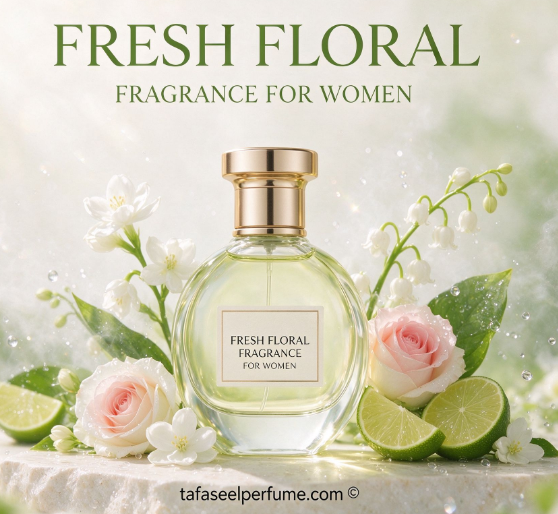
- Fresh Floral Fragrance for Women: The Complete Guide to Light, Blooming, Everyday Elegance: A fresh floral fragrance for women is the scent equivalent of a cool breeze through an open window: crisp citrus, dew-covered petals, and a soft musk trail that never overwhelms. It is the family of perfumes that smells clean, luminous, and effortlessly wearable — the kind of bottle you reach for on a Monday morning and again on a Saturday afternoon.
A fresh floral fragrance for women is the scent equivalent of a cool breeze through an open window: crisp citrus, dew-covered petals, and a soft musk trail that never overwhelms. It is the family of perfumes that smells clean, luminous, and effortlessly wearable — the kind of bottle you reach for on a Monday morning and again on a Saturday afternoon. In this guide, we break down what makes a floral truly "fresh," how the notes unfold on skin, which occasions suit them best, and how to choose the right one without ever smelling the tester strip twice.
If you have ever stood in a perfume hall surrounded by a hundred bottles and walked away with something too sweet, too heavy, or too sharp, the problem was probably not your taste — it was the category. Fresh floral fragrance for women sits in a very specific corner of the fragrance map. It borrows the brightness of citrus and green leaves, the transparency of water and air, and the tenderness of petals such as freesia, lily of the valley, peony, and jasmine. The result is a fragrance that feels like skin rather than costume. Over the sections below we will look at the anatomy of these scents, the difference between fresh floral and its neighbours (fruity floral, green floral, aquatic floral), the weather and wardrobe rules that keep them smelling modern, and the practical layering tricks that make a light perfume last a full working day. Along the way we will point you toward a few reference bottles worth smelling — from a salty, sunlit take on a classic floral icon to a bergamot-and-oud pairing that shows how bright and woody can coexist — so you can build a small, confident wardrobe of fresh florals instead of a drawer full of half-used mistakes.
1. What Exactly Makes a Floral Fragrance "Fresh"?
2. The Fragrance Pyramid: How Fresh Florals Unfold on Skin
3. When and Where to Wear a Fresh Floral Fragrance for Women
4. Fresh Floral vs. Fruity Floral vs. Green Floral
5. The Notes That Keep a Fresh Floral Light in Hot Weather
6. How to Layer a Fresh Floral for Longer Wear
7. Choosing the Right Concentration: EDT, EDP, and Hair Mists
8. Mistakes to Avoid When Buying a Fresh Floral Online
1. What Exactly Makes a Floral Fragrance "Fresh"?
The word "floral" describes the heart of a perfume; the word "fresh" describes its temperature. A fresh floral fragrance for women is built so that the flower notes never sit heavy or syrupy on the skin. Instead, they are lifted by three structural devices. The first is citrus and aldehydes: bergamot, lemon, mandarin, and pink pepper create that first sparkling impression, and modern aldehyde blends give a clean, almost linen-like fizz. The second is green and aquatic accords: violet leaf, galbanum, cucumber, and calone-style marine notes add the sensation of cut stems and cool water, which is why so many fresh florals smell like a florist's shop at 8 a.m. rather than a garden at dusk. The third is transparent musk and soft woods in the base — white musk, cashmeran, cedar — which keep the dry-down close to the skin and prevent the composition from turning into a heavy, powdery cloud.
That architecture explains why the same flower can smell completely different in two bottles. Rose in a fresh floral is usually paired with lychee, bergamot, or a green leaf accord, so it reads as dewy and pink rather than velvety and dark. Jasmine in a fresh floral is usually stripped of its animalic indoles and brightened with citrus, so it feels like sunlit air instead of night-blooming drama. Good reference points are easy to find once you know the pattern: a classic like a salt-laced floral interpretation of a heritage icon shows exactly how a pinch of mineral freshness can make an old-fashioned bouquet feel modern, while a bright woody-citrus composition such as Jo Malone Bergamot and Oud: The Complete Guide to a Woody Citrus Masterpiece demonstrates the same principle from the other direction — citrus first, warmth second, and never the reverse.
It also helps to understand what a fresh floral is not. It is not a "clean" laundry scent, although the two can overlap. It is not a soliflore in the strict sense, although many fresh florals are named after a single flower — in practice they almost always contain a supporting cast of citrus, green notes, and musk. And it is not inherently weak: a well-built eau de parfum in this family can last six to eight hours, it simply projects less aggressively than an amber or a gourmand. Once you accept that a fresh floral is designed to be discovered rather than announced, the whole category becomes much easier to shop.
2. The Fragrance Pyramid: How Fresh Florals Unfold on Skin
Fresh florals are the most narrative of all fragrance families, because their story is told in a strict sequence: brightness, bloom, softness. In the top notes, expect thirty to sixty minutes of citrus, pear, blackcurrant, or watery fruit. This is the part that sells the bottle in a store, and it is also the part that most people mistake for the fragrance itself. Give it time. The heart — usually reached after twenty to forty minutes on warm skin — is where the actual florals appear: peony, freesia, lily of the valley, magnolia, honeysuckle, neroli, orange blossom, or a light rose. This is the phase that defines the scent's personality, and it is where the "fresh" construction earns its keep, because these flowers are being supported by green and aquatic notes instead of heavy resins.
The base is where a cheap fresh floral and a well-made one separate dramatically. Budget versions collapse into a single flat musk note that smells like shampoo. Better compositions use a layered base: white musk for softness, cedar or vetiver for a dry, clean edge, ambrette for a skin-like warmth, and sometimes a whisper of tonka or sandalwood to stop the fragrance from vanishing entirely. This is also why concentration matters so much in this family. In a fragrance philosophy built on layered intensity, such as the approach explored in Elixir Christian Dior: The Concentrated Fragrance Philosophy Behind Sauvage, the base notes are given room to do heavy lifting — the opposite strategy to a fresh floral, but a useful reminder that the dry-down is where a perfume's quality actually lives.
Practically speaking, you should evaluate a fresh floral fragrance for women at three moments: on the tester strip (top notes only), fifteen minutes later on your skin (heart), and two hours later on your skin (base). Never buy from the strip alone. Fresh florals are unusually dependent on skin chemistry, because the citrus and green notes evaporate at different rates on dry versus oily skin, and the musk base can read either powdery or clean depending on your body's natural oils. Spray two candidates, one on each wrist, and live with them for a full afternoon before deciding.
3. When and Where to Wear a Fresh Floral Fragrance for Women
This is the most versatile family in perfumery, and that versatility is exactly why it deserves a permanent place in your collection. The obvious slots are daytime, spring and summer, the office, brunch, a daytime wedding, and travel — anywhere the scent needs to be pleasant in close quarters without invading them. A fresh floral is the fragrance equivalent of a white shirt: it works with everything, but it also means the rest of the outfit has to do the talking.
Less obvious but equally valid: evening wear in warm climates. In high humidity, heavy orientals become suffocating, and a fresh floral with a citrus opening actually projects better because the heat amplifies the top notes. It is also the best choice for anyone who works in a shared space, takes public transport daily, or has colleagues with fragrance sensitivities. If you want a wider survey of bottles that perform in these settings, a list such as Tom Ford Best Perfumes for Her: 7 Iconic Women's Fragrances Worth Owning is a useful starting point, because it shows how a designer house varies its fresh floral output across price points and occasions.
Where fresh florals struggle is in cold weather and late nights. Below about ten degrees, the citrus top notes feel thin and the whole composition can smell like a bathroom air freshener. The fix is not to abandon them but to switch format: choose an eau de parfum over an eau de toilette, apply to moisturised skin, and consider a two-spray layering with a warmer body cream. Conversely, for a black-tie event or a winter evening, let a woody or amber fragrance take over and keep the fresh floral for the next morning.
4. Fresh Floral vs. Fruity Floral vs. Green Floral
These three sub-families are constantly confused, and the confusion costs people money. A fruity floral puts a sweet, edible fruit accord — peach, pear, lychee, raspberry, blackcurrant — at the front of the composition, and usually backs it with a creamy or gourmand base. It smells rounder, sweeter, and more playful. A green floral pushes the leafy, stemmy, cut-grass side hard, sometimes to the point of smelling bitter or vegetal, and is the most "garden-like" of the three. A fresh floral sits between them: it uses fruit and green notes as lifters rather than headlines, keeping the flower itself as the emotional centre while the surrounding notes provide air and light.
The practical test is the sweetness dial. If the fragrance makes you think of a fruit salad or a dessert, it is a fruity floral. If it makes you think of a crushed leaf between your fingers, it is a green floral. If it makes you think of a cool, clean florist's counter — flowers, water, a little citrus in the air — it is a fresh floral. A good illustration of how much a single note can shift the balance is a glamorous, sparkle-forward composition like Juicy Couture Couture Couture EDP: The Glamorous Floral-Fruity Signature That Still Sparkles, which shows the fruity-floral side of the spectrum and makes the restraint of a true fresh floral much easier to appreciate by contrast.
There is also an aquatic floral hybrid worth knowing: florals built over marine and watery accords, which can smell like sea air or a swimming pool depending on the quality of the materials. These are excellent in extreme heat but can read as impersonal or "hotel lobby" in cool weather. And there is the aldehydic floral, the vintage-leaning style that smells like pressed powder and clean linen, which is fresh but not light — a great choice for people who want the freshness without the fragility. A heritage powerhouse such as the one examined in Giorgio Cologne for Women: The Unapologetic Beverly Hills Powerhouse That Redefined Floral Scent belongs to this louder, more assertive floral tradition and is a useful reminder that "floral" covers an enormous range of volume and attitude.
5. The Notes That Keep a Fresh Floral Light in Hot Weather
If your priority is a fragrance that behaves well in heat, learn to scan a note list for these specific materials. Bergamot is the workhorse of the category — bright, slightly bitter, and structurally supportive of almost any flower. Neroli and orange blossom give a clean, honeyed-white-floral effect that reads as sunny rather than sweet. Petitgrain adds a woody-leafy freshness that keeps things from becoming too pretty. Lily of the valley, usually reconstructed in modern perfumery, delivers the single most convincing "fresh flower" impression available. Peony is soft and rosy without the weight of rose. Freesia is peppery and airy. Magnolia is creamy but transparent. Violet leaf adds the cut-stem effect. Cucumber and melon accords, used sparingly, create a cooling sensation on skin.
On the base side, look for white musk, ambrette seed, cashmeran, cedar, and vetiver. These give the fragrance a clean landing instead of a sugary one. Avoid, if heat performance matters to you, heavy doses of vanilla, benzoin, tonka bean, patchouli, and oud — not because they are bad materials, but because they turn a light floral into a warm, dense scent that becomes oppressive above thirty degrees. That said, the boundary is not absolute: a citrus-led composition can carry a surprising amount of wood and still stay crisp, as demonstrated by a salty, woody Mediterranean-style blend such as Tom Ford Costa Azzurra Cologne: The Complete Guide to the Salty, Woody Mediterranean Escape in a Bottle, where the woods give structure rather than warmth.
Application technique matters as much as the formula. Spray on pulse points that are already moisturised — the fragrance binds to hydrated skin and releases more slowly. Spray from a greater distance to create a finer, wider veil. Two sprays on the neck and one on the hair is usually enough for a fresh floral; more than that and the delicate top notes become a single loud blur. In very hot weather, carry a travel spray and reapply once at midday rather than doubling the morning dose.
6. How to Layer a Fresh Floral for Longer Wear
Fresh florals have a reputation for poor longevity, and while the criticism is partly fair, it is also partly a mismatch of expectations. A fragrance designed to sit close to the skin should be discovered rather than announced. Still, if you want more than four hours, layering is the answer. The simplest method is moisture first: an unscented or lightly scented body lotion under the perfume creates an oily film that slows evaporation. The second method is matching formats: a shower gel, body cream, and hair mist in the same scent family build a cumulative effect that lasts significantly longer than perfume alone.
The third and most creative method is cross-layering two fragrances. A fresh floral pairs beautifully with a citrus cologne (more sparkle), a soft woody base (more depth), or a single-note musk (more skin-like warmth). Layering a light citrus scent underneath a floral is one of the most reliable tricks in hot climates, and a fragrance such as the one discussed in Lemon Scent Cologne: The Complete Guide to Fresh, Bright Citrus Fragrance is exactly the kind of bright, simple base note you want under a peony or freesia heart. Apply the heavier or simpler fragrance first, then the floral on top, and keep both to one or two sprays.
What not to do: do not layer two complex florals on top of each other, as the green and aquatic notes will fight and produce a muddy, laundry-detergent effect. Do not spray perfume on top of an unscented antiperspirant that has not fully dried. And do not assume that layering always means more — sometimes the right answer is a single extra spray on the back of the neck, where body heat releases the scent slowly through the day.
7. Choosing the Right Concentration: EDT, EDP, and Hair Mists
Concentration is the most under-discussed variable in the fresh floral category, and it changes the experience more than most people realise. An eau de toilette is typically lighter, brighter, and more transparent — the citrus and green notes dominate, and the wear time is four to five hours. This is the classic fresh floral format, and for many people it is exactly right. An eau de parfum pushes the flower and the base further, giving six to eight hours and a richer dry-down, but it can also make a fresh floral smell slightly heavier or more powdery than intended. An extrait is rarely the right choice here: the point of the category is air, not density.
Beyond the classic formats, the modern market offers hair mists, body mists, and roll-on oils. Hair mists are genuinely useful for fresh florals — hair holds scent longer than skin and releases it as you move, which suits a fragrance that is supposed to be discovered. Body mists are the lightest option and are best used as a layering base or a post-shower refresh rather than as a standalone perfume. Roll-on oils sit closest to the skin and are excellent for people whose skin chemistry burns through alcohol-based sprays quickly.
If you are building a collection rather than buying a single bottle, the sensible structure is one eau de toilette for daytime heat, one eau de parfum for cooler weather and evenings, and one body-format product for layering. Browsing a dedicated category page — for instance the Women s Perfume collection — makes it easier to compare concentrations and bottle sizes side by side, and to see how many options in this family are offered in travel sizes, which is the smartest way to test before committing to a full bottle.
8. Mistakes to Avoid When Buying a Fresh Floral Online
Buying perfume online is now normal, but fresh florals are the hardest category to buy blind, because their beauty lives in the top notes — the exact part you cannot smell through a screen. The first mistake is buying based on the bottle or the marketing copy. Words like "fresh," "airy," and "light" appear on nearly every product page in this category, so they tell you almost nothing. Look for the actual note list and the concentration instead.
The second mistake is buying a full bottle of something you have only smelled on paper. The third is ignoring batch and reformulation issues: popular fresh florals are frequently reformulated for regulatory or cost reasons, and a fragrance you loved five years ago may smell noticeably different today. Read recent reviews specifically, not just the overall rating. The fourth mistake is shopping without a plan — buy one bottle, wear it for two weeks, and only then decide what the gap in your collection actually is.
The fifth mistake is forgetting that fresh florals make excellent gifts and therefore buying them in the wrong format. If you are choosing for someone else, a set that includes a perfume plus a smaller size or a body product removes most of the risk, since the recipient can layer or reapply. A curated Perfume Gift Sets selection is a much safer route than a single large bottle, especially for a scent family this personal. Finally, do not neglect the practical details: check the return policy, confirm the bottle size in millilitres, and be sceptical of prices that seem too good, because fresh florals are among the most counterfeited categories precisely because they are so widely worn.
What is a fresh floral fragrance for women?
A fresh floral fragrance for women is a perfume built around flower notes — peony, freesia, lily of the valley, jasmine, rose, magnolia, neroli — that are lifted by citrus, green, and aquatic accords and grounded in a light musk or soft wood base. The result smells clean, bright, and transparent rather than sweet, powdery, or heavy, and it is designed to sit close to the skin rather than project across a room.
How long does a fresh floral fragrance last?
An eau de toilette typically lasts three to five hours, while an eau de parfum in the same family can reach six to eight hours. Longevity depends heavily on skin type, climate, and application: moisturised skin holds scent longer, and dry heat shortens the life of the top notes. Layering with a matching body lotion or hair mist is the most effective way to extend wear without increasing the strength.
Is a fresh floral fragrance good for the office?
Yes — it is arguably the single best fragrance family for shared workspaces. Because fresh florals project gently and lean on clean citrus, green, and musk notes, they are far less likely to bother colleagues than ambers, gourmands, or heavy orientals. Two sprays on the neck and one on the hair is usually the right dose; keep a travel spray for a discreet midday refresh rather than reapplying heavily.
Can I wear a fresh floral fragrance for women in winter?
You can, but choose the format carefully. In cold weather the citrus top notes can feel thin, so opt for an eau de parfum rather than an eau de toilette, apply to well-moisturised skin, and consider layering it over a warm, woody body cream. Many people keep fresh florals for spring and summer and switch to woods, ambers, or gourmands in winter — but a richer fresh floral with a cedar or musk base works perfectly well in cooler months.
What is the difference between a fresh floral and a fruity floral?
A fruity floral places an edible fruit accord — peach, pear, lychee, raspberry — at the front of the composition and often pairs it with a creamy or sweet base, which makes it rounder and more playful. A fresh floral uses fruit only as a supporting lifter and keeps the flower itself as the centre, with citrus, green, and aquatic notes providing air. If the fragrance makes you think of dessert, it is fruity; if it makes you think of a cool florist's counter, it is fresh.
Are fresh florals suitable for sensitive skin?
Generally they are among the gentler options, since they contain fewer heavy resins, balsams, and spice materials, but "gentle" is not the same as "hypoallergenic." Alcohol-based perfumes can irritate reactive skin regardless of family, and individual ingredients such as certain citrus oils or linalool can trigger sensitivity. Always patch-test on the inner wrist or elbow crease, prefer applying to clothing or hair if skin reacts, and check the ingredient list if you have a known fragrance allergy.
How should I store a fresh floral perfume?
Store it away from light and heat: a closed drawer or a cupboard is better than a bathroom shelf or a sunny windowsill. Fresh florals are especially vulnerable to degradation because their citrus and green top notes are the most volatile components in the formula, and heat accelerates their breakdown. Keep the cap tightly closed, avoid shaking the bottle, and expect an open bottle to stay at its best for roughly two to three years.
Which fresh floral fragrance should I try first?
Start with a transparent, citrus-forward floral rather than a rich or powdery one, because it will tell you quickly whether the category suits your skin. Test at least three candidates — one on each wrist and one on the inner elbow — and evaluate them after two hours, not two minutes. If you want a single reference point to calibrate your nose, choose a well-reviewed modern classic in the family and use it as your baseline before exploring independent or niche interpretations.


