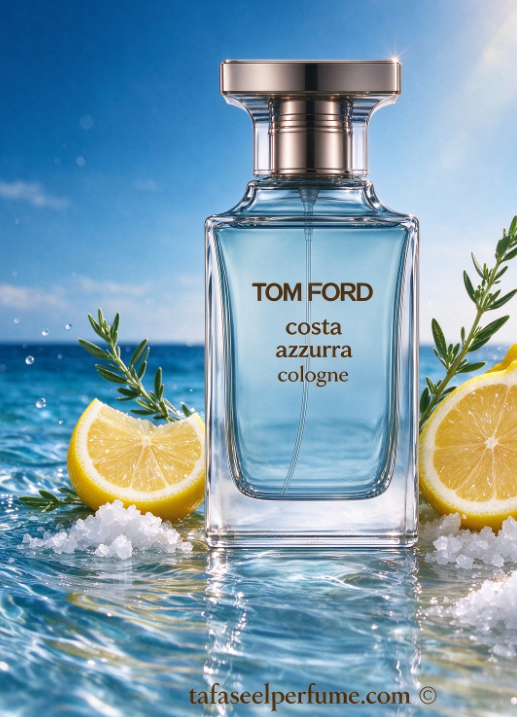
- Tom Ford Costa Azzurra Cologne: The Complete Guide to the Salty, Woody Mediterranean Escape in a Bottle: Quick Intro: Tom Ford Costa Azzurra Cologne is not your average aquatic. It is a Private Blend interpretation of Sardinia’s coastline — salty air, sun-bleached driftwood, Italian lemon, and the dry, resinous breath of the Mediterranean maquis. If you want a summer scent that feels expensive without shouting, this is the conversation you need to have with your nose. For more curated fragrance reading, explore the Perfume Articles and Reviews archive.
Full Introduction: Costa Azzurra sits in a strange and beautiful pocket of the Tom Ford universe. It is classified as a woody aromatic fragrance, but the experience is far more tactile than that label suggests. The opening is a collision of Calabrian lemon, crisp seaweed, and aromatic juniper — a blast of cold sea spray against warm skin. Within minutes, the heart reveals myrtle, lentisk absolute, and driftwood, pulling the composition away from a simple “beach cologne” into something resinous, herbal, and quietly sensual. The base is where Costa Azzurra earns its Private Blend price tag: oakwood, amber, vanilla, and musk create a smooth, lingering dry down that feels like sun-warmed wood rather than sugar. It is unisex in construction, but the woodiness gives it a masculine-leaning gravity that has made it a staple in the Men’s Perfume conversation as much as the Unisex Perfume one. The performance question, however, is where Costa Azzurra becomes genuinely divisive — and that is exactly where this guide begins.
1. The Note Pyramid: What You Actually Smell, Layer by Layer
Tom Ford Costa Azzurra is often described as “salty, sensual, and woody,” but the pyramid tells a more precise story. The top is built on Calabrian lemon, seaweed, and juniper — the lemon is crisp and slightly tart rather than sweet, and the seaweed reads as a green, saline lift rather than a fishy aquatic. The heart introduces myrtle, lentisk absolute, and driftwood; lentisk is the secret weapon here, a resinous Mediterranean shrub that gives the fragrance its dry, almost incense-like herbal texture. The base is a Tom Ford signature move: oakwood, amber, vanilla, and musk, blended so smoothly that the transition from “beach” to “wood-paneled study” feels inevitable rather than abrupt. The Parfum concentration magnifies the oakwood and cypress even further, making the opening sharper and the woodiness denser from the first spray. If you want the full ingredient transparency, Tom Ford’s official product page lists every component, including the bergamot, lemon peel oil, and cedarwood derivatives that support the pyramid.
2. Eau de Parfum vs. Parfum: The Costa Azzurra Split Personality
This is not a simple concentration upgrade. The Costa Azzurra Eau de Parfum is the saltier, more aquatic, more “sea spray on skin” version — the one that smells like a beach club in Sardinia at noon. The Costa Azzurra Parfum, launched later, pushes the Italian lemon and cypress forward while amplifying the oakwood extract and cistus absolute, resulting in a composition that is denser, woodier, and noticeably less “watery” than the EDP. Reviewers consistently note that the Parfum is a “completely different fragrance profile” rather than a louder version of the same scent. The practical implication is simple: if you want the classic Mediterranean salt-and-lemon experience, the EDP is the reference point. If you want something that sits closer to a woody-aromatic cold-weather scent with the same coastal DNA, the Parfum is the more structured choice. For a broader look at how fragrance concentrations change the wearing experience, the Perfume Brands section is a useful cross-reference.
3. Performance Reality Check: Longevity, Projection, and the “Skin Scent” Problem
The performance discourse around Tom Ford Costa Azzurra is unusually polarized, and the polarization is real. Some wearers report 8–9 hours of longevity with roughly 3 hours of meaningful projection on skin. Others describe the scent fading to a skin-close whisper within 3–4 hours, especially in the EDP concentration, and recommend spraying on clothing to extend the life of the fragrance. A Basenotes reviewer sums up the middle ground: “Lasts about 4–5 hours. Gorgeous drift-woody oceanic opening which unfortunately dries down all too quickly into a generic (but very pleasant) modern wood”. The variable is skin chemistry and application technique. Tom Ford’s own guidance is explicit: spray once or twice on clean skin, and do not rub — rubbing breaks down the fragrance and accelerates its disappearance. Applying to the creases of the knees and elbows, where body heat is concentrated, can also stretch the wear time. If performance is your non-negotiable, the Parfum concentration offers a denser structure that some wearers find more tenacious than the EDP, though it still sits on the moderate end of the projection spectrum rather than the “beast mode” end.
4. Season, Occasion, and the “Is This Actually a Summer Scent?” Question
Costa Azzurra is marketed as a warm-weather fragrance, and it is — but the woodiness makes it more versatile than a pure citrus aquatic. The EDP shines in late spring and summer, particularly for daytime wear, alfresco lunches, beach-adjacent evenings, and office environments where you want to smell polished without filling the room. The Parfum, with its amplified oakwood and cypress, performs credibly in early autumn and mild spring as well, when the air is cool enough to let the resinous base breathe without becoming cloying. It is not a winter fragrance in the traditional sense, but it can function as a “cold-weather escape” scent — the kind of thing you wear in February when you need to remember what sunlight feels like. For a broader ranking of how this fragrance sits against other Private Blend releases, the Perfume Ranking and Top Lists resource is a practical companion.
5. The Compliment Factor and the “Generic” Critique: Two Truths at Once
Costa Azzurra is a compliment magnet. Sephora reviewers describe it as “sexy, sensual, sunshine, sea” and a “new staple for my summer rotation,” while others call it “clean and fresh” with “the perfect amount of spice”. The salty-amber dry down is frequently singled out as the moment the fragrance becomes skin-like and intimate rather than loud. At the same time, a persistent critique exists within the fragrance community: that Costa Azzurra is “generic” for a Private Blend, that it smells like a “niche version of Bvlgari Aqva pour Homme,” and that the dry down is a “very pleasant modern wood” rather than something genuinely boundary-pushing. Both things can be true. Costa Azzurra is not trying to be an experimental oud or a challenging leather. It is trying to be the most refined, wearable version of a Mediterranean coastal scent — and for many wearers, that is exactly the point. If you are looking for a dupe or a budget alternative before committing to the full bottle, the market has responded: Divain, DUA Fragrances, and Perfume Parlour all offer Costa Azzurra-inspired options that capture the salty-driftwood-and-herbal-aromatics structure at a fraction of the price.
FAQ: Tom Ford Costa Azzurra Cologne
Is Costa Azzurra a cologne or an eau de parfum? The term “cologne” is used colloquially in the fragrance community to mean a men’s fragrance, but the actual product is sold as an Eau de Parfum (EDP) and a Parfum concentration. The EDP contains a higher concentration of fragrance oil than a traditional eau de toilette or cologne, which gives it more body and a longer development arc on skin.
Is Costa Azzurra unisex or masculine? Tom Ford markets it as a unisex fragrance, and the composition is genuinely gender-neutral in its structure — citrus, salt, herbs, and woods. However, the oakwood-amber-vanilla base and the dry, resinous herbal heart give it a masculine-leaning gravity that many wearers perceive as more “men’s fragrance” than “shared fragrance”. Women who enjoy woody aromatics wear it comfortably, but it is not a sweet or floral unisex.
How many sprays should I use? Tom Ford’s official guidance is one or two sprays on clean skin, applied to desired areas without rubbing. Because Costa Azzurra is not an aggressive projector, some wearers choose three to four sprays across the chest and clothing to extend the wear time. Start with two and adjust based on how your skin holds the fragrance.
Does Costa Azzurra smell like sunscreen or a “beach perfume”? No. It contains no coconut, no creamy solar accord, and no sugary tropical notes. The “beach” association comes from the seaweed and driftwood accords, which read as salty and green rather than lotion-like. The dry down is woody-ambery, closer to sun-baked wood than to tanning oil.
Is the Parfum worth the upgrade over the EDP? It depends on what you want. If you love the saltier, more aquatic EDP and want a louder version of that exact scent, the Parfum will surprise you — it is a different fragrance, not a stronger EDP, with a sharper lemon-cypress opening and a denser oakwood-cistus core. If you want more wood, more resin, and a slightly more “perfume-y” texture, the Parfum is the better fit. Sample both before committing to a full bottle.


