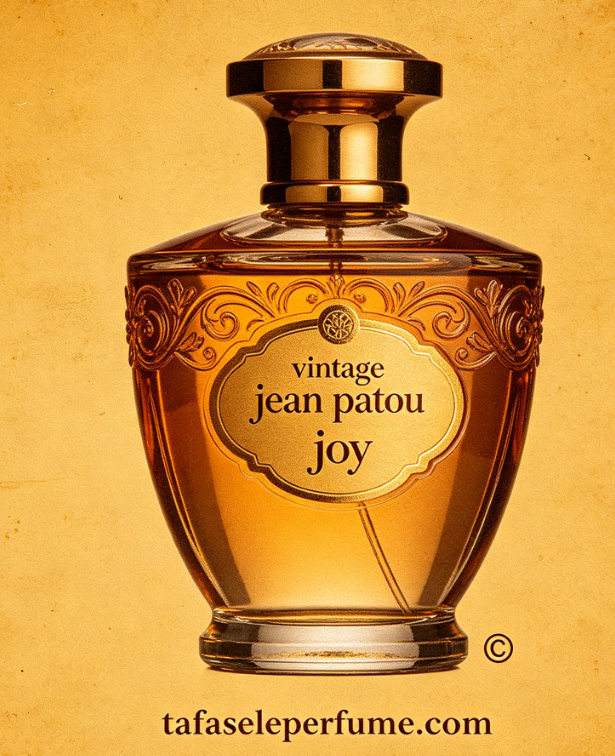
- Vintage Jean Patou Joy · The Olfactory Architecture of Timeless Radiance: Joy · the most expensive perfume in the world — yet its true luxury lies in the silent geometry of jasmine and rose, a vintage alchemy that still whispers after seven decades.
Vintage Jean Patou Joy is not simply a perfume; it is a manifesto of classical perfumery. Launched in 1930 as an antidote to the Great Depression, Joy was built on the radical idea that beauty could be a form of resistance. With an almost architectural precision, perfumer Henri Alméras layered the noblest materials: 10,000 jasmine flowers and 28 dozen roses per 30ml bottle. The result is a chypre-floral that breathes with a luminous, almost melancholic warmth. Decades later, vintage bottles of Joy have become cult objects — not because of their rarity, but because they preserve a scent language that modern perfumery, with all its synthetic fluency, cannot fully translate. This article explores the structure, the myth, and the enduring allure of a fragrance that taught the world that joy is a structure, not a fleeting emotion.
✧ contents ✧
1. The Geometry of Flowers · 2. The Price of Light · 3. Vintage vs. Modern · 4. The Sillage of Memory · 5. Bottle & Ritual · 6. Joy in Contemporary Culture · 7. The Collector’s Compass
1. The Geometry of Flowers · Jasmine, Rose & the Chypre Skeleton
At its heart, vintage Jean Patou Joy is a study in contrasts: the buttery, indolic richness of jasmine grandiflorum against the fresh, almost metallic sparkle of Bulgarian rose. But the genius lies in the base — a chypre architecture of oakmoss, labdanum, and a whisper of sandalwood that holds the florals in a dry, almost austere embrace. This is not the sweet, candied floral of the 21st century; it is a floral that breathes like skin, with a bitter-green undertow that makes it profoundly human. Amber & Musk · The Olfactory Architecture of Warmth, Skin & Eternity echoes a similar tension, but Joy's geometry is sharper, more classical. Each spritz unfolds in three acts: a bright, aldehydic overture, a heart of narcotic flowers, and a dry-down that feels like sun-warmed stone. This is perfume as architecture — every note a load-bearing wall.
The vintage formulation (pre-1980s) is particularly revered because it contains higher concentrations of natural absolutes and real oakmoss, which was later restricted. The scent has a density, a weight that modern interpretations, though beautiful, cannot replicate. It clings to fabric for days, evolving slowly, as if the perfume itself is thinking. For those who seek the original blueprint, hunting a vintage bottle is not an act of nostalgia but of olfactory archaeology.
2. The Price of Light · Why Joy Was “The Most Expensive Perfume”
When Jean Patou launched Joy in 1930, the world was drowning in economic despair. The perfume's legendary tagline — “the costliest perfume in the world” — was not mere marketing; it was a philosophical statement. With over 10,000 jasmine flowers and 28 dozen roses in every 30ml bottle, the material cost alone was astronomical. Best Francis Kurkdjian Perfume: The Olfactory Signature of a Master reminds us that luxury today is often about minimalist composition, but Joy's luxury was about maximalist generosity. The price was a deliberate provocation: in times of scarcity, beauty becomes an act of defiance. Vintage bottles now command prices that reflect not just the ingredients, but the vanishing craft of the master perfumer. Each drop contains the labor of hundreds of harvesters, the patience of extraction, and the vision of a house that refused to compromise. The price, in retrospect, was never about money — it was about the value of radiance in a dark hour.
3. Vintage vs. Modern · The Silent Shift in Scent DNA
Comparing a vintage Jean Patou Joy (say, from the 1960s) with a current edition is like comparing a cathedral to its modern replica. The skeleton is the same, but the soul has been subtly altered. Vintage Joy has a buttery, almost animalic depth — the jasmine is indolic, the rose is fruity-bruised, and the oakmoss is dark and forest-like. Modern formulations, due to IFRA restrictions and cost-cutting, replace oakmoss with synthetic substitutes and reduce the concentration of natural jasmine. The result is a brighter, more transparent floral — beautiful, but missing the gravitational pull of the original. Club de Nuit Perfume · The Nocturnal Architecture of Magnetic Allure explores a different kind of darkness, but Joy's darkness is tender, not aggressive. For purists, the vintage bottle is the only true scripture. The difference is not just in longevity, but in texture: vintage Joy feels velvety, almost chewy, while modern Joy feels airy and crystalline.
4. The Sillage of Memory · Joy and the Personal Archive
Perfume is the most intimate of arts because it lives on skin, and skin is always a canvas of memory. Vintage Jean Patou Joy has a peculiar sillage — it does not shout, but it leaves a trail that seems to hover in the air like a half-remembered song. Many collectors describe the scent as “melancholic,” not because it is sad, but because it carries the weight of time. Eternity Moments by Calvin Klein: a whisper of timeless grace shares this temporal quality, though Joy's grace is more opulent. Wearing vintage Joy is an act of archiving — you become a custodian of a scent that has outlived its era. The sillage is soft, powdery, with a luminous quality that feels like light filtering through stained glass. It is a perfume that demands presence, not projection. Those who wear it often say it makes them feel “dressed” even in the simplest clothes, as if the scent itself is a garment woven from flowers and light.
5. Bottle & Ritual · The Baccarat Crystal and the Act of Anointing
The bottle of vintage Jean Patou Joy is as much a part of the myth as the juice. Early editions came in a Baccarat crystal flacon, heavy and faceted, with a stopper that felt like a jewel. The ritual of opening that bottle — the soft click of the stopper, the first rush of aldehydes and roses — is a ceremony of attention. Salvatore Ferragamo Cologne Gift Set: Timeless Elegance in a Box offers a different kind of elegance, but Joy's elegance is monastic, almost religious. The bottle is not just a container; it is an ark. Collectors often preserve the box, the tissue paper, the little booklet that came with it — because each element adds to the narrative. The ritual of application is also distinct: one does not spray vintage Joy casually. One dabs it, with reverence, on the pulse points, allowing the warmth of the body to awaken the notes gradually. It is a perfume that asks for patience, and in return, it offers a slow, unfolding revelation.
6. Joy in Contemporary Culture · The Vintage Renaissance
In an age of niche perfumery and viral TikTok scents, vintage Jean Patou Joy has found a new audience among younger perfume enthusiasts. It is not a trend, but a counter-trend — a quiet rebellion against the ephemeral. Curve Soul Perfume: The Scented Architecture of Unspoken Identity speaks to this search for identity, and Joy offers a ready-made identity: that of the timeless, the elegant, the unfashionable. Vintage Joy appears in films, in the collections of celebrities, and in the cabinets of archivists. It is referenced in perfumery books as the gold standard of floral chypres. But more than that, it has become a symbol of resistance against the flatness of mass-market scents. Wearing Joy today is a statement: that you value depth over novelty, that you are willing to pay for quality, and that you believe in the power of beauty to transcend its era.
7. The Collector’s Compass · How to Identify a Genuine Vintage Bottle
For those who wish to acquire a piece of olfactory history, the vintage market is a labyrinth. Genuine vintage Jean Patou Joy (pre-1980) can be identified by several markers: the bottle shape (the classic square with a faceted stopper), the label (often with the cursive “Patou” and “Joy” in gold), and the batch code. The juice itself should be a deep golden-amber, never too pale. Parfum Van Cleef & Arpels: The Alchemy of Precious Scents offers a similar allure, but Joy's alchemy is uniquely floral. Beware of fakes — they are common, and the scent is often too sweet or too sharp. Authentic vintage Joy has a dry, almost dusty opening that blooms into a rich, honeyed floral. The best sources are reputable auction houses, estate sales, and established vintage perfume dealers. The price can be staggering, but for the true connoisseur, it is the price of a dream.
Explore more olfactory architectures: Coconut & Hibiscus Perfume: The Tropical Symphony of Contrasts · Musky Fruity Perfume · The Architecture of Radiant Contradiction · Invictus Victory by Paco Rabanne · Cologne Sport · CHANEL · ARS Fort Pierce · Bvlgari White Tea Shower Gel · Unisex Perfume · Women's Perfume · Men's Perfume · Perfume Gift Sets · Beauty · Brands · RankingFrequently Asked Questions · Vintage Jean Patou Joy
Absolutely — if the bottle has been stored properly (cool, dark, stable temperature). The top notes may fade, but the heart and base often remain magnificent. Many collectors describe the aged juice as even more complex, with a deepened honeyed quality.
Check the batch code, the label design, and the bottle shape. Pre-1980 bottles usually have a faceted Baccarat stopper and a gold-embossed label. The juice should be a rich amber color, not pale yellow. If the scent is overwhelmingly sweet or sharp, it may be a modern reformulation or a counterfeit.
It's a combination of rarity, the high concentration of natural floral absolutes (jasmine and rose), and the historical cachet. Also, because oakmoss and certain natural ingredients are now restricted, the vintage formula cannot be legally replicated today. Each bottle is a finite piece of perfumery history.
The Parfum (extrait) has a higher concentration of oils and a more profound, long-lasting sillage. The Eau de Parfum is lighter and more diffusive. For vintage collectors, the Parfum is the most coveted because it retains the original composition's density.
Yes, absolutely. Joy is a floral chypre, and its dry-down has a woody, mossy, almost leathery quality that makes it surprisingly unisex. Many men appreciate its complexity and the fact that it does not smell like a typical masculine fragrance.
Keep it in its original box, away from light, heat, and humidity. A dark closet or a drawer is ideal. Avoid storing it in the bathroom. If the bottle is unopened, it can last for decades; once opened, try to use it within a few years, though many say it only gets better with time.
Not really. Some compare it to Chanel No. 5 or Guerlain's classics, but Joy has a distinct, almost buttery jasmine and a drier, more austere chypre base. Modern perfumes often use synthetic substitutes that lack the depth and the radiant, almost melancholic warmth of vintage Joy.
Vintage Jean Patou Joy · an architecture of petals and light · 2026


