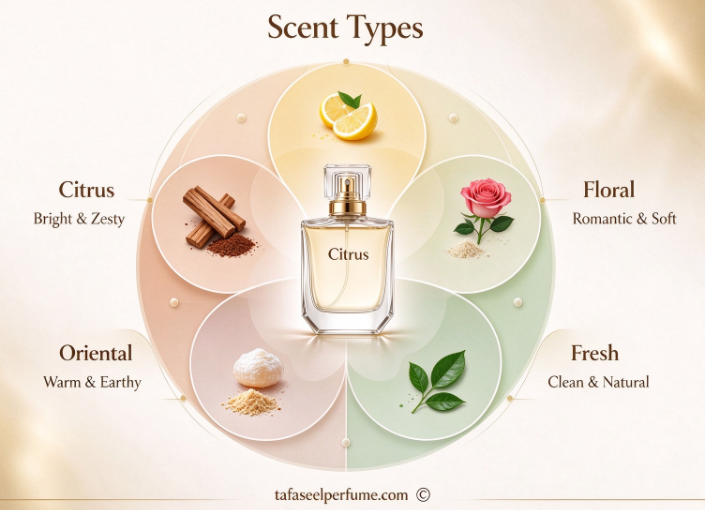
- The Ultimate Guide to Scent Types: Decoding Fragrance Families and Finding Your Signature Scent: Have you ever wondered why some perfumes make you feel energized while others wrap you in warmth? The answer lies in scent types — the fragrance families that define how a perfume smells, evolves, and makes you feel. This comprehensive guide breaks down every major scent type, from fresh citrus to smoky oud, so you can navigate the fragrance counter with confidence and discover the scents that truly speak to you.
Understanding scent types is the single most useful skill in perfumery. Whether you are browsing the Women's Perfume aisle, exploring Men's Perfume, or diving into the world of Unisex Perfume, every bottle belongs to a fragrance family that tells you how it will wear on skin. In this guide, we explore each scent type in depth, share tips for matching fragrance families to seasons and occasions, answer the most common questions, and help you build a wardrobe of scents that reflects your personality. From the sparkling brightness of Dior Sauvage to the smooth, dreamy nostalgia of Gap Dream Eau de Toilette, every fragrance is a gateway into a scent family — and by the end of this article, you will know exactly which doors to open.
1. What Are Scent Types? The Foundation of Fragrance Families
Learn what scent types are, why the fragrance wheel matters, and how perfumers use families to classify every perfume on the market.
2. Fresh Scent Types: Citrus, Aquatic, and Green Fragrances
Discover the crisp, energizing world of fresh scent types — perfect for daytime, warm weather, and anyone who loves a clean, uplifting aura.
3. Floral Scent Types: From Soliflores to Opulent Bouquets
Explore the romantic and diverse floral family, from delicate freesia to bold rose and jasmine compositions that define timeless femininity.
4. Woody Scent Types: Sandalwood, Cedar, and Vetiver
Uncover the grounding, sophisticated world of woody scent types that anchor countless iconic fragrances for men and women alike.
5. Oriental and Amber Scent Types: Warmth, Spice, and Resins
Dive into the sensual, enveloping realm of oriental and amber scent types, where spices, resins, and vanilla create unforgettable warmth.
6. Oud and Leather Scent Types: The Bold and the Luxurious
Explore the most commanding scent types in perfumery — rich oud and supple leather — and learn why they define luxury and confidence.
7. Gourmand Scent Types: Sweet, Edible, and Irresistible
Indulge in the delicious world of gourmand scent types, where vanilla, caramel, and chocolate turn perfume into dessert for the senses.
8. How to Match Scent Types to Seasons and Occasions
Practical guidance on pairing fragrance families with weather, time of day, dress codes, and personal style for flawless scent choices.
9. Building a Fragrance Wardrobe Around Scent Types
Learn how to curate a versatile collection by balancing different scent types — and how to avoid redundancy in your perfume shelf.
10. Common Mistakes When Choosing Scent Types (and How to Avoid Them)
From testing on paper only to ignoring dry-down, discover the pitfalls that lead to fragrance regret and how to shop smarter.
11. Scent Types for Beginners: Where to Start
A friendly starting point for fragrance newcomers, with accessible scent types and entry-level picks that rarely disappoint.
12. Niche vs. Designer Scent Types: Does It Matter?
Understand the difference between niche and designer approaches to scent types, and whether the price tag reflects a better fragrance.
1. What Are Scent Types? The Foundation of Fragrance Families
Scent types — also called fragrance families — are the broad categories used to classify perfumes according to their dominant olfactory characteristics. The concept dates back to the early twentieth century, when perfumers and fragrance houses needed a shared language to describe the increasingly complex compositions being created. Over time, the classification evolved into the familiar fragrance wheel, which organizes scent types into four primary families — fresh, floral, woody, and oriental (amber) — each with subfamilies that capture nuances like citrus, aquatic, green, fruity, gourmand, and leather.
Understanding scent types matters because they act as a reliable predictor of how a fragrance will behave on your skin. A fresh scent type such as a citrus cologne will typically open bright and fade relatively quickly, making it ideal for hot days and casual settings. A woody scent type like sandalwood or cedar tends to unfold slowly and linger for hours, offering depth and sophistication. An oriental scent type built on amber and resins wraps the wearer in warmth and projects strongly in cool weather. When you know the family, you can anticipate the arc of the fragrance — from top notes through heart to base — and make smarter choices whether you are shopping in store or online.
The fragrance wheel is not a rigid law but a practical map. Many modern perfumes are hybrids: a floral opening may rest on a woody-amber base, or a gourmand heart might sit atop a fresh citrus top. This blending is precisely why learning scent types is so rewarding — once you recognize the building blocks, you can decode any composition and articulate what you love. It also helps you explore beyond your comfort zone without wasting money on blind buys. If you consistently gravitate toward fresh scent types, you might enjoy stretching into green or aromatic subfamilies; if you adore oriental scent types, the amber-woody and spicy subfamilies are natural next steps. Throughout this guide, we will reference real fragrances — such as the aromatic freshness of Prada Luna Rossa or the bold oud character of Bond No. 9 Nomad — to show how scent types play out in practice.
2. Fresh Scent Types: Citrus, Aquatic, and Green Fragrances
Fresh scent types are the most immediately recognizable family in perfumery. They are defined by brightness, lift, and an almost effervescent quality that makes them feel clean and energizing. Within the fresh family, three subfamilies dominate: citrus, aquatic (also called ozonic or marine), and green.
Citrus scent types showcase notes of bergamot, lemon, orange, grapefruit, lime, and neroli. They are the quintessential summer fragrances and often serve as the sparkling top notes of countless compositions across every family. A classic citrus cologne can feel like a burst of sunshine — refreshing, optimistic, and effortlessly wearable. Because citrus molecules evaporate quickly, these fragrances tend to have shorter longevity, which is why many modern citrus scent types are anchored with woody or musk bases to extend their performance. Aquatic scent types evoke sea breeze, salt air, and cool water. They rely on synthetic aroma chemicals such as Calone to create that distinctive "marine" effect, often blended with light florals and woods. Aquatic fragrances are hugely popular in men's perfumery — the sporty elegance of Lacoste fragrances exemplifies this fresh, athletic character — and they are equally beloved by anyone seeking a clean, unobtrusive scent for the gym or office. For workout-ready options, see this guide to the best gym cologne.
Green scent types capture the smell of cut grass, crushed leaves, stems, and herbs. Notes like galbanum, violet leaf, and basil give green fragrances a sappy, vegetal freshness that feels natural and grounded. Green scent types can be crisp and sharp or soft and dewy, and they often appear in unisex compositions. Fresh scent types as a whole are your go-to for daytime wear, spring and summer, casual occasions, and any situation where you want to feel polished without being overpowering. They layer beautifully with florals and light woods, and they are an excellent entry point for fragrance beginners. If you are exploring the category, sampling a range of citrus and aquatic options — from designer icons to niche experiments — will quickly teach you where your preferences lie within the fresh spectrum.
3. Floral Scent Types: From Soliflores to Opulent Bouquets
Floral scent types are the heart of traditional perfumery and the largest family in the fragrance wheel. They celebrate the aroma of flowers in every form — single blooms, lush bouquets, and abstract floral accords. Within the floral family, perfumers distinguish several subfamilies: soliflores (a single flower rendered in full), floral bouquets (multiple flowers blended harmoniously), fruity florals (flowers lifted by juicy fruit notes), and white florals (the heady, narcotic blooms of tuberose, jasmine, gardenia, and orange blossom).
The appeal of floral scent types lies in their emotional range. A delicate freesia composition feels airy and romantic, while a rich rose-oud blend feels opulent and seductive. White florals can be intensely feminine and sensual, projecting confidence and warmth. Fruity florals bring playfulness and youthful energy, often pairing peony or rose with peach, pear, or berries. Because florals are so versatile, they appear in every corner of the market — from women's perfume icons to modern unisex perfume creations that blur gender lines. A beautiful example of a focused floral study is the freesia genre; for a deep dive, explore this complete guide to freesia perfume notes.
When shopping for floral scent types, pay attention to the supporting notes. A floral built on a musk base will feel soft and skin-like; one built on a woody-amber base will feel richer and more dramatic; one lifted by citrus will feel fresher and more daytime-appropriate. This is why two perfumes that both list "rose" can smell completely different. Floral scent types suit spring and early summer beautifully, but heavier white florals can also shine on cool evenings and formal occasions. For anyone building a fragrance wardrobe, florals are indispensable — they provide elegance, romance, and a timeless counterpoint to fresher or woodier choices. If you are drawn to bold, city-inspired compositions, the floral-amber character of Valentino Born in Roma shows how florals can be reimagined with modern attitude.
4. Woody Scent Types: Sandalwood, Cedar, and Vetiver
Woody scent types are the backbone of perfumery. They provide structure, longevity, and a sense of grounded elegance that few other families can match. The woody family includes sandalwood (creamy, milky, warm), cedar (dry, pencil-shaving crispness), vetiver (earthy, smoky, grassy), patchouli (damp, rich, camphoraceous), and guaiac wood (smoky and leather-like). These materials appear as base notes in the vast majority of perfumes, but they also star in dedicated woody compositions that let their character take center stage.
Sandalwood scent types are prized for their smooth, velvety warmth. They feel meditative and luxurious, often appearing in oriental and gourmand contexts as well as pure woody blends. Cedar scent types bring a clean, dry sharpness that reads as masculine and tailored, making them a staple of men's fragrance. Vetiver scent types are earthy and sophisticated, with a grassy-smoky duality that appeals to lovers of nuanced, natural-smelling perfumes. Patchouli adds depth and a slightly sweet earthiness, and when used skillfully it lends a bohemian richness rather than the heavy hippie associations of decades past.
Woody scent types are incredibly versatile. They shine in autumn and winter, but lighter woods like cedar and vetiver can work year-round. They are ideal for office wear because they project quietly and feel professional, and they layer beautifully with citrus, florals, and spices. For a masterclass in woody storytelling, look at Radio Bombay by DS & Durga, which weaves sandalwood with copper and sensory narrative. If you are new to the family, start with a creamy sandalwood or a clean cedar and gradually explore vetiver and patchouli. Many people who believe they "don't like perfume" actually adore woody scent types because they smell natural, intimate, and never cloying. A woody fragrance can be your quiet signature — the scent people associate with you without ever being overwhelmed by it.
5. Oriental and Amber Scent Types: Warmth, Spice, and Resins
Oriental scent types — increasingly called amber scent types — are defined by warmth, sensuality, and richness. They rely on materials such as amber, labdanum, benzoin, vanilla, tonka bean, cinnamon, clove, saffron, and resins like frankincense and myrrh. The result is a fragrance that feels enveloping, exotic, and deeply comforting. Oriental scent types are the perfumes of candlelit evenings, cold weather, and special occasions.
Within the oriental family, perfumers distinguish several subfamilies. Soft orientals blend amber and vanilla with light florals for a creamy, wearable warmth. Floral orientals pair opulent flowers with spices and resins, creating dramatic, feminine compositions. Woody orientals add sandalwood, patchouli, or oud for depth and structure — this is one of the most popular and long-lasting scent types in modern perfumery. Spicy orientals foreground cinnamon, clove, cardamom, or saffron, delivering a bold, attention-grabbing character. The warmth of amber can also be interpreted in a fresh, modern way — the sunset-inspired Valentino Coral Men demonstrates how a warm, golden mood can be rendered with contemporary elegance.
Oriental and amber scent types are powerful and often require a light hand — one or two sprays is usually enough. They perform best in cool weather, where their richness feels cozy rather than suffocating, and they are ideal for evening events, date nights, and formal occasions. If you love the idea of warmth but find traditional orientals too heavy, explore modern amber scent types built with airy musk or citrus accents. These "transparent ambers" retain the golden glow while feeling lighter and more versatile. For collectors, oriental scent types are essential to a balanced wardrobe: they provide the depth and drama that fresh and floral fragrances cannot. When you want to feel confident, alluring, and unforgettable, an amber-rich fragrance is often the answer.
6. Oud and Leather Scent Types: The Bold and the Luxurious
Oud and leather scent types occupy the boldest end of the fragrance spectrum. They are associated with luxury, power, and unmistakable presence. Oud — also spelled agarwood — is a resinous heartwood formed when Aquilaria trees are infected by a specific mold. Its scent is dark, smoky, woody, and slightly medicinal, with animalic and sweet facets. Oud has been a cornerstone of Middle Eastern perfumery for centuries and has become a global phenomenon in designer and niche fragrances alike. A standout example is Bond No. 9 Nomad, which pairs oud with a wandering, modern spirit.
Leather scent types evoke supple hides, saddles, and vintage glove boxes. They can be smoky and dry (birch tar), soft and suede-like (isobutyl quinoline), or floral and abstract (Shoe by Demeter). Leather fragrances feel tailored, confident, and slightly rebellious — the olfactory equivalent of a well-worn jacket. Both oud and leather scent types project strongly and last for hours, sometimes days on fabric. They are not for the faint of heart, but for wearers who want their fragrance to make a statement.
These scent types are best suited to evening wear, formal events, and cool weather. They layer intriguingly with rose (the classic rose-oud pairing), with spices, and with amber. When shopping for oud and leather, sampling is essential — the difference between a smooth, creamy oud and a harsh, barnyard oud is enormous, and leather can range from refined suede to smoky tar. Niche houses are often the best place to explore, but designer oud fragrances have become increasingly sophisticated and accessible. If you are new to the family, begin with a rose-oud or a suede-leather composition; these are the friendliest entry points. Once you acclimate, you can explore the darker, more animalic corners of the family. For anyone who loves the idea of a men's perfume with real gravitas, oud and leather scent types deliver unmatched intensity and sophistication.
7. Gourmand Scent Types: Sweet, Edible, and Irresistible
Gourmand scent types are the dessert course of perfumery. They feature edible notes — vanilla, caramel, chocolate, coffee, honey, almond, praline, marshmallow, and fruit — that make fragrances smell delicious enough to eat. The gourmand family emerged in the 1990s with groundbreaking releases like Angel, and it has since become one of the most popular scent types in the world, especially among younger fragrance fans.
Vanilla is the anchor of most gourmand scent types. It can be sugary and cake-like or dark and smoky, depending on the supporting notes. Caramel and praline add buttery sweetness; chocolate and coffee bring bitter richness; honey adds a golden, animalic glow; and fruity notes provide juiciness. Gourmand fragrances can be playful and casual, or luxurious and sensual, depending on how the sweetness is balanced. A dreamy, nostalgic softness characterizes some gourmand-adjacent compositions — for example, the Gap Dream Eau de Toilette evokes a gentle, comforting mood that gourmand lovers often appreciate.
Gourmand scent types are ideal for cool weather, evening wear, and cozy occasions. They project well and can be polarizing in hot climates or professional settings, where their sweetness may feel overwhelming. The key to wearing gourmands successfully is moderation and balance — a single spray of a rich caramel-vanilla fragrance can be more effective than several sprays. For those who find traditional gourmands too sweet, explore "dry gourmands" built on coffee, cocoa, or smoky vanilla, or pair a sweet fragrance with a woody base for contrast. Gourmands also make excellent layering partners: a vanilla gourmand can soften a sharp woody scent, while a coffee gourmand can add depth to a fresh citrus. If you love the idea of perfume gift sets, gourmand fragrance families are often crowd-pleasers and make thoughtful presents.
8. How to Match Scent Types to Seasons and Occasions
Matching scent types to seasons and occasions is one of the most practical skills in fragrance. The general principle is simple: heat amplifies fragrance, so lighter scent types suit warm weather, while richer scent types suit cold weather. But the reality is more nuanced, and understanding the interplay between temperature, humidity, and occasion will help you choose confidently.
Spring calls for fresh and floral scent types — citrus, green, light florals, and soft musks. These fragrances mirror the season's energy and feel appropriate as the world reopens. Summer demands the lightest scent types: citrus colognes, aquatics, and airy florals. Heavy orientals and gourmands can become cloying in the heat, so save them for cool evenings. Autumn is the season for woody and soft oriental scent types — sandalwood, cedar, vetiver, amber, and spices feel natural as the air turns crisp. Winter welcomes the boldest scent types: rich orientals, oud, leather, and gourmands. These fragrances provide warmth and comfort when the temperature drops.
Occasion matters just as much as season. For the office, choose moderate-projecting scent types such as fresh, light floral, or soft woody fragrances — you want to be noticed, not announced. For evenings out, orientals, oud, leather, and gourmands shine. For the gym, fresh and aquatic scent types are ideal, as they feel clean and energizing. For formal events, choose a sophisticated woody-oriental or a classic floral. And for everyday wear, let your personal preference lead — a signature scent type that makes you feel like yourself is always the right choice. Many fragrance lovers maintain a small rotation of scent types tailored to these contexts, which is the essence of building a fragrance wardrobe.
9. Building a Fragrance Wardrobe Around Scent Types
A fragrance wardrobe is a curated collection of perfumes that covers different scent types and occasions, much like a clothing wardrobe covers different dress codes. The goal is versatility without redundancy — a set of fragrances that feels complete and expresses your personality.
A classic approach is to choose one or two fragrances from each major scent type family. Start with a fresh scent type for daytime and warm weather, a floral or woody signature for regular wear, an oriental or amber for evenings and cold weather, and a bold oud or leather for special occasions. Add a gourmand if you love sweetness, and a green or aromatic for casual days. This structure ensures you always have an appropriate option, whether you are heading to a meeting, a dinner date, or a weekend hike.
When building your wardrobe, consider how the scent types complement each other. A men's perfume wardrobe might combine a citrus-aromatic for work, a woody-amber for evenings, and an oud for formal events. A women's perfume wardrobe might pair a fruity floral for spring, a white floral for summer evenings, and an oriental gourmand for winter. The unisex perfume category offers wonderful flexibility, as many unisex fragrances blend scent types in ways that suit any wearer. Also think about formats: mini sizes and gift sets are excellent for testing scent types before committing to a full bottle. If you enjoy exploring, the perfume ranking and top lists section can point you toward the most acclaimed examples of each family. Over time, your wardrobe will evolve as your taste does — and that is part of the pleasure.
10. Common Mistakes When Choosing Scent Types (and How to Avoid Them)
Even experienced fragrance lovers make mistakes when choosing scent types. Recognizing these pitfalls will save you money and help you find fragrances you truly love.
Mistake one: testing on paper only. Paper strips are useful for initial impressions, but fragrance evolves on skin. A scent type that smells harsh on paper may bloom beautifully on your skin, and vice versa. Always test on skin and wait at least thirty minutes before deciding. Mistake two: judging by top notes. The opening notes of a fragrance last only minutes. The heart and base — the dry-down — are what you will smell for most of the day. Never buy based on the first spray alone. Mistake three: ignoring weather and occasion. A rich oriental worn to a summer office meeting will feel out of place and may overwhelm those around you. Match scent types to context. Mistake four: over-spraying. Many people who dislike a fragrance have simply applied too much. Two to four sprays is usually sufficient, and less is more with bold scent types like oud and gourmand.
Mistake five: buying blind based on reviews. Reviews are helpful, but fragrance is deeply personal and skin chemistry varies. Use reviews to narrow your list, then sample before purchasing. Mistake six: sticking to one scent type forever. While a signature scent is lovely, exploring other scent types keeps your fragrance life exciting and helps you understand your true preferences. Mistake seven: storing fragrances incorrectly. Heat and light degrade perfume, altering the scent type's character over time. Store bottles in a cool, dark place. Mistake eight: rushing the process. Great fragrance discoveries take time. Sample widely, revisit favorites, and let your nose develop. The journey through scent types is one of the most rewarding aspects of fragrance appreciation.
11. Scent Types for Beginners: Where to Start
If you are new to fragrance, the sheer number of scent types can feel overwhelming. The good news is that you do not need to learn everything at once. Start with the two or three families that sound most appealing and build from there.
Most beginners find fresh scent types the easiest entry point. Citrus and aquatic fragrances are widely liked, feel clean, and are appropriate for everyday wear. From there, explore light florals or soft woody fragrances, which introduce the concepts of heart and base notes without being intimidating. Once you are comfortable, sample an oriental or gourmand to experience warmth and sweetness, and try an oud or leather when you feel ready for boldness.
Practical starting tips: visit a store and smell no more than three to five fragrances per visit (your nose fatigues quickly), ask for samples, and keep a simple notebook recording which scent types you enjoyed and why. Explore the perfume articles and reviews section for guides on specific fragrances — for example, this detailed breakdown of what CK Euphoria smells like illustrates how a scent type translates into a real composition. Also browse the perfume brands section to understand how different houses interpret scent types. Many newcomers worry about choosing the "right" fragrance — but the only right fragrance is one you enjoy wearing. Beginners who sample across scent types with curiosity rather than pressure almost always find their signature sooner. And remember: your taste will evolve, so enjoy the exploration.
12. Niche vs. Designer Scent Types: Does It Matter?
The question of niche versus designer is one of the most debated topics in fragrance. Does a niche perfume, with its higher price tag and limited distribution, offer a better interpretation of scent types than a designer fragrance available at every department store? The honest answer is: it depends on what you value.
Designer scent types tend to be created with broad appeal in mind. They are often refined, easy to wear, and backed by extensive market research. They excel at delivering polished versions of popular families — a fresh aquatic, a fruity floral, a woody-amber — at accessible prices. Their consistency and wearability are genuine strengths. Niche scent types, by contrast, are created by smaller houses with fewer commercial constraints. They often explore unusual combinations, higher concentrations of rare materials, and unconventional interpretations of familiar families. A niche oud may be more animalic and complex; a niche floral may use rare absolutes; a niche fresh fragrance may take an experimental aquatic approach.
Neither category is inherently superior. A beautifully made designer fragrance can rival any niche release, and a poorly executed niche perfume can be just as disappointing as a cheap designer one. What matters is the quality of the composition, the materials, and how the fragrance performs on your skin. Scent types are a language, and both designer and niche houses speak it — sometimes with different accents. Explore both. Discover the latest releases from the house of Oman in this guide to Amouage new fragrances, a classic example of a niche house reinterpreting oriental scent types. And if you enjoy luxury beyond perfume, browse the spa and fragrance collection. The best approach is to let your nose, not the label, decide.
What are the main scent types in perfume?
The main scent types are fresh (citrus, aquatic, green), floral (soliflores, bouquets, white florals, fruity florals), woody (sandalwood, cedar, vetiver, patchouli), oriental or amber (soft, floral, woody, spicy), oud and leather, and gourmand. Most fragrances blend elements from multiple families, but every perfume has a dominant scent type that defines its character.
How do I find my scent type?
Start by noticing which fragrances you love on others and on yourself. Sample widely across the major scent types — fresh, floral, woody, oriental, oud, leather, and gourmand — and keep notes on what you enjoy. Test on skin, not paper, and wait for the dry-down before deciding. Over time, patterns will emerge, revealing your preferred scent types.
What scent types are best for hot weather?
Fresh scent types are best for hot weather: citrus, aquatic, and green fragrances. Light florals and airy musks also work well. Heat amplifies fragrance, so rich orientals, oud, leather, and gourmands can feel overwhelming in summer. Save those for cool evenings or winter, and apply lightly in hot climates.
What scent types are best for cold weather?
Oriental and amber scent types, oud, leather, gourmand, and rich woody fragrances are ideal for cold weather. Their warmth and depth feel comforting when temperatures drop, and their slower evaporation suits cool air. Spicy orientals and vanilla gourmands are especially popular in winter.
What scent types are best for the office?
Choose moderate-projecting scent types for the office: fresh citrus, light florals, soft woody fragrances, and clean musks. Avoid heavy orientals, oud, leather, and strong gourmands, which can overwhelm a shared space. Apply lightly — one or two sprays is usually enough in professional settings.
What scent types are best for the gym?
Fresh scent types — citrus, aquatic, and green fragrances — are ideal for the gym because they feel clean and energizing. Light, sporty fragrances with good freshness perform well during workouts. Avoid heavy gourmands and rich orientals, which can become cloying with body heat.
Can I wear multiple scent types at once?
Yes, layering is a popular way to combine scent types. The key is to pair complementary families: a fresh citrus with a light woody base, or a floral with a soft amber. Avoid layering two strong, dominant fragrances, as they may compete. Start with one spray of each and adjust.
Are scent types the same as fragrance families?
Yes, scent types and fragrance families refer to the same concept: the broad categories used to classify perfumes, such as fresh, floral, woody, oriental, oud, leather, and gourmand. The terms are used interchangeably in the fragrance industry, though "fragrance family" is more common in formal perfumery contexts.
Which scent type lasts the longest?
Oriental and amber scent types, oud, leather, and rich woody fragrances generally last the longest because they are built on heavy base notes like resins, woods, and musks that evaporate slowly. Fresh citrus scent types tend to be the shortest-lived, often fading within a few hours unless anchored by woody or musk bases.
How many scent types should I have in my collection?
There is no fixed number, but a versatile wardrobe typically includes at least one fragrance from each major category: fresh, floral, woody, oriental, and either oud, leather, or gourmand. Three to six well-chosen fragrances can cover most occasions and seasons. Quality and personal enjoyment matter more than quantity.


