- Perfume Van Cleef & Arpels: The Complete Guide to High-Jewelry Fragrance, Notes, Longevity, and Smart Buying: A short introduction. Van Cleef & Arpels is a name most people associate with the Alhambra clover and Place Vendôme windows, not necessarily with a perfume counter. Yet the maison has been composing fragrance since 1976, and its current offering — anchored by Collection Extraordinaire — is one of the most quietly rewarding luxury perfume portfolios on the market.
A short introduction. Van Cleef & Arpels is a name most people associate with the Alhambra clover and Place Vendôme windows, not necessarily with a perfume counter. Yet the maison has been composing fragrance since 1976, and its current offering — anchored by Collection Extraordinaire — is one of the most quietly rewarding luxury perfume portfolios on the market. This guide explains what Van Cleef & Arpels perfume actually smells like, which compositions deserve your attention, how they behave on skin, and how to choose with confidence rather than guesswork.
A larger introduction. The confusion around Van Cleef & Arpels perfume is understandable. The brand is first and foremost a high jeweler, and its fragrance line has never chased the same viral visibility as its necklaces. But that distance from trend is precisely the point. Collection Extraordinaire, inspired by the Les Jardins high-jewelry collection, is built around a denser, more resinous architecture than the average designer release, and the difference is noticeable the moment you move past the opening spray. These are not loud perfumes in the conventional sense. They are structured perfumes — compositions where citrus, white florals, resins, woods, and vanillas are placed with the same deliberateness a jeweler applies to stone selection. The result is a collection that rewards patience. A first sniff may read “elegant” or “pretty”; a third wearing reveals why certain bottles become signatures. This guide is organized around that reality: what the brand does well, which scents carry the line, how climate and concentration change the experience, and where a first purchase makes the most sense.
1. What Makes Van Cleef & Arpels Perfume Different from Other Luxury Houses
Most luxury fashion houses treat fragrance as an accessible entry point — a lipstick, a cap, a logo, and a scent that sits comfortably within a known trend. Van Cleef & Arpels approaches perfume from the opposite direction. The brand’s identity is jewelry, and its fragrance line carries a jeweler’s logic: material selection first, structure second, trend last.
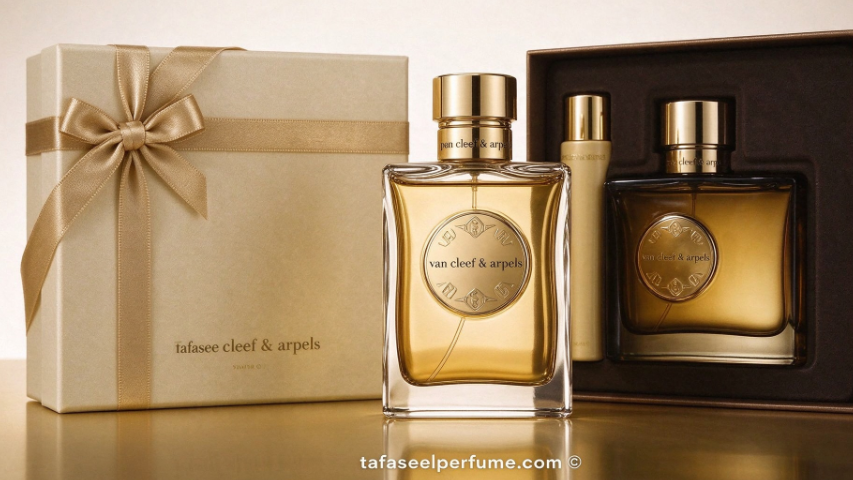
This shows up most clearly in Collection Extraordinaire. The line was inspired by the Les Jardins high-jewelry collection and is deliberately positioned as a niche collection within a luxury house — six core rare and luxurious scents, presented in heavy glass bottles engraved with the VCA monogram. The compositions use a higher proportion of natural materials and a denser resinous base than the standard designer template, which is why reviewers consistently describe the line as smelling “expensive” in a way that is difficult to fake.
What this means for a buyer is straightforward. If you are looking for a perfume that announces itself across a room in the first thirty seconds, Van Cleef & Arpels is probably not your first stop. If you are looking for a fragrance that develops slowly, sits close enough to be discovered rather than broadcast, and still leaves a trace on fabric hours later, the house is unusually competitive. The brand’s perfumes are often described as having “staying power” not because they are aggressively loud, but because the base materials bind to skin and fabric with unusual tenacity. That is a jewelry-house instinct applied to scent: the piece should feel substantial without shouting.
It also explains why the line has a devoted but somewhat under-the-radar following. These are perfumes for people who have moved past the discovery-by-hype phase and want a composition that behaves like an object — considered, durable, and specific. If that profile sounds familiar, browsing a curated women’s perfume or unisex perfume selection alongside the brand’s own counter is a practical way to calibrate expectations.
2. Collection Extraordinaire: The Heart of the Van Cleef & Arpels Perfume Portfolio
If you are going to understand one part of this brand, make it Collection Extraordinaire. It is the line that carries the maison’s fragrance identity and the one most often recommended to first-time buyers who want something more substantive than a standard eau de parfum.
The collection’s defining characteristic is its resinous, high-concentration architecture. The formulas are built to evolve rather than disappear. Citrus and aromatic openings settle into floral or spice hearts, and the base — usually a combination of resins, woods, tonka, vanilla, or amber — anchors the composition for hours. In humid climates, this architecture matters enormously. Lighter eau de toilettes can evaporate by lunchtime, while Collection Extraordinaire eau de parfums continue to unfold through the afternoon and into the evening. The line is not “strong” in the way an oud or an amber bomb is strong; it is persistent, which is a different and often more wearable quality.
The six core scents cover a deliberately broad territory. Neroli Amara is the bright, clean citrus-floral entry point; Bois Doré is the warm, tonka-and-woods comfort scent; Orchidée Vanille leans unapologetically into vanilla; Santal Blanc is creamy sandalwood softness; Ambre Impérial brings amber warmth with spice; and Oud Blanc reinterprets oud through white smoke, rose, and vanilla rather than animalic heaviness. The range is not a flanker wall. Each bottle has a distinct olfactory argument, which is increasingly rare in the luxury segment.
For a buyer who is unsure where to begin, the most useful mental map is this: choose Neroli Amara if you want freshness with structure; choose Bois Doré or Orchidée Vanille if you want warmth and comfort; choose Santal Blanc if you want softness without sweetness; and choose Ambre Impérial or Oud Blanc if you want an evening-leaning composition with more resin and depth. That map will not replace a skin test, but it will keep you from sampling blindly.
3. The Van Cleef & Arpels Perfumes That Actually Earn Their Place
A house can have a beautiful concept and still fail at execution. Van Cleef & Arpels does not. The strongest compositions in the line share a common trait: they feel complete, not like sketches of an idea. Here are the bottles that consistently justify the price of admission.
Neroli Amara is the line’s most immediately likeable scent and the easiest entry point for anyone who gravitates toward citrus-florals. The opening is bitter orange and bergamot with a flicker of pink pepper; the heart is neroli and orange blossom absolute, and the effect is closer to biting into a sweet, citrusy orange than to a generic cologne. It is clean without being sterile, uplifting without being shallow. Reviewers note that it wears light on skin but still leaves a clear trail, and it is one of the few “fresh” luxury perfumes that does not collapse into a vague white musk after an hour. If your reference points are fragrances in the spicy floral or bright citrus-floral families, Neroli Amara will feel like a more polished, more expensive version of the idea.
Bois Doré is the opposite argument. It opens with tonka bean, vanilla, and sweet woods, and the overall impression is of something incredibly smooth and comforting — a fragrance that feels familiar before you can identify why. The tonka brings an almond-like, slightly bitter facet that keeps the sweetness from becoming gourmand; the woods give it structure; and there is a fine, dry, tobacco-like veil in the drydown that gives the composition depth without smoke or leather heaviness. It is the bottle to choose if you want a signature scent that works in cool weather, in the evening, or whenever you want to feel wrapped in something rather than announced by it.
Orchidée Vanille and Santal Blanc cover the two poles of softness. Orchidée Vanille places vanilla planifolia at the center of a floral, creamy composition — warm, enveloping, and best suited to autumn and winter or evening wear. Santal Blanc moves in the other direction: creamy sandalwood, fig milk, and soft musk create a clean, elegant texture that reads as “expensive skin” rather than “perfume”. Neither is a statement scent, and that is precisely their value. They are the bottles you reach for when you want to smell considered without effort.
Ambre Impérial and Oud Blanc are the evening and depth options. Ambre Impérial blends amber, vanilla, pink pepper, and bergamot into something that manages to be sweet, spicy, fresh, and warm at the same time — a rare balancing act that makes it a reliable choice for special occasions and cooler weather. Oud Blanc, created by Anne Flipo, takes the smoke of burning oud as its inspiration and translates it into creamy vanilla, velvety rose, and frankincense rather than animalic intensity; the result is a modern, wearable oud that does not require commitment to the oud genre. If your frame of reference includes houses like Versace, Oud Blanc will feel like a quieter, more resinous alternative to the same luxury impulse.
One historical footnote deserves a place here: First, composed by Jean-Claude Ellena in 1976, is the fragrance that introduced Van Cleef & Arpels to perfumery. It is an aldehydic white-floral bouquet — jasmine, rose, and green facets — that smells unmistakably of another era and remains a reference point for lovers of classic French perfumery. It is not the right first bottle for most modern buyers, but it explains the house’s instinct for structure and explains why even the contemporary Collection Extraordinaire scents feel rooted in a longer tradition rather than assembled from trend data.
4. Longevity, Climate, and Concentration: How Van Cleef & Arpels Perfume Behaves on Skin
Performance is the question that decides whether a luxury perfume becomes a repeat purchase or a beautiful bottle that stays on the shelf. Van Cleef & Arpels performs well on average, but “well” depends on concentration, climate, and the specific olfactory family you choose.
The most important rule is concentration. The Collection Extraordinaire eau de parfums contain a higher percentage of aromatic compounds than lighter concentrations, which means they evolve more slowly and last longer. In humid or hot climates, this is not a luxury — it is a practical necessity. Lighter eau de toilettes can evaporate rapidly, while an eau de parfum from this line will still be present after the initial citrus and floral phases have passed. If you live in a climate where fragrance tends to disappear by midday, the concentration difference alone justifies choosing the eau de parfum.
Climate also changes which scent works. High humidity amplifies sweetness and can make heavy amber or vanilla compositions feel cloying during the day. In tropical or humid conditions, the more effective strategy is to lean on drier, woodier, or citrus-forward compositions during daylight hours and save the richer orientals and ambers for air-conditioned evenings. This is why Neroli Amara and Santal Blanc feel easier in heat, while Bois Doré and Ambre Impérial come into their own in cooler weather or after dark.
Olfactory family is the third variable. Citrus and fresh compositions are the most ephemeral within the brand; they are beautiful but may require reapplication depending on skin and climate. Floral and white-floral scents sit in the middle — moderate sillage, elegant, but potentially heavy in humidity if the sweetness is not balanced by green or citrus accents. Oriental, woody, and resinous compositions are the strongest performers: the resins bind to skin and fabric, providing longevity and a sophisticated trail that lasts through an evening and often into the next day. Reviewers of Bois Doré and similar base-heavy compositions consistently report multi-hour wear and a clear presence on clothing, which is exactly what you want from a perfume at this price point.
The practical takeaway is not complicated. If longevity is your priority, choose an eau de parfum from the resinous or woody side of the line, apply to moisturized skin, and spray once on fabric. The base architecture will do the rest.
5. How to Choose and Buy Van Cleef & Arpels Perfume Without Guessing
The most common mistake with luxury perfume is buying the idea of a scent rather than the scent itself. Van Cleef & Arpels makes this easier than most houses because the line is small and internally coherent, but a few guidelines still save time and money.
Start with the Collection Extraordinaire discovery set or samples, not a full bottle. The six core scents cover citrus-floral, woody-tonka, vanilla, creamy sandalwood, amber, and oud. Sampling all six on skin over a week tells you more about your preferences than any number of reviews. Pay attention to the drydown, not the opening. The first ten minutes are often misleading; the true character emerges after the top notes settle and the heart — jasmine, rose, orange blossom, or spice — takes center stage.
Match concentration to climate and use case. If you live in a humid climate and want a daytime signature, Neroli Amara or Santal Blanc in eau de parfum is a more practical choice than a rich amber or oud. If you want an evening scent for cooler months, Bois Doré, Ambre Impérial, or Oud Blanc will deliver more of what you are paying for. There is no universal “best” Van Cleef & Arpels perfume; there is only the right concentration and olfactory family for your conditions.
Test on fabric as well as skin. The resinous bases in this line behave differently on cloth. A single spray on a scarf or jacket collar will often last for days and give you a clearer picture of the base architecture than a skin test alone. This is also useful for judging whether a scent leans too sweet or too dry for your taste before committing to a bottle.
Buy from a source that lets you verify authenticity and batch code. The bottles are heavy glass and visually distinctive, but the luxury fragrance market has a counterfeit problem. A authorized retailer or a trusted perfume specialist is worth the slight premium. If you are building a broader wardrobe, exploring adjacent categories — a perfume gift set, a mini size, or a unisex option from a complementary house — is a low-risk way to expand without duplicating the same idea twice.
Finally, do not overlook the brand’s quieter offerings. Van Cleef & Arpels is not only Collection Extraordinaire. Oriens, a fruity-sweet composition from 2010, has a devoted following for its raspberry-praline opening and surprising sillage, though it is more polarizing than the core line. Rose Rouge pairs rose with blackcurrant, pink pepper, cacao, and patchouli — a sweeter, more extroverted floral that works well as an everyday signature for people who thought they disliked rose. The house’s range is broader than a single collection, and the best bottle for you may sit just outside the most obvious entry point.
6. Frequently Asked Questions About Perfume Van Cleef & Arpels
Are Van Cleef & Arpels perfumes worth the price?
Yes, provided you value composition and longevity over trend visibility. A 75 ml eau de parfum sits in the same general range as other luxury niche-adjacent lines, and the juice is built around a denser, more resinous architecture than most designer releases at a similar price. The bottles are substantial, the range is coherent, and the scents are distinctive without being difficult to wear. If you want a perfume that feels like an object rather than a disposable trend, the value proposition is strong.
Which Van Cleef & Arpels perfume lasts the longest?
The resinous and woody compositions generally outlast the citrus and fresh ones. Bois Doré, Ambre Impérial, Oud Blanc, and the deeper sandalwood or vanilla compositions consistently report multi-hour wear and clear presence on fabric. Neroli Amara and other citrus-forward scents are beautiful but more ephemeral on skin, especially in heat. Concentration matters as much as family: the eau de parfums from Collection Extraordinaire are designed to evolve slowly rather than disappear quickly.
Is Van Cleef & Arpels perfume unisex or gendered?
The brand does not enforce rigid gender boundaries. Several Collection Extraordinaire scents — Bois Doré, Ambre Impérial, Oud Blanc, and Santal Blanc in particular — are worn comfortably by both men and women, and the line is often discussed in unisex terms. The more floral compositions lean feminine in conventional marketing, but the actual wearing experience is broad. If a scent appeals to you, gender labeling should not be the deciding factor.
How does humidity affect Van Cleef & Arpels perfume?
High humidity amplifies sweetness and can make heavy amber, vanilla, or resinous compositions feel heavier than intended during the day. In humid climates, the more effective approach is to wear drier, woodier, or citrus-forward scents in daylight and reserve the richer orientals for air-conditioned evenings. Concentration also matters: an eau de parfum will hold its structure longer than an eau de toilette in humid conditions.
What is the best first Van Cleef & Arpels perfume to buy?
For most first-time buyers, Neroli Amara is the safest entry point: it is immediately likeable, versatile, and clearly demonstrates the line’s citrus-floral polish. If you prefer warmth and woods over freshness, Bois Doré is the stronger choice — comforting, sophisticated, and representative of the house’s resinous base style. Sampling both before committing to a full bottle is the most reliable route.
Does Van Cleef & Arpels perfume work for men?
Yes. The brand’s unisex-leaning compositions — Bois Doré, Ambre Impérial, Oud Blanc, Santal Blanc, and to some extent Encens Précieux — are regularly worn by men, and the line’s emphasis on structure and resin rather than sweet florals makes it more approachable than many designer women’s lines. A curated men’s perfume selection is a reasonable place to cross-reference if you are unsure where to start.


