- Emeraude Perfume by Coty: The Forgotten 1921 Amber That Taught Shalimar How to Smell: Short Intro: Emeraude perfume by Coty is the 1921 oriental that most fragrance lovers have never smelled but have indirectly worn a thousand times over. It is the quiet, green-tinged ancestor of Shalimar, a drugstore classic that once sat on the same vanity as Chanel No. 5, and a lesson in how a single amber accord can outlive the empire that built it.
Long Intro: François Coty released Emeraude in 1921, the same year Coco Chanel launched No. 5, and for a brief moment the two perfumes shared a shelf in the modern woman’s imagination. Where No. 5 was abstract and aldehydic, Emeraude was warm, resinous, and deliberately old-world: a soft amber built on citrus, jasmine, and a vanilla–benzoin foundation that smelled like powdered skin and expensive candle smoke. It was not the first oriental, but historians at the Osmothèque treat it as the earlier prototype of the family that Shalimar would commercially consolidate four years later. Emeraude has survived for over a century not because it was the loudest perfume in the room, but because its structure—bright citrus over a saturated resinous base—became the blueprint for nearly every “warm” feminine fragrance that followed. Today it occupies a strange double life: a beloved vintage treasure for collectors, a heavily reformulated drugstore ghost for everyone else, and a name that still appears in the same breath as Shalimar, Tabu, and Arpège. This guide treats Emeraude perfume by Coty as what it is: a living archive of early twentieth-century perfumery, a wearable argument about reformulation, and one of the most quietly influential compositions ever poured into a green bottle.
Contents
1. What Emeraude Perfume by Coty Actually Smells Like
2. The 1921 Launch and the Race with Chanel No. 5
3. Emeraude and Shalimar: The Four-Year Head Start That History Forgot
4. The Notes: Citrus, Jasmine, and a Resin Bed That Refuses to Leave
5. Vintage Versus Modern Emeraude: A Reformulation Story
6. The Bottle, the Emerald, and the Marketing of Luxury
7. Who Should Wear Emeraude in 2026
8. Where Emeraude Sits in the Oriental Family Tree
9. Frequently Asked Questions About Emeraude Perfume by Coty
1. What Emeraude Perfume by Coty Actually Smells Like
Emeraude opens with a burst of orange, lemon, and bergamot that is brighter and more persistent than most vintage orientals allow. That citrus is not a fleeting courtesy: it stays close to the skin for the first half hour, lifting what could otherwise become a heavy, sweet composition. The heart is floral but not precious: jasmine and ylang-ylang bring a creamy, slightly tropical weight, while rose and Brazilian rosewood add a powdery-woody texture that feels like the olfactory equivalent of a matte silk blouse. What arrives underneath is the real Emeraude: amber, sandalwood, patchouli, opoponax, benzoin, and vanilla, a base that smells like warm resin, old wooden furniture, and a vanilla pod left in a drawer. One Fragrantica reviewer described the effect as “a green light on the starboard side of a ship passing in the darkness”—a freshness that does not disappear but instead rides on top of the resin, making the whole thing feel transparent rather than thick. For a modern nose accustomed to clean woods and sugar-heavy gourmands, Emeraude can feel almost medicinal at first, but that is the point: it is a classical oriental with the volume turned down and the structure turned up.
2. The 1921 Launch and the Race with Chanel No. 5
The year 1921 was an unusually crowded moment in perfume history. François Coty had already redefined the industry with L’Origan and Chypre, and Emeraude arrived as another “precious” amber in his catalogue, sold in France, the United States, and England simultaneously. Chanel No. 5 launched the same year, and the contrast was immediate: No. 5 smelled like a cleaned-up abstraction of soap and skin, while Emeraude smelled like a warm room in an old house. Both were marketed to modern women, but Emeraude’s campaign leaned on the emerald as a symbol of luxury and elegance rather than modernity for its own sake. The fragrance found a devoted audience among women who wanted to smell expensive without smelling experimental. The wife of Jacques Guerlain was reportedly an early adopter—an anecdote that gains weight when considered alongside what Guerlain released four years later. Emeraude did not outsell No. 5, and it never became a global icon in the way Chanel’s aldehydic floral did, but it carved a parallel lane: the oriental for women who preferred powder and resin to soap and sparkle. That lane would eventually become one of the most commercially dominant territories in feminine perfumery.
3. Emeraude and Shalimar: The Four-Year Head Start That History Forgot
The relationship between Emeraude perfume by Coty and Guerlain’s Shalimar is one of the most debated genealogies in fragrance history. Shalimar launched in 1925 and is conventionally credited as the founding document of the modern oriental family. But historians at the Osmothèque and elsewhere point out that Emeraude used vanilla, opoponax, labdanum, citrus, and bergamot in a structure that anticipated Shalimar by four years. Whether Jacques Guerlain directly smelled Emeraude and adapted its architecture is impossible to prove; the two houses were competing closely in the early 1920s, and the broader move toward heavy resinous bases was already visible in the post-war Paris market. What is clear is that Emeraude and Shalimar share a recognizable skeleton: a bright citrus opening, a floral heart, and a vanilla–resin base that prioritizes warmth over freshness. Wearers who know both often describe Emeraude as the softer, greener sibling—Shalimar has more leather and a sharper resinous bite, while Emeraude leans into citrus and jasmine without the same animalic tension. A vintage Emeraude advertisement from the 1920s even framed the perfume as “a touch of the Blarney stone kiss,” a romantic Irish-inflected pitch that had nothing to do with Guerlain and everything to do with selling a dream of soft, green luxury. The conventional date of 1925 belongs to Shalimar because of its cultural and commercial weight, but the structural case for Emeraude as the earlier prototype remains defensible.
4. The Notes: Citrus, Jasmine, and a Resin Bed That Refuses to Leave
Emeraude’s pyramid is deceptively simple on paper. The top notes are orange, bergamot, and lemon. The heart is jasmine, ylang-ylang, rose, and Brazilian rosewood. The base is amber, sandalwood, patchouli, opoponax, benzoin, and vanilla. What makes it worth studying is not the list but the proportions. The citrus is not there to create a “fresh” impression; it is there to keep the resin from collapsing into syrup. The florals are not there to make it “feminine” in a modern sense; they provide a powdery, slightly waxy body that holds the amber in place. The base is the main event, but it is a base that smells different depending on the version: vintage parfum and early colognes carry a depth and animalic warmth that modern eau de cologne concentrations struggle to reproduce. Some reviewers find the current version sharper and more synthetic, with a camphoraceous or medicinal opening that can read as harsh to noses raised on softer ambers. Others argue that even the modern Emeraude retains a recognizable resinous core and remains one of the most affordable ways to smell a classical oriental structure. The honest answer is that Emeraude is a formula in motion: what you smell depends heavily on the bottle in front of you.
5. Vintage Versus Modern Emeraude: A Reformulation Story
Few drugstore perfumes have a more dramatic vintage-versus-modern divide than Emeraude. A 1980s vintage splash is often described as richer, softer, and more naturally floral, with a vanilla–benzoin base that feels like a warm blanket rather than a chemistry experiment. Modern eau de cologne versions are louder in the opening, with a sharper citrus blast that some wearers find impressive and others find thin. Reformulation is not unique to Emeraude, but the gap is unusually audible because the original formula was built on materials—animalic infusions, specific resins, and a particular balance of vanillin—that are either restricted or prohibitively expensive today. One Basenotes reviewer put it bluntly: “The new version is sharp & chemical, but the vintage is orange blossom, vanilla, amber & musk”. Another reviewer described the modern version as a “drugstore classic” that remains pleasant but has lost the depth that made the original feel precious. The practical takeaway is that if you want to understand why Emeraude mattered, seek out a vintage miniature or a pre-1990s bottle before judging the name. If you simply want an affordable amber cologne with a recognizable lineage, the current version still delivers a version of the story, just a thinner one.
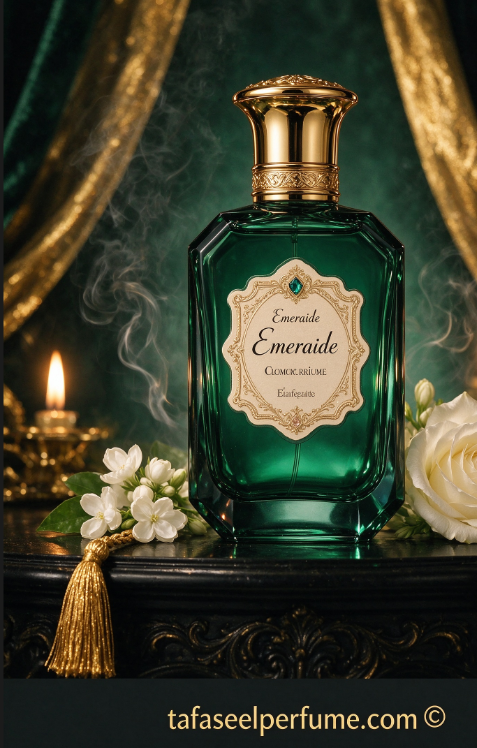
6. The Bottle, the Emerald, and the Marketing of Luxury
François Coty understood that perfume was sold as much through the eyes as through the nose. Emeraude’s packaging history runs from simple clear-glass bottles with gold screw caps to limited-edition presentations and, most notably, a René Lalique-designed bottle that treated perfume as a luxury object rather than a toiletry. The name itself—French for emerald—was chosen to evoke green light, cold stone, and old money, and the early marketing leaned into that association without apology. A 1920s advertisement described Emeraude as smelling of Paris and the “Emerald Isle,” a romanticized pitch that positioned the perfume somewhere between travel, nostalgia, and luxury. Coty was one of the first perfumers to treat packaging as part of the composition, and Emeraude benefited from that philosophy: the green juice and the jewel-toned name created a visual identity that survived long after the original formula began to change. For collectors, the bottle is often the artifact that survives when the perfume inside has turned; for historians, it is a reminder that Emeraude was never just a smell. It was a complete commercial object, designed to sit on a vanity and signal a particular kind of feminine elegance.
7. Who Should Wear Emeraude in 2026
Emeraude perfume by Coty is not a blind reach for every wardrobe, but it rewards a specific kind of wearer. If you already love Shalimar, Tabu, or vintage Arpège, Emeraude belongs on your sampling list as a lighter, greener cousin that shows where the oriental family began. If you enjoy powdery ambers and resinous vanillas but find modern gourmands too sweet or too loud, the best vintage Emeraude you can find will feel like a revelation: warm, dry, and strangely comforting. If you are new to classical perfumery and want an affordable entry point, the current eau de cologne is a low-risk way to experience the architecture, but do not expect it to smell like a luxury parfum. Emeraude is also an excellent reference scent for anyone learning about the difference between vintage and modern formulations: one bottle can teach you more about reformulation than a dozen articles. For more context on how classical structures continue to shape contemporary taste, the Monalisa Perfume article explores how a name can carry a whole olfactory world, while the Banana Republic Grassland Cologne guide shows how a modern green barbershop scent borrows from older templates. If your taste leans toward the sweet and resinous end of the spectrum, the Tom Noir Extreme review is a useful contrast case: a gourmand that goes loud where Emeraude goes quiet.
8. Where Emeraude Sits in the Oriental Family Tree
The oriental family is usually drawn as a line that starts with Shalimar and branches outward into Tabu, Youth-Dew, Opium, and the modern amber boom. Emeraude complicates that line by existing before it. The Osmothèque treats Emeraude and Shalimar as twin foundations of the same arc: Emeraude opened the door, and Shalimar walked through it with more commercial force. That framing matters because it changes how we think about influence. Emeraude did not need to be a bestseller to shape the genre; it needed only to demonstrate that a citrus–resin structure could be elegant, wearable, and unmistakably feminine. That demonstration was enough to make it a reference point for the perfumers and houses that followed. Today, the oriental family has expanded into leathery orientals, spicy orientals, gourmand orientals, and every hybrid in between, but the basic move—bright top, warm base, a heart that holds the two together—remains Emeraude’s most durable contribution. For readers interested in how the amber family continues to evolve, the Ajmal Amber Santal review shows a modern spicy-woody amber that takes the same resinous impulse in a different direction, while the Bahar The Spirit of Dubai guide explores what happens when an aquatic oud tries to do the opposite of Emeraude: stay fresh while going deep.
9. Frequently Asked Questions About Emeraude Perfume by Coty
Is Emeraude perfume by Coty still being made?
Yes, Emeraude has been in continuous or near-continuous production since 1921, though the formula has been reformulated multiple times and the brand’s prestige has shifted from luxury house to drugstore staple. The current version is widely available as an eau de cologne, but it smells noticeably different from vintage bottles.
Is Emeraude a dupe of Shalimar?
No. Emeraude came first. Shalimar launched in 1925, four years after Emeraude, and the two share a structural resemblance because they belong to the same emerging oriental family. Emeraude is often described as softer and greener, while Shalimar is more resinous and leathery.
What does Emeraude perfume by Coty smell like?
It opens with orange, bergamot, and lemon, moves into jasmine, ylang-ylang, rose, and Brazilian rosewood, and settles into a base of amber, sandalwood, patchouli, opoponax, benzoin, and vanilla. The overall effect is a soft, powdery, resinous amber with a persistent citrus freshness that keeps it from becoming heavy.
Should I buy vintage or modern Emeraude?
If you want to understand the perfume’s historical character, seek out a vintage miniature or a pre-1990s bottle. If you want an affordable everyday cologne and do not mind a sharper, lighter interpretation, the modern version is acceptable. Just do not expect them to smell identical.
Is Emeraude suitable for men?
Emeraude is marketed as a feminine fragrance, but its structure—citrus, woods, resins, and vanilla—is not inherently gendered. Many men who enjoy vintage orientals or powdery ambers wear it comfortably, especially in the parfum or early cologne concentrations. The Unisex Perfume category is a good place to explore similar structures without the gendered marketing.
How long does Emeraude last?
Vintage parfum and early eau de cologne concentrations can last six to eight hours on skin, sometimes longer on fabric. Modern eau de cologne is lighter and typically lasts three to five hours, with the citrus opening fading faster than the resinous base.
Why is Emeraude green?
The green color is both a literal reference to the emerald and a marketing decision: François Coty wanted the perfume to look like a jewel, and the green juice reinforced the name. The color itself does not indicate a “green” or fresh fragrance in the modern sense; the scent is an oriental amber.
Is Emeraude a safe blind buy?
Not for a modern nose raised on sweet gourmands or clean woods. Emeraude is powdery, resinous, and can read as medicinal or old-fashioned at first spray. Sampling a vintage miniature or decant is strongly recommended before committing to a full bottle, especially if you are buying an older formulation.
What is the connection between Emeraude and René Lalique?
René Lalique designed at least one bottle for Emeraude in the 1920s, and Coty was among the first perfumers to treat bottle design as an essential part of the luxury object. Lalique’s involvement places Emeraude in the same design lineage as some of the most collectible perfume bottles of the Art Deco era.
Where can I read more about classical oriental perfumes?
The Perfume Articles and Reviews section covers a wide range of classical and modern compositions, from barbershop classics like Calvin Klein Eternity for Men to powdery iris fragrances like Chloé Love. For a broader overview of how brands build and revise their olfactory identities, the Brands page is a useful starting point.


