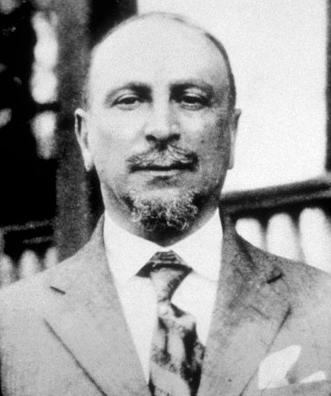
- Ernest Daltroff Perfumer:
Company:Parfums Caron
Web:parfumscaron.com
Ernest Daltroff, a French perfumer and the visionary founder of Parfums Caron, a prestigious fragrance house, was born on November 17, 1867, into an upper-middle-class family of Russian descent. His mother's nightly ritual of placing a drop of her perfume behind his ears ignited a lifelong fascination with scents during his childhood.
In his youth, Daltroff embarked on extensive travels and worked in the clothing industry. However, his encounter with the Exposition Universelle in 1900 proved transformative: he became entranced by the aromas of flowers, fruits, and spices, developing an extraordinary olfactory memory. Despite lacking formal training, he 毅然决然 (resolutely) dedicated himself to a career in perfumery.
In 1903, Daltroff partnered with his brother Raoul to establish a workshop in Asnières-sur-Seine within the former perfumery "Emilia." A year later, he founded Parfums Caron in central Paris at 10 rue de la Paix. The name was partially inspired by the "Mercerie Parfumerie Caron" at 20 rue Rossini, which he acquired from Madame Anne-Marie Caron. He chose "Caron" for its brevity, memorability, and cross-lingual pronunciation, while retaining a distinct French identity.
In 1906, Daltroff met Félicie Wanpouille, a young milliner working on the same street. She introduced him to her clientele and became his creative collaborator and muse. While Daltroff crafted fragrances, Wanpouille designed bottles and served as artistic director, together launching iconic scents likeNarcisse Noir(1911) andN'aimez Que Moi(1917).
Daltroff's innovative palette frequently incorporated bases from Mr. Naef and the Fabriques de Laire, notably Mousse de Saxe. His portfolio includedTabac Blond,En Avion,Fleurs De Rocaille, andNuit de Noël. In 1918, he was invited to the Bronx International Exposition of Science, Arts, and Industries in New York alongside rival François Coty, where he won the prize for "most forward-thinking company," opening the American market during the interwar period.
A Caron boutique debuted on Fifth Avenue in 1923. In 1934, Daltroff revolutionized men's fragrance withPour Un Homme, challenging the dominance of cologne. In 1939, rising antisemitism forced him to seek refuge in the U.S., where he died on February 3, 1941, buried in Quogue Cemetery, New York.
Daltroff's legacy endures as a profound influence on modern perfumery. Described as the most subtle perfumer of his era, his work mirrored the artistry of painters and musicians, cementing his status as a pioneer in olfactory innovation.


