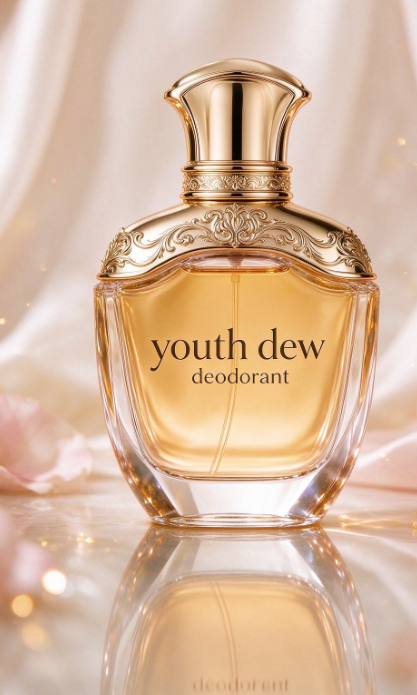
- Youth Dew Deodorant: The Vintage Amber-Spicy Antiperspirant That Still Divides—and Delivers: Quick intro. Youth Dew deodorant is one of those rare drugstore-adjacent classics that refuses to disappear quietly. It carries the DNA of a 1953 bath oil that changed the fragrance industry, yet it lives in a roll-on bottle meant for daily underarm protection. The result is a product that smells like vintage glamour, fights wetness with aluminum chlorohydrate, and sparks fiercely split opinions among the people who use it.
Quick intro. Youth Dew deodorant is one of those rare drugstore-adjacent classics that refuses to disappear quietly. It carries the DNA of a 1953 bath oil that changed the fragrance industry, yet it lives in a roll-on bottle meant for daily underarm protection. The result is a product that smells like vintage glamour, fights wetness with aluminum chlorohydrate, and sparks fiercely split opinions among the people who use it. If you have ever wondered whether the deodorant is “the same” as the perfume, whether it is still being made, or whether an old-school antiperspirant can still make sense in a modern routine, this guide breaks it down without the marketing gloss.
Big intro. Estée Lauder did not launch Youth Dew as a perfume. It arrived in 1953 as a scented bath oil, and women who were told to use fragrance “by the drop” poured it into their baths by the bottle instead. That origin story matters for the deodorant because it explains the scent’s architecture: this is not a shy, clean-musk formula. It is an amber-spicy composition built on rose, jonquil, lavender, jasmine, muguet, spices, moss, vetiver, and patchouli, with the vintage perfume’s aldehydic sparkle and peach-bergamot opening hovering somewhere in the background. The roll-on version translates that opulence into an antiperspirant format, using aluminum chlorohydrate to reduce wetness while leaving a recognizable trail of Youth Dew on the skin. It glides on without the chalky white cast that plagues many drugstore sticks, and loyal users describe it as gentle, long-lasting, and capable of surviving a full day without odor breakthrough. But it is not a universally beloved product. Some reviewers find the deodorant’s fragrance too light, complaining that it fades within half an hour, while others mourn a perceived reformulation that changed the scent they remembere. Availability is equally patchy: certain retailers list the roll-on as “no longer available online,” yet Estée Lauder’s own regional sites continue to sell it and user reports from 2025 insist it is still in production. That contradiction is part of the Youth Dew deodorant experience in 2026. It is a legacy product, not a trend product, and the people who love it tend to love it for decades—one reviewer has used it daily for twenty-five years, another for forty. If you are curious about where this odd, fragrant, old-school antiperspirant fits into a modern shelf, the sections below cover the scent, the mechanics, the layering strategy, and the market reality in detail.
Article map. Four focused sections follow, each built around a question that actually shapes whether Youth Dew deodorant belongs in your routine.
1. What Youth Dew Deodorant Actually Is—and Where It Came From
A short history of the 1953 bath oil that became a deodorant, and why the roll-on still feels like a fragment of mid-century perfumery.
2. The Scent and the Antiperspirant: How the Two Halves Work Together
Breaking down the amber-spicy structure, the aluminum chlorohydrate mechanism, and the real-world reports of longevity versus fade.
3. How to Wear It: Layering, Application, and the Reformulation Question
Practical guidance for getting the most out of the roll-on, plus an honest look at the “scent changed” complaints.
4. Is It Still Available? The Confusing State of Youth Dew Deodorant in 2026
Separating discontinued rumors from regional stock realities, and where to look if you want to try it.
1. What Youth Dew Deodorant Actually Is—and Where It Came From
The origin is not a deodorant story. Youth Dew entered the world as a bath oil, and that distinction shaped everything about its personality. In the early 1950s, Estée Lauder was building a brand around the idea that fragrance could be a daily pleasure rather than a precious occasional luxury. Youth Dew bath oil was priced and positioned so that women felt permission to use it generously—by the bottle, not by the drop—and it quickly became a scent people wore on skin, in baths, and eventually in every ancillary format the brand could produce. The deodorant is a descendant of that logic: if you already love the scent, why not let it live in your underarm routine too? For a broader look at how deodorants and antiperspirants differ as categories, the Deodorant & Antiperspirant collection is a useful reference point, but Youth Dew sits in its own lane because the fragrance is not an afterthought—it is the reason the product exists.
The roll-on format is deliberately unglamorous. The packaging is a standard 75ml roll-on: no chrome, no heavy glass, no display-worthy silhouette. What matters is the glide. Estée Lauder describes the formula as gliding on smoothly and comfortably “without whitening,” and that is not a minor detail for a scented antiperspirant. Many fragrance-forward deodorants either leave a visible residue or pill under clothing; this one is designed to disappear into the skin while leaving the scent behind. The trade-off is that the experience feels utilitarian compared with the perfume, which is part of the product’s strange charm. You are not getting a luxury object. You are getting a workhorse that happens to smell like a 1950s boudoir.
The 1953 DNA is still detectable. Even though the deodorant is not a perfume, it carries the same skeleton: a floral-spicy heart wrapped in moss, vetiver, and patchouli. If you have smelled Youth Dew in any form, you will recognize the deodorant immediately. If you have not, the closest shorthand is “vintage amber-spicy with a rose-and-spice center and an earthy base.” That is not a clean, aquatic, or citrus-fresh scent. It is rich, slightly old-fashioned, and unapologetically perfumed. For readers who enjoy exploring scent families beyond the mainstream, the Body Art section offers a different angle on how fragrance and body products intersect, but Youth Dew deodorant remains a case study in how a single historic accord can migrate across product categories without losing its identity.
2. The Scent and the Antiperspirant: How the Two Halves Work Together
The fragrance architecture is vintage, not modern. On the official product page, the deodorant’s scent is listed as top notes of rose, jonquil, and lavender; middle notes of jasmine, muguet, and spices; and base notes of moss, vetiver, and patchouli. That is a simplified version of the full perfume pyramid, which historically included aldehydes, bergamot, peach, and a broader spice bouquet in the opening. What survives in the deodorant is the part that matters most for skin: the floral-spicy core and the earthy, resinous dry-down. The aldehydic “sparkle” that gives the vintage perfume its champagne-like lift is less prominent in the roll-on, which is one reason some longtime users perceive the deodorant as a quieter, softer interpretation of the scent rather than a direct replica.
The active ingredient is aluminum chlorohydrate, and it behaves like a classic antiperspirant. The formula lists aluminum chlorohydrate alongside water, steareth-2, alcohol denat., and the Youth Dew fragrance blend. That means it is not a deodorant-only product that merely masks odor; it is an antiperspirant that reduces wetness by forming a temporary plug in the sweat duct. For people who need genuine wetness control, this is a functional advantage. For people who avoid aluminum salts, it is a disqualifier. The safety conversation around aluminum chlorohydrate is nuanced: Germany’s Federal Institute for Risk Assessment has stated that adverse health effects from daily use of antiperspirants containing aluminum chlorohydrate are unlikely according to current scientific knowledge, while also noting that the tolerable weekly intake could be approached if an antiperspirant is the sole aluminum source. That is not a green light for unlimited use, but it is also not a reason to panic. The practical takeaway is the same as with any aluminum-based antiperspirant: use it on intact skin, do not apply it to freshly shaved or irritated underarms, and let it dry before dressing.
User reports are split between “all-day” and “gone in thirty minutes.” The most enthusiastic reviews describe total confidence: “Absolutely NO perspiration ever,” “fresh for 48 hours,” and “one bottle lasts for two months”. Those reviewers are often long-term users who have built the product into a stable routine and may be applying it to clean, dry skin every morning as directed. The negative reviews are equally specific: the fragrance is “too light and subtle” and “completely dissipates after 30 minutes,” leading at least one reviewer to argue that it functions more like a “30 minute deodorant” than a true antiperspirant. Both experiences can be true because the variables are different: skin chemistry, application timing, the amount applied, and whether the underarm is dry or damp all change how the fragrance and the aluminum salt perform. Youth Dew deodorant is not a high-tech encapsulation formula; it is a traditional roll-on, and it rewards consistent, correct application more than it rewards hope.
The “smells like the perfume” question is complicated. Many buyers come to the deodorant because they already wear the eau de parfum and want a matching layer. The deodorant does carry the Youth Dew accord, but it is not a concentrated perfume. It is a scented antiperspirant, which means the fragrance is diluted by the functional base and by the water and alcohol in the formula. On some skin it reads as a soft echo of the perfume; on other skin it can seem almost absent after the first hour. That variability is why layering matters so much, and it is also why some reviewers who expected a full-strength Youth Dew experience walked away disappointed. If your goal is scent intensity, the deodorant alone is not the answer. If your goal is a coherent fragrance wardrobe with a matching underarm layer, it can be a satisfying piece of the puzzle.
3. How to Wear It: Layering, Application, and the Reformulation Question
Application timing is not a detail—it is the whole game. The official instruction is straightforward: roll onto dry underarms after bathing. “Dry” is the operative word. Applying a roll-on to damp skin dilutes the formula, encourages migration onto clothing, and can make the fragrance fade faster. If you shower in the morning, wait a minute or two, pat the underarm completely dry, and then apply. If you prefer evening application, the same rule applies: clean, dry skin, and enough time for the product to set before you put on a shirt. Estée Lauder’s own layering guidance for the Youth Dew line emphasizes damp-skin moisturizing followed by fragrance on pulse points, and while that advice is written for the body lotion and perfume, the underlying principle—build scent on skin that is prepped, not wet—applies to the deodorant as well. For a broader view of how layering works across different product formats, the Ranking section is a useful place to compare approaches, but Youth Dew is unusual because the deodorant is already a scented layer, so you are not starting from a blank canvas.
Layering with Youth Dew perfume amplifies the effect—up to a point. The most common strategy among longtime users is to apply the deodorant first, let it dry, and then apply the eau de parfum to pulse points or clothing. This creates a gradient: the deodorant provides a low, skin-close hum of the scent, while the perfume provides the sillage and the top-note sparkle. The risk is over-application. Youth Dew is a rich amber-spicy composition, and stacking the deodorant with a heavy hand of perfume can tip the whole effect from “opulent” to “overwhelming,” especially in warm weather or enclosed spaces. A lighter touch works better: one or two sprays of perfume, not five, and let the deodorant do the background work. If you already own the body lotion or body satinee, applying that first on damp skin and then following with the deodorant creates an even more seamless scent continuum, though the deodorant’s functional base means it should still go on clean, dry skin rather than on top of a wet lotion.
The reformulation complaint is real but hard to pin down. A recurring theme in user reviews is that the scent “changed” at some point and no longer matches the Youth Dew the reviewer remembers. One reviewer who had used the deodorant for years wrote that the new version “smells awful” and that they had stopped buying it[reference:24]. Estée Lauder’s customer-service response was polite but did not confirm or deny a formula change, which is typical of how large beauty companies handle reformulation questions. The ingredient list does show a long fragrance component with many individual aroma chemicals—linalool, limonene, citronellol, benzyl salicylate, coumarin, eugenol, patchouli oil, lavender oil, and others—which is consistent with a complex vintage accord that may be subject to raw-material sourcing changes over time. Whether the current deodorant smells “the same” as a bottle from ten or twenty years ago is impossible to answer generically because fragrance perception is personal and because the perfume industry’s raw materials do shift. What is clear is that the current product still carries the rose-spice-moss-patchouli signature, and new users who have no vintage reference point often describe it as pleasant and recognizable rather than “wrong.” If you are reformulation-sensitive, buy a single roll-on first rather than a multi-pack, and judge it on your own skin before committing.
Clothing and skin-type notes. The formula is described as non-whitening, and multiple reviewers confirm that it does not leave white marks on clothes. That is a meaningful advantage for a scented antiperspirant, because white residue is one of the fastest ways a product loses daily-use appeal. The alcohol content is relatively high in the ingredient order, so people with very reactive or freshly shaved underarms may feel a sting if they apply immediately after shaving. Waiting a few hours, or applying on a day when you have not shaved, reduces that risk. The fragrance oils in the formula are also worth noting for anyone with known sensitivities to linalool, limonene, or eugenol: these are common fragrance allergens, and they are present here. That does not make the product unsafe for the general population, but it does mean that patch-testing on a small area is sensible if you have a history of contact dermatitis.
4. Is It Still Available? The Confusing State of Youth Dew Deodorant in 2026
Discontinued or not? Both answers are circulating. The availability picture is genuinely messy. Some retail listings show the Youth Dew roll-on as “no longer available online” or “unlikely to receive more stock,” which fuels the discontinued rumor. At the same time, Estée Lauder’s regional e-commerce sites continue to list and sell the product, and a 2025 user forum reply stated plainly that the brand still makes it and that it remains a strong seller among older customers. The most accurate reading is that Youth Dew deodorant is a legacy SKU with uneven regional distribution: some markets have dropped it, others still stock it, and third-party sellers and eBay listings fill the gaps for buyers in markets where it is no longer on shelf. That is not the same as a global discontinuation, but it is also not the same as reliable year-round availability at every retailer.
Where to look if you want to try it. The first stop should be Estée Lauder’s own website for your region, because the brand’s direct channels are the most likely to carry current stock and to list the product accurately. If the roll-on is not shown there, department-store beauty counters and authorized retailers are the next best option. After that, resale platforms and specialty fragrance retailers may have it, but the usual caveats apply: check the seller’s reputation, confirm the size and condition, and be aware that old stock may have been stored in warm conditions that affect the formula’s texture and scent. The Tafaseel collection page is a useful example of how a curated fragrance destination organizes legacy and niche products, and it reinforces the point that a product’s cultural longevity does not guarantee frictionless retail availability. Youth Dew deodorant is a product you sometimes have to look for, not a product you can assume will be on the shelf at every pharmacy.
What to do if you cannot find the deodorant. If the roll-on is unavailable in your market and you still want the Youth Dew experience, the most direct fallback is the eau de parfum layered over an unscented or lightly scented antiperspirant. You lose the convenience of an all-in-one product, but you gain control: you can choose an antiperspirant that suits your skin’s sensitivity and then apply the perfume to pulse points or clothing for the scent. The body lotion or body satinee is another bridge product if you want scent on skin without the intensity of the perfume. None of these are exact substitutes for the deodorant, because the deodorant’s specific texture and application ritual are part of what longtime users value, but they preserve the fragrance in your routine while you wait for stock to return or decide whether to hunt down a bottle through resale.
The bottom line on availability. Youth Dew deodorant is not a product you can evaluate purely through the lens of “is it discontinued?” It is a product you evaluate by checking your region, checking the brand’s direct site, and being willing to look at authorized resale if the first two options fail. The rumors of its death have been exaggerated, but the distribution is genuinely inconsistent. That inconsistency is itself a useful filter: the people who end up using Youth Dew deodorant are often the people who care enough to seek it out, and that matches the product’s identity as a legacy item rather than a mass-market staple.
Frequently Asked Questions About Youth Dew Deodorant
Is Youth Dew deodorant discontinued?
There is no single global answer. Some retailers have stopped carrying it and list it as no longer available, but Estée Lauder continues to sell the roll-on through certain regional websites, and user reports from 2025 confirm it is still in production. The safest approach is to check the Estée Lauder site for your country and, if it is not listed, look at authorized department stores or resale platforms. Availability is regional, not universal.
Does Youth Dew deodorant smell exactly like the perfume?
It carries the same amber-spicy Youth Dew accord—rose, jonquil, lavender, jasmine, spices, moss, vetiver, and patchouli—but it is not a concentrated perfume. The functional antiperspirant base dilutes the fragrance, and on some skin it reads as a soft echo rather than a full-strength statement. Many users layer it with the eau de parfum to amplify the effect. If you expect the deodorant alone to perform like a perfume, you will likely be disappointed; if you expect it to be a scented underarm layer, the match is much closer.
Is aluminum chlorohydrate in Youth Dew deodorant safe?
Aluminum chlorohydrate is a standard antiperspirant active, and current scientific assessments from bodies such as Germany’s Federal Institute for Risk Assessment state that adverse health effects from daily use are unlikely according to current knowledge, while noting that the tolerable weekly intake could be approached if an antiperspirant is the only aluminum source. It should not be applied to broken or freshly shaved skin. If you have kidney disease or a specific medical concern about aluminum exposure, speak with a clinician before using any aluminum-based antiperspirant.
Why do some reviews say the scent disappears quickly?
Youth Dew deodorant is a traditional roll-on, not an encapsulated long-wear fragrance. Application on damp skin, a small amount of product, and individual skin chemistry can all shorten the scent’s lifespan. Reviewers who apply it to clean, dry underarms and use a sufficient amount tend to report much better longevity, while those who apply it sparingly or on damp skin sometimes find it fades within thirty minutes. Layering with the perfume or a scented body product is the most reliable way to extend the effect.
Can I use Youth Dew deodorant if I have sensitive skin?
The formula contains fragrance allergens such as linalool, limonene, citronellol, eugenol, and benzyl salicylate, and it includes alcohol denat., which can sting on freshly shaved or irritated skin. It is not marketed as a sensitive-skin product. If you have a history of contact dermatitis or fragrance sensitivity, patch-test on a small area of the inner arm before using it on the underarm. People without sensitivity often describe it as gentle, but “gentle” in user reviews is not the same as “hypoallergenic” on a label.
What is the best way to apply it for maximum effect?
Apply to clean, completely dry underarms after bathing, and let it set for a minute before dressing. If you are layering with Youth Dew perfume, apply the deodorant first, let it dry, and then apply one or two sprays of perfume to pulse points or clothing. Avoid applying it to damp skin or immediately after shaving. A consistent morning routine—same timing, same dry-skin preparation—produces more reliable results than occasional heavy application.
Does it leave white marks on clothes?
The formula is described by Estée Lauder as gliding on “without whitening,” and multiple user reviews confirm that it does not leave the chalky white residue associated with many solid antiperspirants. As with any roll-on, allowing it to dry fully before dressing further reduces the chance of transfer. Dark clothing is less forgiving of any residue, so a short drying wait is worth the extra minute.
Where can I buy Youth Dew deodorant if it is not on the Estée Lauder site in my country?
Check authorized department-store beauty counters first, then reputable fragrance retailers that carry legacy Estée Lauder products. Resale platforms and eBay listings are an option, but verify the seller’s history and the product’s condition before buying. Legacy SKUs are more susceptible to long storage and inconsistent stock, so buying from a source with a clear return policy is worth the small premium over the cheapest listing.


