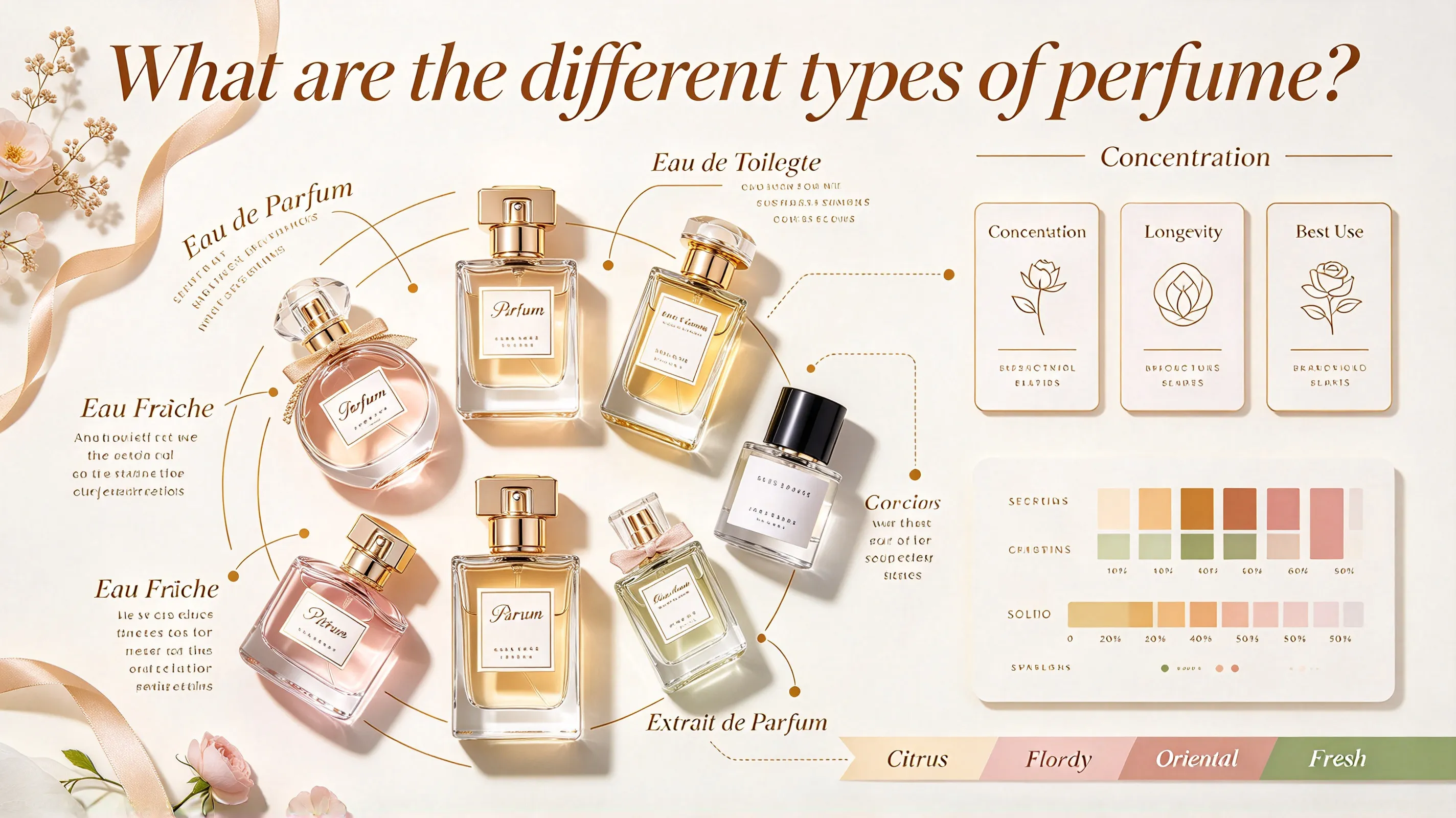
- What are the different types of perfume?: A long-form exploration of how fragrance is classified—from the percentage of oil in the bottle to the olfactory families that define what you actually smell—plus answers to the questions every perfume wearer eventually asks.
The Complete Guide to Perfume Types: Concentrations, Families, and Everything In Between
A long-form exploration of how fragrance is classified—from the percentage of oil in the bottle to the olfactory families that define what you actually smell—plus answers to the questions every perfume wearer eventually asks.
Introduction: Why "Perfume Type" Means More Than One Thing
Walk into any fragrance counter and you will encounter a vocabulary that feels deliberately opaque: eau de parfum, extrait, fougère, chypre, sillage, dry down. The word "perfume" itself is used both as a generic term for any scented liquid and as a specific technical category denoting the most concentrated form. This dual usage is the source of much confusion. To understand perfume types, you need to separate two distinct classification systems that operate in parallel.
The first system is concentration: how much fragrance oil is dissolved in the alcohol-and-water base. This determines intensity, longevity, and often price. The second system is olfactive family: how the fragrance smells, based on its dominant ingredients and accords. A perfume's concentration tells you how strong it is; its family tells you what it smells like. Both matter, and neither is inherently "better" than the other. A light eau de cologne in a beautifully constructed citrus family can be just as sophisticated as a heavy extrait in an amber family—it simply serves a different purpose.
This guide walks through both systems in detail, then addresses the practical questions that arise when you actually wear the stuff: how to make it last, where to spray it, and why the same bottle smells different on your skin than on your friend's.
Part One: Perfume Types by Concentration
The Basic Formula
All fine fragrances are built on a simple triad: fragrance oil + alcohol + water. The oil carries the scent molecules; the alcohol acts as a solvent and propellant, evaporating on the skin to release the fragrance; water softens the mixture. The ratio of oil to alcohol is what defines the concentration category. Historically, these categories emerged as practical designations rather than rigid regulations—there is no universal governing body enforcing exact percentages, and brands vary. But the following ranges are widely accepted as industry conventions.
Parfum (Extrait de Parfum, Pure Perfume)
Concentration: Typically 15–30% fragrance oil, with some artisanal extraits reaching 40%.
Parfum, also called extrait de parfum or pure perfume, sits at the apex of the concentration hierarchy. It is the most expensive form, not only because of the oil content but because extraits often use higher-quality raw materials and a higher proportion of base notes—the heavy, long-lasting ingredients like sandalwood, amber, vanilla, and musk. The result is a fragrance that unfolds slowly, sits close to the skin rather than projecting aggressively, and can last eight hours or more. Parfum is not necessarily "louder" than an eau de parfum; its intensity is more about depth and tenacity than projection. It is the form to choose when you want a scent that feels intimate, deliberate, and enduring.
Eau de Parfum (EDP)
Concentration: Generally 10–20% fragrance oil.
Eau de parfum is the modern workhorse of the fragrance world and the category most designer and niche releases occupy. It strikes a balance: richer and longer-lasting than an eau de toilette, but more accessible and often more diffusive than a pure parfum. An EDP typically wears for four to eight hours and offers what the industry calls "rich scent projection"—it announces itself without overwhelming. For most people, most of the time, EDP is the sweet spot.
Eau de Toilette (EDT)
Concentration: Generally 5–15% fragrance oil.
Eau de toilette is lighter, fresher, and designed for everyday wear. The name comes from the French toilette, meaning grooming or dressing—an EDT was historically a splash-on fragrance used as part of a morning routine. EDTs tend to emphasize top notes (citrus, green, aromatic) because the lower oil concentration allows the brighter, more volatile materials to shine. They wear for roughly three to five hours and are ideal for warm weather, office environments, or anyone who prefers to reapply throughout the day. Do not mistake "lighter" for "inferior": many of the most iconic fragrances of the late twentieth century were EDTs, and a well-made EDT can be more vivid and pleasurable than a poorly constructed EDP.
Eau de Cologne (EDC)
Concentration: Generally 2–6% fragrance oil.
Eau de cologne is the original modern fragrance category, dating to eighteenth-century Cologne, Germany (hence the name). Traditional colognes are built around citrus and herbal notes—bergamot, lemon, neroli, rosemary—and are designed to be refreshing rather than enduring. They last one to three hours at most and are best understood as a ritual rather than a statement: a splash after a shower, a lift on a hot afternoon, a fragrance you wear for yourself rather than for the room.
Eau Fraîche and Other Light Forms
Concentration: Often below 3% fragrance oil.
At the very lightest end of the spectrum sit eau fraîche, body mists, and fragrance veils. These are barely-there scents designed for a fleeting impression—a spritz on linen, a refresh after the gym, a way to layer without competing with a stronger fragrance. They are not meant to last, and judging them by the standards of an extrait misses the point entirely.
A Note on "Cologne"
In everyday American English, "cologne" is often used to mean "men's fragrance," regardless of concentration. In the technical language of perfumery, however, cologne refers strictly to the low-concentration citrus-herbal category described above. A men's fragrance can be an eau de parfum, an extrait, or an eau de toilette—"cologne" as a gender label is a marketing convention, not a chemical one.
Concentration at a Glance
| Type | Typical Oil Concentration | Longevity | Character |
|---|---|---|---|
| Parfum / Extrait | 15–30% (up to 40%) | 6–8+ hours | Deep, intimate, base-note heavy |
| Eau de Parfum (EDP) | 10–20% | 4–8 hours | Balanced, rich, versatile |
| Eau de Toilette (EDT) | 5–15% | 3–5 hours | Fresh, bright, everyday |
| Eau de Cologne (EDC) | 2–6% | 1–3 hours | Citrus-herbal, refreshing |
| Eau Fraîche / Mist | Under 3% | Under 2 hours | Fleeting, layering, refreshment |
Ranges are approximate and vary by house and formulation.
Part Two: Perfume Types by Olfactive Family
Concentration tells you how a fragrance performs; family tells you what it is. Olfactive classification is the shared vocabulary of perfumery—a way to organize the vast universe of scent into recognisable territories so that wearers, sellers, and perfumers can communicate meaningfully. Without classification, every composition is its own island; with it, you can say "I prefer chypre over fougère" and be understood.
There is no single universal classification system. The Société Française des Parfumeurs (SFP) recognizes seven primary families, each with sub-families. Michael Edwards' Fragrance Wheel—the system most commonly used in English-language retail—organizes fragrances into four broad segments (Fresh, Floral, Amber, Woody) with a ring of sub-families around the circumference. Other systems exist, and terms like gourmand or aquatic are widely used in retail and media without being formal families in the SFP grid. What follows draws primarily on the SFP framework, with notes on the terms you will encounter in everyday fragrance shopping.
The Seven SFP Families
1. Citrus (Hespéridés). Built on volatile zest materials: bergamot, lemon, mandarin, neroli, petitgrain, grapefruit. Citrus is the oldest modern family, rooted in eau de cologne, and remains the quintessential summer and morning wear. Its brightness is deceptive: a great citrus fragrance uses careful blending to give the fleeting top notes a structural foundation.
2. Floral. The largest and most diverse family, centered on rose, jasmine, tuberose, ylang-ylang, and countless other flowers. Floral fragrances range from soliflores (a single flower rendered in isolation) to elaborate bouquets. Sub-families include floral fruity, floral green, floral aldehydic, and floral woody. Floral is often described as the heart of perfumery itself.
3. Fougère. A structurally defined family: lavender top, geranium heart, oakmoss and coumarin base. The name means "fern" in French, though no fern has a scent—the term was coined by Houbigant's Fougère Royale (1882) to evoke an imaginary green freshness. Fougère is the backbone of many classic men's fragrances and remains a reference point for aromatic, herbaceous compositions.
4. Chypre. Another structurally defined family: a citrus top (typically bergamot), a floral heart (rose, jasmine), and a base of oakmoss, labdanum, and patchouli. Codified by François Coty's Chypre de Coty (1917), chypre is named after Cyprus and evokes a mossy, resinous, sophisticated dryness. It is one of the most intellectually satisfying families in perfumery—and one of the most affected by modern restrictions on oakmoss.
5. Woody (Boisés). Anchored in cedar, sandalwood, vetiver, oud, and patchouli. Woody fragrances range from dry and austere to creamy and enveloping. They form the base of countless compositions in other families, but when woods dominate, the result is grounded, warm, and often long-lasting.
6. Amber (Ambrés, formerly Orientaux). Sweet balsamic materials—vanilla, benzoin, labdanum, tonka bean—combined with resinous and sometimes animalic supports. Amber is the family of warmth, comfort, and sensuality. The term "oriental" is increasingly replaced by "amber" in contemporary classification for clarity and cultural sensitivity. Amber fragrances are often the most tenacious on skin.
7. Leather (Cuirs). Built around quinoline, isobutyl quinoline, or modern leather accords. Leather fragrances evoke tanned hide, smoke, and animalic depth. They are among the most distinctive and polarizing families—unmistakable, often challenging, and deeply rewarding for those who love them.
Beyond the Seven: Terms You Will Actually See
Retail and media use a looser vocabulary that does not map neatly onto the SFP grid. The most important of these common terms are:
-
Gourmand: Edible compositions centered on vanilla, caramel, chocolate, coffee, almond. Born commercially with Thierry Mugler's Angel (1992). Not an SFP family, but one of the most commercially significant categories in modern perfumery.
-
Aquatic / Marine: Built around calone and modern marine molecules, emerging in the late 1980s and 1990s with Cool Water and L'Eau d'Issey. Evokes sea air, watermelon rind, and wet stone.
-
Aromatic: Herbal compositions centered on rosemary, thyme, sage, and basil—the "Mediterranean signature." Often folded into fougère or fresh categories in retail.
-
Aldehydic: Structured around aldehydes, delivering a metallic-soapy lift. Codified by Chanel N°5 (1921). A historical pillar of modern perfumery, now relatively rare.
-
Animalic: Foregrounding civet, castoreum, ambergris, or hyraceum. Sometimes treated as a sub-family of leather or amber; often a standalone descriptor in niche perfumery.
The Fragrance Wheel in Brief
Michael Edwards' wheel organizes families by perceptual proximity: families that sit adjacent share dominant molecules and layer well together, while opposites create contrast. The four primary segments are Fresh (citrus, green, water, aromatic), Floral (single floral, floral bouquet, fruity floral, aldehydic), Amber (soft amber, floral amber, woody amber), and Woody (woods, mossy woods, dry woods). Sub-families sit around the circumference, showing how styles connect, overlap, and evolve. For a wearer, the wheel is a practical tool: if you love a fragrance in one segment, the adjacent segments are likely to appeal to you as well.
Part Three: The Architecture of a Fragrance—Top, Middle, and Base Notes
A fragrance is not a static smell. It is a timed release of volatile materials, and the way it changes on skin is one of the great pleasures of wearing perfume. This evolution is conventionally described through the fragrance pyramid: top notes, middle (heart) notes, and base notes.
Top notes (also called head notes) are the first impression—the burst of scent in the opening seconds and minutes. They are made of highly volatile materials: citrus, light florals, green notes, aromatic herbs. Top notes typically fade within 5–15 minutes, though some last up to 30. They are the fragrance's greeting, not its substance.
Middle notes (heart notes) emerge as the top notes dissipate. They define the fragrance's character—its emotional and aesthetic core. Rose, jasmine, ylang-ylang, spices, and soft fruits commonly occupy the heart. A middle note may last one to four hours, and its quality often determines whether a fragrance feels coherent or disjointed.
Base notes (dry-down notes) are the foundation. Heavy, low-volatility materials—sandalwood, cedar, vetiver, patchouli, amber, vanilla, musk, oakmoss—linger on the skin for hours, sometimes into the next day. Base notes are what you smell when you bring your wrist to your nose at the end of the day; they are the fragrance's lasting signature and the reason some perfumes feel like they become yours over time.
Not every fragrance follows a dramatic arc. Linear fragrances are designed to smell more or less the same from application to dry-down. But most fine fragrances are composed with intention: the top notes invite you in, the heart tells the story, and the base leaves the memory.
Part Four: Frequently Asked Questions
What is the difference between perfume, Eau de Parfum, and Eau de Toilette?
The difference is concentration. Parfum (extrait) contains the highest percentage of fragrance oil—typically 15–30%, sometimes more—and lasts the longest. Eau de parfum sits in the middle at roughly 10–20% and balances richness with wearability. Eau de toilette is lighter, usually 5–15%, and is designed for everyday freshness. These are conventions, not laws; a given brand's EDT may outperform another brand's EDP.
Which concentration lasts the longest?
Parfum (extrait de parfum) generally lasts longest on skin, followed by eau de parfum, eau de toilette, eau de cologne, and eau fraîche. But longevity also depends on the olfactive family: amber, woody, and leather fragrances tend to cling to skin far longer than citrus or aquatic compositions, regardless of concentration.
What is sillage, and how is it different from longevity?
Longevity is how long a fragrance lasts on you. Sillage (pronounced see-yazh) is the scent trail you leave behind—the cloud of fragrance that others smell when you walk past. A fragrance can have excellent longevity but modest sillage (it sits close to the skin), or strong sillage but moderate longevity (it projects loudly but fades relatively quickly). Neither is inherently better; the right balance depends on context. An office fragrance usually benefits from low sillage, while an evening fragrance may be designed to project.
Where should I apply perfume to make it last?
Pulse points are the classic answer: wrists, neck, behind the ears, inner elbows, behind the knees. These areas generate warmth, which helps diffuse and amplify the scent. Apply to clean, moisturized skin—dry skin releases fragrance molecules faster and shortens longevity. Avoid rubbing your wrists together after spraying; friction and heat disrupt the top notes and accelerate their fade. For extra tenacity, spray lightly on hair and clothing (test fabric first to avoid staining).
Should I apply perfume before or after moisturizer?
After. Unscented moisturizer creates a lipid layer on the skin that binds aromatic molecules and slows their release into the air, extending longevity—especially for lighter concentrations like EDT and EDC. Dry skin, by contrast, lets fragrance dissipate more quickly. A moisturized base is one of the simplest and most effective ways to get more from your perfume.
Why does the same perfume smell different on me than on someone else?
Skin chemistry, body temperature, diet, medication, and even the pH of your skin all influence how a fragrance develops. The same molecules can read as sweet on one person and dry on another. This is why testing on skin—not on paper—is essential, and why a fragrance you love on a friend may not work on you. There is no "correct" way for a perfume to smell; there is only how it smells on you.
How should I store perfume?
Cool, dark, and dry. Heat, sunlight, and humidity degrade fragrance molecules and can turn a beautiful perfume sour or flat over time. Keep bottles in their original packaging if possible, away from bathroom steam and windowsills. A bedroom drawer or cabinet is ideal. Done properly, a bottle can remain wearable for years; stored badly, it can deteriorate in months.
Can I layer different perfumes?
Yes—layering is a legitimate practice, though it works best when the fragrances share a family or adjacent families on the fragrance wheel. Pairing a citrus EDT with a woody EDP, or a floral with a soft amber, can create a personalized effect. The risk is dissonance: two fragrances with clashing dominant accords can produce a muddled, unpleasant result. Test on skin, start with one spray of each, and adjust.
Is expensive perfume always better?
No. Price reflects many factors—raw material cost, brand positioning, packaging, marketing—not a linear measure of quality. A well-composed eau de toilette from a thoughtful independent house can be more pleasurable than a poorly constructed extrait from a luxury brand. The best fragrance is the one you enjoy wearing, at the concentration and price point that suit your life.
What does "dry down" mean?
The dry down is the final phase of a fragrance's evolution—the scent that remains after the top and middle notes have faded, when the base notes fully emerge. It is often the truest expression of a perfume's character, and it is the reason you should never judge a fragrance solely by its opening spray. Give it at least thirty minutes on skin before deciding.
Conclusion: A Vocabulary, Not a Hierarchy
The types of perfume are not rungs on a ladder. An eau de cologne is not a failed extrait; a fougère is not a lesser floral. Each category exists because it serves a distinct sensory and practical purpose. Concentration determines performance; family determines character; and the interaction between the two—along with your own skin chemistry, the climate, and the occasion—determines whether a fragrance feels like you.
The most useful thing you can do as a wearer is learn the vocabulary well enough to navigate it, then forget the rules and trust your nose. Sample widely. Test on skin. Notice how a fragrance changes over hours, not minutes. And remember that the "best" perfume type is the one that makes you want to bring your wrist to your nose again and again—whatever the label on the bottle says.


