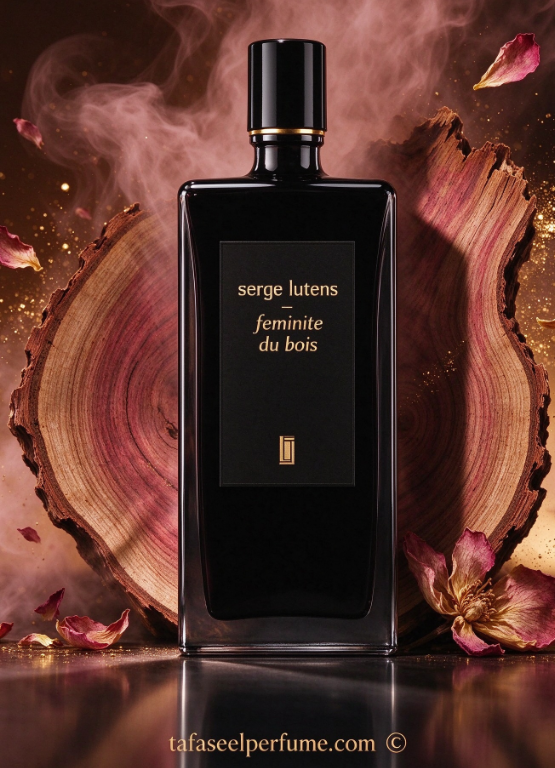
- Serge Lutens Féminité du Bois: The Fragrance That Redefined Femininity Through Wood: A quiet revolution bottled in cedar. Before gender-neutral perfumery became a marketing category, Féminité du Bois was already doing the work—placing an uncompromising overdose of wood at the center of a composition meant for women, and in doing so, redrawing the boundaries of what femininity could smell like. Released in 1992 under Shiseido and later adopted into the Serge Lutens line in 2009, it remains a landmark of modern perfumery: not because it shouted, but because it refused to conform.
This article explores Féminité du Bois from every angle that matters—its origin as an act of creative disruption, the architecture of its cedar-forward accord, the cultural shift it anticipated by decades, and the reasons it still feels contemporary more than thirty years after its debut. Whether you encounter it as a collector, a curious newcomer, or someone searching for a fragrance that sits outside the usual categories, the story of Féminité du Bois is inseparable from the scent itself: angular yet tender, austere yet edible, ancient yet unmistakably modern.
The Origin Story: A Perfume Born Against the Tide
Féminité du Bois did not emerge from a focus group. It came from a conviction. In the early 1990s, the fragrance industry was saturated with what Serge Lutens himself described as “bottled blends aimed at stereotypes of men and women”—working women, housewives, sporty men—each category packaged with its own predictable olfactory template.Lutens, freshly appointed as artistic director at Shiseido, wanted something else: a perfume that returned to the fundamentals of scent as memory, built around a single material pushed to the edge of reason.
That material was cedarwood. The brief was not to soften it into a conventional woody-floral but to let it dominate—over 60 percent of the composition, by Lutens’s own recollection. “More cedar, more cedar, I want a forest,” he recalled telling his team as they worked through draft after draft. The industry was skeptical. A wood-dominant feminine fragrance had no obvious precedent; the codes of the time reserved such overdoses for masculine releases. Lutens proceeded anyway, and the result was a perfume that did not so much enter the market as cut through it.
The creative authorship reflects this hybrid origin. The original 1992 Shiseido release is signed by Pierre Bourdon and Christopher Sheldrake; when the fragrance migrated to the Serge Lutens house in 2009, Sheldrake’s name alone remained on the formula.This double lineage helps explain why Féminité du Bois feels both meticulously constructed and instinctually driven—a tension between French perfumery craft and Lutens’s more autodidactic, image-driven sensibility. For those tracing the genealogy of niche perfumery, it belongs alongside the works that convinced the industry that personal obsession could outsell demographic calculation.
The Olfactory Architecture: Cedar as Spine, Fruit as Skin
To describe Féminité du Bois as a “woody fragrance” is accurate but incomplete. The cedar is the spine, but the flesh of the perfume is built from an unlikely convergence of dried fruit, warm spice, and floral sweetness. The opening is often described as sharp or resinous—a blast of Virginia cedar and a tart, almost plum-skin sourness—before the composition settles into something far more plush and atmospheric.
The heart reveals the fragrance’s most distinctive tension. Plum and peach provide a jammy, slightly fermented fruitiness, while cinnamon, clove, and ginger add a spicy heat that keeps the sweetness from becoming cloying. Violet and rose introduce a powdery floral softness, and orange blossom lends a honeyed, almost beeswax-like glow. The base extends this warmth with sandalwood, benzoin, musk, and vanilla—materials that round the cedar’s edges without ever neutralizing its presence.
What distinguishes Féminité du Bois from later cedar-forward releases is its restraint. The fruit is not juicy; the spices are not gourmand; the flowers are not bouquet-like. Each element is dried, concentrated, and held in suspension. The overall effect is closer to a cedar chest lined with silk and dried plums than to a “perfume” in the conventional sense—which is precisely what Lutens intended when he spoke of the scent as a “marquetry of wood enlivened by the ether air of Marrakesh.”
The Gender Question: “Feminine” Without the Usual Signals
Féminité du Bois is routinely called one of the first unisex fragrances, but that label can obscure its more radical proposition. The perfume was not unisex in the contemporary sense of being marketed to everyone; it was feminine in a register that had been coded as masculine. By placing cedar—a material traditionally associated with men’s perfumery, with pencil shavings and dry timber—at the heart of a women’s release, Lutens did not neutralize gender. He expanded it.
This distinction matters. Many so-called genderless fragrances achieve neutrality by smoothing out the extremes: a little citrus, a little musk, nothing too dry, nothing too sweet. Féminité du Bois does the opposite. It is unapologetically dry and austere at one moment, unexpectedly sweet and plush at another. The femininity it proposes is not softness replacing structure, but structure itself becoming a kind of tenderness. Lutens described the fragrance as embodying a femininity made of “right and obtuse angles” rather than flowing curves—a Cubist femininity, pulled together by the femininity within the creator rather than by external convention.
For wearers who have felt alienated by the usual signals of “women’s perfume”—floral bouquets, sugar, powder, polite fruit—Féminité du Bois offers something different: a fragrance that feels like self-definition rather than categorization. It sits naturally alongside the broader archive of unisex perfume, but its real home is in the lineage of scents that made room for identities the market had not yet named.
Shiseido and Serge Lutens: Two Versions, One Soul
The 1992 Shiseido edition and the 2009 Serge Lutens edition are not identical, and the differences are instructive. Long-term wearers often describe the Shiseido version as more transparent and integrated—a quieter, more seamless weave of cedar, fruit, and floral notes. The Serge Lutens version is frequently characterized as brighter and sharper, with the cedar more assertive and the spices more pronounced.
These variations are not simply a matter of reformulation for cost or regulation, though those factors always play a role. They reflect a shift in context. The 1992 release was a Shiseido product, conceived within the constraints and possibilities of a large beauty corporation. The 2009 release entered the Serge Lutens universe proper, where the same composition had to stand alongside the house’s denser, more oriental-leaning aesthetic. The fragrance did not change its soul, but its accent shifted—from a whisper in a corporate corridor to a statement in an artist’s salon.
For collectors, this duality is part of the appeal. Comparing vintage Shiseido bottles with early Lutens releases and contemporary versions has become a small subculture within fragrance appreciation. The differences are subtle but real: a matter of degrees in sweetness, dryness, and diffusion. What remains constant is the cedar-plum architecture—the same improbable, enduring idea that a wood overdose could be the most intimate thing a perfume does. Those exploring the wider perfume brands landscape will find that few compositions reward this kind of longitudinal attention.
The Sensory Experience: Silence, Silk, and Violet Dusk
Féminité du Bois is not a loud perfume. It does not project across a room or announce itself before you enter. It sits close to the skin, radiating in a quiet, almost meditative register. Long-time wearers describe it in terms of atmosphere rather than statement: a cool violet dusk in late summer, the scent of plum wine lifted into the air, the touch of raw silk against skin, a cedar box opened after years of storage.
This quietness is not a defect. It is the point. The fragrance was designed for intimacy—for the wearer’s own experience of scent as memory and interiority. It does not perform femininity for an audience; it offers a private, grounded sensuality that becomes more legible the longer you live with it. Many wearers report that the fragrance reveals new layers over time: cinnamon becoming more distinct, clove emerging, peach ripening, orange blossom glowing beside violet. What initially reads as “cedar and plum” gradually becomes a more complex weave of resins, wax, and spice.
This is also why Féminité du Bois has never been a mass-market blockbuster. It does not flatter the wearer with immediate, legible sweetness. It asks for patience and attention, and it rewards both. For those building a wardrobe around scent as a personal language rather than a social signal, it occupies a singular place—closer to a ritual object than a fashion accessory. The perfume articles archive on this site explores many such compositions, but few embody the principle as completely as this one.
The Legacy: A Blueprint for Perfumery’s Interior Turn
The influence of Féminité du Bois is difficult to overstate, precisely because it operated on two levels at once. On the surface, it helped legitimize the idea that a single material—especially a “masculine” material like cedar—could carry an entire composition. In its wake came a wave of fragrances built around ingredient overdoses, from Diptyque’s Tam Dao to a generation of woody-fruity releases that followed its template.Pierre Bourdon himself revisited the cedar-fruit accord in Dolce Vita, rendering it more commercial; others took the sandalwood route, the incense route, the dried-fruit route.
More fundamentally, Féminité du Bois demonstrated that a perfume could be personal, idiosyncratic, and commercially “difficult” without being marginal. It proved that wearers were hungry for scents that did not treat them as demographic data points. Lutens has said that after its release, women told him, “I’ve finally found my perfume”—not because it made them into something else, but because it allowed them to recognize something they already were.
This is the legacy that matters most: not a style of cedar, but a way of thinking about what a fragrance can do. It can refuse the obvious categories. It can be feminine without softness, woody without austerity, sweet without innocence. It can be quiet and still change the conversation. For anyone exploring the upper reaches of the perfume ranking landscape—the scents that define eras rather than seasons—Féminité du Bois is not optional reading. It is one of the source texts.
How to Approach Féminité du Bois Today
If you are encountering Féminité du Bois for the first time, adjust your expectations away from “pretty” or “clean.” This is a fragrance that smells like material: wood, resin, dried fruit, spice, wax, skin. It is not conventionally fresh, and it is not gourmand in the dessert sense. It is closer to a dried-flower arrangement that has absorbed the scent of the drawer it was kept in—dusty, sweet, resinous, and strangely alive.
Wear it on skin rather than fabric to appreciate its evolution. The opening can feel sharp or sour to some noses; give it fifteen to twenty minutes to settle into its plum-and-cedar heart. Apply sparingly—one or two sprays are sufficient for the intimate sillage this fragrance is designed to produce. It performs beautifully in cool weather and transitional seasons, when its dried-fruit warmth and woody dryness feel most legible. It also layers intriguingly with simpler woody or incense-focused scents, though many wearers prefer it unadorned.
For those building a collection around women’s perfume that resists conventional floral-fruity codes, Féminité du Bois is a foundational reference. It pairs naturally with the idea of fragrance as a gift set for someone who values originality over trend, and it belongs in any serious consideration of the Tafaseel perfume collection as a touchstone of the woody-fruity genre. More than three decades after its release, it remains what it was from the beginning: a perfume that does not ask permission.


