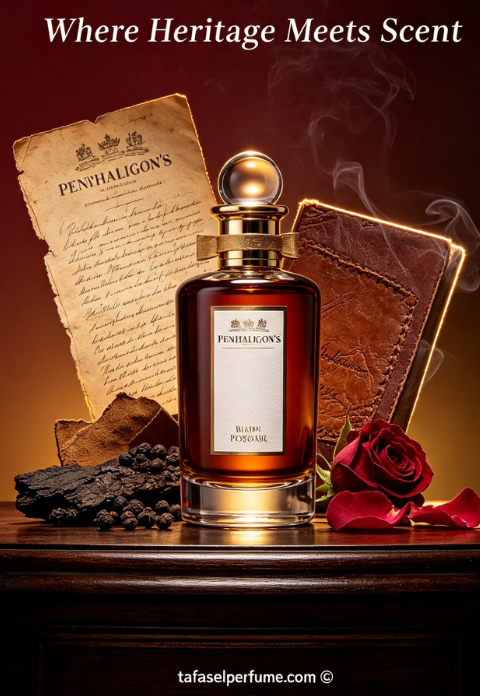
- Penhaligons · the alchemy of British fragrance: Penhaligons is not merely a perfume house; it is a living archive of British perfume craftsmanship. Since 1870, its bottles have held the whispers of London’s streets, the calm of English gardens, and the fire of rare spices. Each fragrance is a narrative, woven with heritage and a touch of rebellion.
Penhaligons (often stylised as Penhaligon’s) stands as one of the few remaining independent British perfumers with a royal warrant. Its story begins with William Penhaligon, a barber from Cornwall who settled in Jermyn Street, London, and created his first scent – Hammam Bouquet – inspired by the steam and opulence of the nearby Turkish baths. That single fragrance set the tone for a house that refuses to follow trends, instead crafting compositions that feel both timeless and startlingly modern.
From the green, bitter bite of Blenheim Bouquet to the cosy, rum-soaked warmth of Halfeti, Penhaligons captures the eccentricity of Britain: aristocratic, whimsical, and deeply romantic. Every bottle is a character, every spray an invitation to a different world. The brand’s enduring appeal lies in its ability to balance tradition with a mischievous wit – evident in the portrait-labelled bottles and the narrative-driven collections like “The Portraits”.
Today, Penhaligons remains a beacon for those who seek perfumes with soul. Whether you are drawn to citrusy colognes, floral chypres, or dark oriental blends, the house offers a spectrum that rewards exploration. This article delves into the facets that make Penhaligons an icon – from its historic roots to its modern-day cult following.
⋆ contents
- 1. The barber’s vision – birth of a perfume house
- 2. Hammam Bouquet – the scent that started it all
- 3. Blenheim Bouquet – a tribute to the palace
- 4. Halfeti – the dark rose of the East
- 5. Portraits collection – animals, aristocrats & alchemy
- 6. The art of British perfumery – materials & mastery
- 7. Penhaligons today – cult status & global reach
- 8. Why Penhaligons endures – the magic of storytelling
1. The barber’s vision – birth of a perfume house
Penhaligons was born from the hands of a barber, not a perfumer – and that is precisely its charm. William Penhaligon opened his barber shop at No. 12 Jermyn Street in 1870, a stone’s throw from St. James’s Palace. At the time, barbers were expected to offer pomades, shaving soaps, and colognes. But William had a deeper curiosity: he began blending his own fragrances, using the finest essential oils and absolutes he could source from across the British Empire.
His first creation, Hammam Bouquet, was a direct response to the exotic, heady atmosphere of the nearby Turkish Baths – a place where Victorian gentlemen gathered to socialise and refresh. William saw an opportunity to bottle that sensation: the steam, the florals, the spices, and the clean musk. That single fragrance would define the house’s philosophy: perfume as memory, as atmosphere, as emotion.
Within a decade, Penhaligons had earned a Royal Warrant from Queen Victoria herself, a distinction that remains with the brand today. The shop became a destination for the aristocracy, writers, and artists who appreciated its refusal to conform to the saccharine trends of the era. It was, and remains, a house built on character, not commerce.
For those exploring similar heritage fragrances, our Brands guide offers a wider perspective on historic perfume houses.
2. Hammam Bouquet – the scent that started it all
Hammam Bouquet is not just a perfume; it is a time capsule. Launched in 1872, it remains in production today with its original formula largely intact – a rarity in an industry driven by reformulation. Its composition is a lush, almost decadent blend of rose, violet, iris, and sandalwood, underpinned by a warm, slightly animalic base of musk and amber.
What makes Hammam Bouquet so distinctive is its unabashed romanticism. It does not whisper; it speaks in a low, honeyed tone. The opening is a burst of spicy carnation and lemon, quickly giving way to a floral heart that feels both powdery and alive. The dry-down is a smooth, balsamic embrace that lingers for hours. It is a scent that defies gender categories – equally compelling on a man’s skin as on a woman’s.
For a modern audience, Hammam Bouquet might seem anachronistic, but that is its power. It offers a glimpse into a world where perfume was an expression of individuality, not a mass-market commodity. Many collectors consider it the “ur-fragrance” of British perfumery, a benchmark against which other classic colognes are measured. It also paved the way for the house’s later successes, including the crisp Blenheim Bouquet.
3. Blenheim Bouquet – a tribute to the palace
If Hammam Bouquet is the heart of Penhaligons, Blenheim Bouquet is its backbone. Created in 1902 for the Duke of Marlborough, this fragrance was named after Blenheim Palace, the Duke’s grandiose estate in Oxfordshire. It is a composition of staggering clarity: citrus, pine, and black pepper, with a dry, woody finish that feels like a brisk walk through an English forest.
The genius of Blenheim Bouquet lies in its simplicity. There is no sweetness, no floral compromise – just the sharp, invigorating brightness of lemon and lime, softened by the resinous warmth of pine needles. It was famously a favourite of Sir Winston Churchill, who wore it as a daily signature. Its longevity on the skin is remarkable, given its light profile, a testament to the quality of the raw materials.
Today, Blenheim Bouquet remains one of Penhaligons’ best-selling men’s fragrances, though it has become a unisex classic. It is the scent of British reserve and quiet confidence – a perfect example of how Penhaligons transforms simple ingredients into profound statements.
Discover more crisp, refined scents in our Men’s Perfume collection, where classics like this are celebrated.
4. Halfeti – the dark rose of the East
In 2015, Penhaligons introduced Halfeti, a fragrance that would become a modern masterpiece and a commercial triumph. Named after a small Turkish village on the banks of the Euphrates, Halfeti is a dark, opulent rose – but not the powdery, innocent rose of Victorian gardens. This rose is spiced, leathery, and tinged with the bitterness of black cumin and saffron.
Halfeti opens with a blast of bergamot and grapefruit, but it quickly descends into a heart of Turkish rose, jasmine, and a hint of earthy patchouli. The base is where the magic happens: a blend of oud, leather, vanilla, and amber that creates a smoky, almost mysterious aura. It is simultaneously sensual and brooding, a fragrance that demands attention without shouting.
The success of Halfeti spawned an entire family of flankers – Halfeti Cedar, Halfeti Leather, and Halfeti Oud – each exploring a different facet of the original. For many, Halfeti represents the evolution of Penhaligons: a house that honours its past while embracing contemporary tastes. It is frequently cited as a gateway fragrance for those new to niche perfumery, and it has earned a loyal following across the globe.
5. Portraits collection – animals, aristocrats & alchemy
The Portraits collection, launched in 2016, is perhaps the most audacious and creative chapter in Penhaligons’ history. Each fragrance is personified by a character – often an animal or a fantastical aristocrat – complete with a name, a backstory, and a whimsical portrait label. The collection includes “The Tragedy of Lord George” (a brandy-soaked fougère), “The Coveted Duchess Rose” (a powdery, romantic rose), and “The Revenge of Lady Blanche” (a green, iris-led chypre), among others.
What makes the Portraits collection so compelling is its narrative depth. Each fragrance is not merely a scent; it is a character study. The bottle’s label shows a stylised illustration of the character, and the accompanying copy tells a short story that invites the wearer to step into that role. This approach has resonated strongly with a generation that values storytelling and personal expression.
From a perfumery perspective, the Portraits range is diverse and technically impressive. “Much Ado About The Duke” is a gin-and-tonic infused vetiver, while “The Uncompromising Sohan” leans into smoky, incense-laced orientalism. The collection has become a cultural phenomenon, often selling out within hours of re-stock. It proves that Penhaligons can be both playful and profound – a rare balance.
Explore artistic fragrance storytelling further with our Unisex Perfume edit, which includes many narrative-driven scents.
6. The art of British perfumery – materials & mastery
At its core, Penhaligons is defined by its commitment to quality and craftsmanship. The house uses a high proportion of natural ingredients, sourced from Grasse, India, Morocco, and beyond. Their in-house perfumers – including the renowned Olivier Cresp and Alberto Morillas – are given creative freedom to experiment, resulting in compositions that are both technically flawless and emotionally resonant.
Unlike many mainstream brands, Penhaligons does not chase “beast-mode” performance or viral trends. Instead, they focus on elegance and nuance. A Penhaligons fragrance unfolds slowly, revealing new layers over hours. The materials are treated with respect: the rose is distilled to retain its freshness, the sandalwood is aged, the citrus is cold-pressed to preserve its vibrancy. This attention to detail is what sets the house apart.
Furthermore, Penhaligons has a deep reverence for British botanical heritage. Many of their scents feature ingredients like lavender, mint, rosemary, and oakmoss – native plants that evoke the English countryside. This connection to place is a defining characteristic, making their perfumes feel both grounded and aspirational. It is a reminder that luxury is not about excess, but about excellence.
7. Penhaligons today – cult status & global reach
From its single shop on Jermyn Street, Penhaligons has grown into a global brand with boutiques in London, New York, Paris, and Tokyo. Yet it has managed to retain its boutique, artisanal feel. The stores are designed to feel like Victorian apothecaries, with mahogany counters, glass cabinets, and the signature blue-and-white striped wallpaper that has become a visual trademark.
In the age of social media, Penhaligons has cultivated a devoted online community. Fans share their collections, trade samples, and debate the merits of vintage vs. modern formulations. The brand’s limited editions and seasonal releases, such as the “Savoy Steam” inspired by the Savoy Hotel, create a sense of anticipation and exclusivity. It is a brand that rewards loyalty, and its customers are fiercely loyal in return.
Penhaligons also collaborates with other British institutions, including the Royal Opera House and Liberty London, further cementing its status as a cultural icon. Despite its growth, the brand remains independently owned, allowing it to make decisions based on artistry rather than quarterly earnings. This independence is rare and precious in today’s consolidated beauty industry.
For more curated fragrance insights, visit our Ranking page, where we highlight cult favourites and hidden gems.
8. Why Penhaligons endures – the magic of storytelling
What ultimately sets Penhaligons apart is its understanding that perfume is storytelling. Each fragrance is an invitation to imagine – a garden in the rain, a library of leather-bound books, a midnight ball in a crumbling castle. The house doesn’t just sell scent; it sells a feeling, a memory, a fantasy.
This narrative approach is evident in everything from the product names to the packaging. The bottles are designed to look like antique apothecary flasks, complete with a ribbon and a medal. The copy is poetic, witty, and deeply evocative. Even the branding feels like an old friend – familiar, yet endlessly surprising. It is no wonder that Penhaligons has inspired countless other niche brands to prioritise storytelling in their own work.
In an era of fast fashion and disposable culture, Penhaligons stands as a bastion of permanence. Its fragrances are not meant to be used up and forgotten; they are meant to be collected, cherished, and passed down. They are heirlooms in liquid form. And that, perhaps, is the greatest legacy of William Penhaligon: creating not just perfumes, but memories that transcend time.
— For those who wish to delve deeper into the world of exquisite perfumery, explore our Beauty and Tafaseel guides for more inspiration.
Penhaligons · where each bottle holds a story, and every story is worth wearing.


