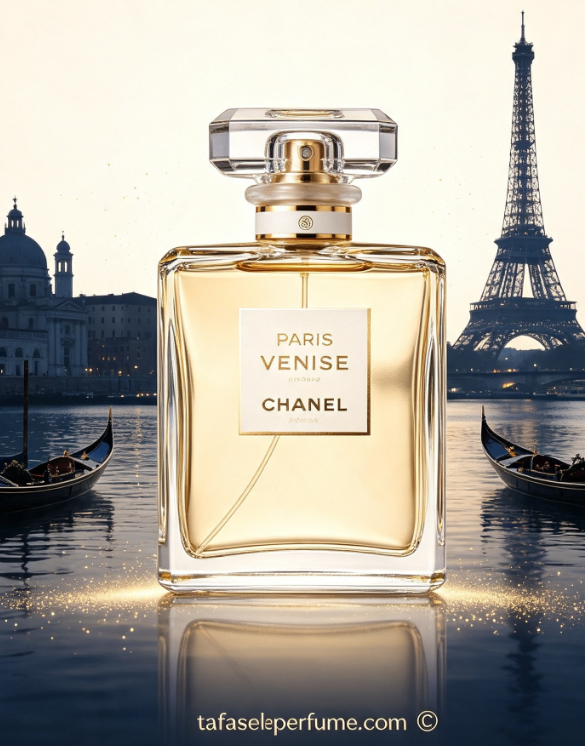
- Paris · Venise · Chanel: The Velvet Architecture of Eternal Elegance & Sillage: Paris meets Venise through the lens of Chanel — a floating dialogue between the City of Light and the Lagoon of Dreams, wrapped in the most iconic couture of fragrance.
Paris is the epicentre of chic, the atelier of avant-garde; Venise is the mirror of water, the theatre of masquerade and mystery. Chanel, the house that rewrote the rules of modern luxury, has always drawn from both — the sharp tailoring of Parisian streets and the liquid gold of Venetian light. This article unravels the triptych: how the French capital’s architectural geometry, the Italian city’s baroque soul, and Chanel’s timeless codes converge into a fragrance philosophy that is both intellectual and sensual. From the Riviera to the Grand Canal, we explore the olfactory bridges, the silent echoes, and the velvet threads that bind these three names into one enduring story of allure.
✧ THE VELVET ARCHITECTURE ✧
01. The Parisian Atelier: Chanel’s Geometric Spirit
02. Venise — The Floating Mirror of Chanel’s Imagination
03. Coco & the Canal: The Venetian Rendez-Vous
04. The Golden Ratio of Light: Parisian Radiance & Venetian Glow
05. Velvet, Tweed & Mosaico: Texture as Signature
06. Sillage of a City: How Paris Breathes Through Chanel
07. The Masquerade of Venise: Mystery in Every Drop
08. Chanel N°5 and the Venetian Twilight
01. The Parisian Atelier: Chanel’s Geometric Spirit
Paris is not merely a city; it is a method. The boulevards cut like clean strokes, the Haussmann façades repeat in rhythmic cadence. Chanel absorbed this discipline — the sharp shoulder, the straight skirt, the sober palette. In fragrance, this translates to aldehydic crispness, the architectural line of iris and neroli. The atelier at 31 Rue Cambon remains the spiritual compass; every Chanel perfume begins with that Parisian clarity: a structure that holds the light without excess. Dior J'adore Perfume Price · The Golden Ratio of Luxury & Value resonates with similar architectural precision, yet Chanel’s geometry is more severe — a straight line that refuses to bend.
The Parisian influence is not decorative; it is foundational. The Chanel woman walks with a straight spine, and her perfume must echo that posture. Venise enters later as the ornament, but the skeleton is always Parisian. This is why Chanel fragrances feel both modern and eternal — they are built like palaces, not gardens. The aldehydes are the glass roofs, the white flowers the marble floors.
02. Venise — The Floating Mirror of Chanel’s Imagination
Venise is water made architecture. It is the city where reflections double, where Byzantine mosaics shimmer beneath the laguna’s breath. For Chanel, Venise represented the exotic, the baroque, the counterpoint to Parisian restraint. The Venetian influence appears in the opulence of amber, the warmth of vanilla, the dark allure of patchouli. While Paris provides the cut, Venise provides the velvet. Borghese Perfume · The Velvet Architecture of Italian Radiance & Timeless Seduction echoes that Italian glow, but Chanel’s Venetian side is always disciplined, never excessive.
It is said that Coco Chanel fell in love with Venise during her travels with Boy Capel. The city’s masks, its gondolas, its golden light — all of it seeped into her visual language. In perfume, this translates to a certain melancholy sweetness, a nostalgia for something that floats. The Venetian chapter of Chanel is not about carnival; it is about the silence between the canals.
03. Coco & the Canal: The Venetian Rendez-Vous
The relationship between Coco Chanel and Venise is not a footnote; it is a creative axis. After the death of Capel, she sought refuge in the floating city, where she discovered the Byzantine crosses that would become her emblem. Venise gave her the vocabulary of ornament, which she translated into jewellery, into lace, and into the warmth of her later perfumes. The Venetian palette — gold, burgundy, teal — found its way into the Chanel universe, softening the starkness of the Parisian atelier. Pleasure in Full Bloom: The Art of Estée Lauder Eau de Parfum shares that floral abundance, but Chanel’s Venetian bloom is always framed by black and white.
In fragrance, this rendez-vous is most visible in the oriental side of Chanel — the Coromandel, the Bois des Îles. They are Paris–Venise in a bottle: the structure of sandalwood and the shimmer of ylang-ylang. The rendez-vous is not a collision but a conversation; Venise softens Paris, and Paris disciplines Venise.
04. The Golden Ratio of Light: Parisian Radiance & Venetian Glow
Light is the ultimate material. Paris offers a northern, diffused luminosity — the light of impressionist paintings, of grey skies and silver river. Venise offers a southern, reflected light — the gold of Titian, the ochre of Giorgione. Chanel balances these two luminosities. In the Les Exclusifs collection, one can trace the shift: La Pausa (Parisian, sober, iris) versus Coromandel (Venetian, exuberant, patchouli). The golden ratio of the house is exactly this equilibrium: not too bright, not too dark. Valentino Yellow Dream for Men · A Golden Reverie in a Bottle captures that golden dream, but Chanel’s gold is always tempered by the silver of Paris.
This duality is what makes Chanel timeless. The Parisian radiance is intellectual; the Venetian glow is sensual. Together, they create a olfactory architecture that is both rigorous and poetic — a building of glass and velvet.
05. Velvet, Tweed & Mosaico: Texture as Signature
Texture is the forgotten note in perfume. Chanel understands that fragrance is not just about scent but about tactile memory. Tweed is the Parisian texture — crisp, structured, slightly rough. Velvet is the Venetian texture — soft, deep, absorbent. Mosaico (the Byzantine art) is the visual equivalent of Chanel’s layering: small pieces of amber, musk, and flowers forming a cohesive image. In fragrances like Cuir de Russie, the leather is tweed; in N°22, the white flowers are velvet. Jean Paul Gaultier Le Male Eau de Parfum: The Modern Reinvention of an Iconic Masculine Scent plays with texture too, but Chanel’s approach is more architectural — every note has a surface and a depth.
The velvet of Chanel is never plush; it is crushed velvet — worn, elegant, with a slight metallic sheen from the Parisian side. The mosaico is the composition itself: fragmented, yet whole.
06. Sillage of a City: How Paris Breathes Through Chanel
Sillage is the trail a perfume leaves behind. Paris breathes through Chanel in the form of citrus top notes — the sharpness of bergamot, the brightness of lemon — that evoke the clean air of the Seine. The heart is always floral, but with a powdery dryness that recalls the tuileries in autumn. The base is vetiver or sandalwood, grounding the fragrance like the stone of the Louvre. Amazon Avon Perfume · The Velvet Architecture of Iconic Scent & Modern Alchemy might evoke a different city, but Chanel’s Parisian sillage is unmistakable: it is the scent of a woman walking fast, her coat open, her hair in the wind.
The Parisian breath is also the breath of Gabrielle herself — rebellious, modernist, cutting through the Belle Époque with a pair of scissors. That breath is still alive in every spray of N°5.
07. The Masquerade of Venise: Mystery in Every Drop
Venise is the city of masks, and Chanel has always been fascinated by the hidden. The Venetian masquerade is not about disguise but about revelation — wearing a mask allows one to speak the truth. In perfume, this translates to the paradox of Chanel’s orientals: they are warm, yet distant; sweet, yet dry. The mystery is in the indolic heart of jasmine or the fruity whisper of peach that appears and disappears. Prada La Femme Water Splash · The Ethereal Architecture of Luminous Grace has its own mystery, but Chanel’s Venetian mask is always a domino — black, elegant, with a single tear of gold.
This masquerade is also the game of gender — Chanel refused to perfume only for women. The Venetian androgyny, the casanova spirit, runs through the masculine and feminine lines alike. Venise gives Chanel the permission to be ambiguous.
08. Chanel N°5 and the Venetian Twilight
N°5 is the most Parisian of perfumes, yet it holds a Venetian secret. The aldehyde explosion is the sunset over the Grand Canal — abstract, golden, slightly metallic. The ylang-ylang and neroli are the palazzi reflecting in the water. Ernest Beaux, the perfumer, created a constructivist masterpiece, but the soul of N°5 is a Venetian twilight: the moment when the sky turns peach and lavender, and the city becomes a dream. How Much Is Burberry Goddess? Price, Value & Where to Buy might capture a different goddess, but N°5 is the goddess of twilight — both Parisian and Venetian.
The twilight is also the liminal space that Chanel inhabits — between day and night, between structure and flow. N°5 is the most famous example of this Paris–Venise synthesis: a perfume that smells like nothing else, yet contains everything.
09. Architectural Fragrance: Palaces, Palazzos & Perfume
Architecture is the common language. Paris offers the palace — the symmetrical, the monumental, the classical. Venise offers the palazzo — the asymmetrical, the decorated, the Byzantine. Chanel builds its fragrances like architects: each note is a column, each chord is a façade. The top notes are the entrance; the heart is the salon; the base is the garden. Valentino Men’s: The Velvet Architecture of Masculine Elegance & Sillage also plays with architecture, but Chanel’s building is always a monument to modernity.
The palace and the palazzo coexist in the Chanel universe — the rigidity of the former and the fluidity of the latter. This is why Chanel perfumes are never merely pretty; they are inhabitable.
10. Eternal Return: Paris–Venise–Chanel as a Modern Trinity
The trinity of Paris, Venise, and Chanel is not a historical accident; it is a myth that repeats. Every generation rediscovers the tension between the northern and southern sensibilities, between the structural and the ornamental. Chanel is the mediator, the alchemist who turns two cities into one olfactory language. The eternal return is the seasonal rhythm of fashion and perfume — spring in Paris, autumn in Venise, and always Chanel. 2.12 Carolina Herrera · The Velvet Architecture of American Elegance & the Code of Refined Femininity may speak of New York, but the trinity we explore is uniquely European, uniquely Chanel.
In the end, Paris–Venise–Chanel is a state of mind: a way of moving through the world with grace, intelligence, and a touch of velvet. It is the sillage of a life well-lived.
✧ FAQ — Paris · Venise · Chanel ✧
Venice represents the ornamental, the baroque, and the exotic — a counterbalance to Parisian minimalism. Chanel absorbed Venetian light, colour, and texture, which softened her rigorous aesthetic and added a layer of mystery.
Paris appears through structure — crisp aldehydes, clean iris, sharp citrus. It’s the architectural skeleton of every Chanel fragrance, providing clarity, modernity, and a certain intellectual coolness.
While no perfume is named ‘Venise’, the Venetian spirit is strong in Les Exclusifs like Coromandel (oriental warmth) and Bois des Îles (velvety sandalwood). The 1920s travel diaries of Coco Chanel also reveal Venetian inspirations.
It’s a metaphor for the fusion of Parisian geometry (architecture) and Venetian softness (velvet). In fragrance, it’s the interplay of sharp notes and warm, enveloping bases — the building and the draping.
Yes — Chanel N°5 is the quintessence. Its aldehydic sparkle is Paris, its floral heart is universal, and its powdery-woody drydown carries a Venetian twilight warmth. Other candidates: Cuir de Russie, 1932.
Chanel’s in-house perfumer and artistic director work like architects — they start with a Parisian sketch (clear, minimal) and then add Venetian embellishments (rich, textured) through natural materials and dosage.
Absolutely. The Paris–Venise–Chanel triangle speaks to the universal desire for both structure and sensuality, for the intellectual and the emotional — a timeless appeal that resonates across generations.
Explore more: Unisex Perfume · Women’s Perfume · Men’s Perfume · Perfume Gift Sets
• The Velvet Architecture of Paris · Venise · Chanel •


