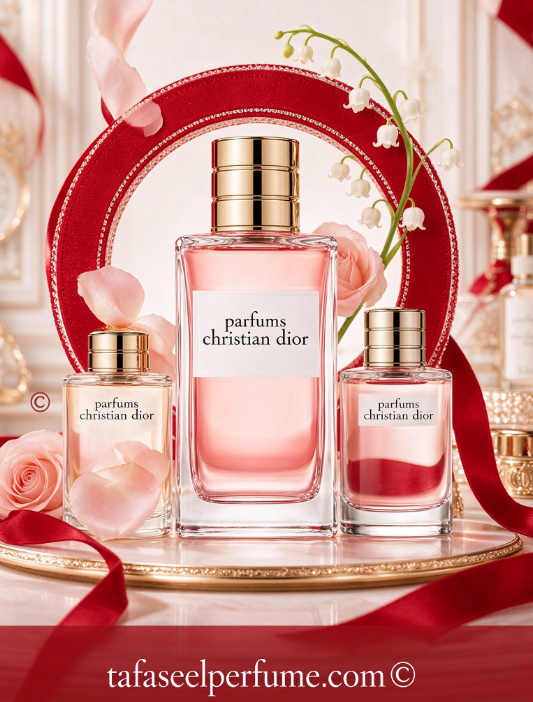
- Parfums Christian Dior: The Couturier’s Olfactory Empire, From Miss Dior to the Private Collection: A short introduction. Parfums Christian Dior is not a fragrance house that was added to a fashion brand as an afterthought. It began in 1947 with a single sentence—“Make me a perfume that smells like love”—and grew into one of the most consequential perfume portfolios in the world.
A short introduction. Parfums Christian Dior is not a fragrance house that was added to a fashion brand as an afterthought. It began in 1947 with a single sentence—“Make me a perfume that smells like love”—and grew into one of the most consequential perfume portfolios in the world. From the green chypre shock of Miss Dior to the ambery provocation of Poison, from the solar florals of J’adore to the mineral freshness of Sauvage, every major Dior perfume carries the fingerprint of haute couture: structure, contrast, and a refusal to be quiet.
A larger introduction. Christian Dior was explicit about his ambition: “I feel myself to be as much a perfumer as a couturier”. That sentence explains almost everything about Parfums Christian Dior. When he presented the New Look on 12 February 1947, he did not wait for the clothes to settle before releasing a scent. Miss Dior was composed by Paul Vacher in parallel with the first collection, and the salons of 30 Avenue Montaigne were sprayed so heavily with it that the fragrance became inseparable from the silhouette. Since then, Dior perfumes have been built like garments—not as flat accords, but as architectures of top, heart, and base notes, each one designed to finish a look the way a hat or a glove once did. The house has passed through the hands of remarkable perfumers: Paul Vacher, Edmond Roudnitska, Edouard Fléchier, François Demachy, and now Francis Kurkdjian. It has produced feminine icons, masculine blockbusters, and a private collection that treats fragrance as bespoke tailoring. If you are exploring the wardrobe from the outside, the categories are clear: Women’s Perfume and Men’s Perfume hold the pillars, while Unisex Perfume captures the more fluid experiments. But understanding Parfums Christian Dior requires going closer to the individual creations, because each one was designed to solve a different problem of style, memory, or desire.
Inside this guide — 1. Miss Dior: The Scent of Love and the New Look · 2. Poison: The Fragrance That Broke the Rules · 3. J’adore: The Solar Floral Monument · 4. Sauvage: The Masculine Landscape · 5. La Collection Privée: Haute Couture in a Bottle · 6. The Perfumers Behind the Empire · 7. Bottles, Graphics, and the Dior Silhouette · 8. The Wider Dior Fragrance Family · 9. Legacy and the Contemporary Chapter
1. Miss Dior: The Scent of Love and the New Look
Miss Dior is where Parfums Christian Dior begins, and it remains the house’s emotional centre. The brief Christian Dior gave Paul Vacher was not technical: “Make me a perfume that smells like love”. The result, released in 1947 alongside the New Look, was a green chypre—a composition of citrus, flowers, and patchouli that felt both refined and unrestrained. The name was not invented by a marketing department. It was the nickname of Christian Dior’s younger sister, Catherine Dior, a member of the French Resistance and a flower grower of unusual strength. That biographical detail matters because Miss Dior is not a generic “feminine floral.” It is a portrait: elegant on the surface, resistant underneath.
The bottle carried the couture logic further. The original Miss Dior flacon was a double-handled amphora, its curves echoing the “En 8” silhouette of the New Look. In 1950 the design shifted toward a simplified, geometric glass with a houndstooth engraving—a direct quotation from the tailoring codes of the house. Over the decades Miss Dior has been reinterpreted many times, from the 1967 ready-to-wear tribute under Marc Bohan to the contemporary parfum versions composed under Francis Kurkdjian. What has never changed is the idea that a Dior perfume should feel like a garment: structured enough to hold a silhouette, floral enough to remember the body inside it. For anyone building a first serious fragrance wardrobe, Miss Dior is less a “safe choice” than a foundational one. It belongs in the same conversation as the Perfume Gift Sets category, because it is the scent people choose when they want to give someone an entrance into the Dior universe rather than a single trend.
2. Poison: The Fragrance That Broke the Rules
If Miss Dior was the house’s couture debut, Poison was its deliberate scandal. Launched in 1985 under the direction of Maurice Roger, then head of Dior perfumes, Poison was conceived as a dense, opulent, unapologetically excessive oriental floral. The idea was inspired by Paul Valéry’s phrase “perfume is the poison of the soul,” and the perfumer chosen to execute it was Edouard Fléchier. In an era moving toward lighter, cleaner fragrances, Poison went the other way: plum, coriander, tuberose, honey, cinnamon, incense, amber, vanilla, and sandalwood arrived in a cloud that announced itself before the wearer entered the room. It won the Catherine de Médicis Prize for best women’s fragrance in 1986 and became a pop-cultural reference point for a generation that associated perfume with provocation rather than discretion.
Poison also established the Dior habit of building families rather than single products. The original was followed by Tendre Poison in 1994, Hypnotic Poison in 1998, Pure Poison in 2004, and Midnight Poison in 2007, each one a different colour and a different emotional register, yet all sharing a recognisable curve of bottle and a refusal of timidity. The original Poison remains the reference: a fragrance that smells like velvet, dark fruit, and a decision already made. It is not a perfume for every day of the week, and that is precisely the point. Dior’s couture history is full of dramatic gestures—the Bar jacket, the cinched waist, the voluminous skirt—and Poison translates that gesture into scent. For collectors who want to understand how a perfume house can shape a cultural moment, Poison is as important as any dress in the archive.
3. J’adore: The Solar Floral Monument
J’adore is the perfume that turned Parfums Christian Dior into a global floral authority. Composed as a celebration of women and released to become one of the most widely recognised feminine fragrances in the world, J’adore is built around a lush bouquet: ylang-ylang from Madagascar and the Comoros, Damascus rose from Turkey, jasmine grandiflorum from Grasse, and jasmine sambac from India. The effect is not a single flower but an imagined flower—a solar, golden, almost liquid floral accord that feels both abundant and precise. Under François Demachy, the composition was refined and deepened; under Francis Kurkdjian, it has been extended into new concentrations such as L’Or de J’adore, which heightens the orange blossom, jasmine, and centifolia rose absolutes into a richer, more extract-like expression.
The bottle is part of the argument. The J’adore flacon, with its elongated neck and golden collar, is designed to read as a piece of jewellery as much as a container. It sits on a dressing table the way a couture necklace sits on skin: visible, deliberate, and slightly theatrical. This is the Dior approach to feminine perfumery at its most legible—perfume as adornment, but also perfume as a declaration of presence. If you are shopping across categories, J’adore is the kind of scent that works just as well as a signature as it does inside a curated Mini Size & Gift Sets selection, because its identity is strong enough to survive a smaller format. It is also a useful benchmark for anyone exploring Brands comparatively: few designer florals have J’adore’s combination of radiance, persistence, and couture finish.
4. Sauvage: The Masculine Landscape
Sauvage changed the economics of Dior perfume, and it did so without abandoning the house’s aesthetic discipline. Created by François Demachy and launched in 2015, Sauvage was inspired by the desert at dawn—a landscape of heat, cold, stone, and open sky—and built around Calabrian bergamot, ambroxan, and a dry, woody base. The result was a masculine fragrance that felt clean but not sterile, fresh but not light. It became a commercial phenomenon and, more importantly, a reference point: a modern fougère that could be worn with a T-shirt or a tailored coat, and that introduced a new generation to the idea that “fresh” could still have depth.
The Sauvage line now includes multiple concentrations, but the original architecture remains the key. Bergamot provides the opening voltage; ambroxan supplies the mineral, skin-like warmth; and the woody-herbal heart keeps the composition from becoming sweet or predictable. Demachy’s stated intention was to make a fragrance that was both “original” and “noble,” and the tension between those two words is what makes Sauvage more interesting than its many imitators. In a men’s wardrobe, it functions as a default that does not feel like a compromise—a rare thing in contemporary masculine perfumery. For readers comparing Men’s Perfume options, Sauvage is the obvious starting point, but it is also a useful measure of how much space a designer can still claim between accessibility and craft.
5. La Collection Privée: Haute Couture in a Bottle
La Collection Privée Christian Dior is the house’s olfactory atelier: a line of fragrances made with the logic of bespoke tailoring rather than mass-market perfumery. The collection brings together rare materials, layered structures, and a deliberately unisex approach, allowing the same composition to read differently depending on skin and intention. It is where Dior explores the more rarefied corners of its identity: the gardens at La Colle Noire, the lily of the valley and rose and jasmine that Christian Dior loved, the amber and leather and incense accords that feel closer to the atelier than to the department-store counter.
The recent chapter of La Collection Privée has been shaped by Francis Kurkdjian, who took over fragrance creation at Dior after François Demachy. Kurkdjian’s first major statement in the private line was a trio of extraits—lily of the valley, rose, and jasmine—presented with embroidered flacons that translate haute couture techniques into glass and thread. This is not marketing decoration; it is the logical endpoint of Christian Dior’s original idea that a perfume should be finished with the same precision as a dress. The private collection is also the best place to see how Dior handles materials: the rose is not a generic rose, the jasmine is not a background note, and the lily of the valley is treated as a technical challenge rather than a pleasant default. For anyone who has moved past the pillars and wants to explore the outer edges of the house, La Collection Privée is the destination. It rewards slow wearing and comparison, much like the Perfume Gift Sets that allow several expressions to be tested side by side.
6. The Perfumers Behind the Empire
Parfums Christian Dior is often discussed as a monolith, but it has been shaped by a sequence of distinct perfumers, each one leaving a different signature. Paul Vacher composed Miss Dior in 1947 under the most intimate brief in perfume history—make it smell like love. Edmond Roudnitska, one of the most important perfumers of the twentieth century, worked with Dior on fragrances such as Diorissimo and Diorama, bringing a hyper-refined natural style that still defines the house’s floral credibility. Edouard Fléchier gave Dior Poison, a composition that remains a benchmark for oriental florals because it refused to dilute its density. François Demachy, olfactory creation director from 2006 to 2021, modernised the masculine line with Sauvage and deepened J’adore, while also expanding La Collection Privée into a serious haute-parfumerie proposition. Francis Kurkdjian, who succeeded Demachy, has brought a technically precise, material-focused sensibility to both the private collection and the contemporary reinterpretations of Miss Dior and J’adore.
This lineage matters because it explains why Dior perfumes do not all smell like the same brand. A house can become a formula—one perfumer, one style, endless variations. Dior has instead operated like a couture atelier with changing artistic directors: the codes remain, but the hand changes. The result is a portfolio with genuine internal contrast. Miss Dior, Poison, J’adore, Sauvage, and La Collection Privée do not compete for the same territory; they occupy different rooms in the same house. Understanding that structure is more useful than memorising a list of “top ten” fragrances, because it allows you to navigate by intention rather than by hype. If you want a broader view of how the house is ranked and discussed by collectors, the Ranking section is a useful complement to the primary sources.
7. Bottles, Graphics, and the Dior Silhouette
Dior has always treated the perfume bottle as a piece of fashion, not a neutral vessel. The original Miss Dior amphora was chosen by Christian Dior himself because its curves echoed the “En 8” line of the New Look. The 1950 houndstooth bottle translated a fabric pattern into glass. The 1952 Bobby flacon, shaped like Dior’s beloved dog, proved that whimsy could coexist with luxury. Later bottles—the J’adore drop, the Poison orb, the Sauvage magnetic cap—each carry a distinct silhouette that can be recognised across a room. This is not incidental. In a market where countless fragrances smell pleasant but look interchangeable, Dior has used packaging as a form of authorship. The bottle is the first sentence of the fragrance, and Dior has almost always known how to write an opening line.
The graphics reinforce the same logic. The Miss Dior bow, the Poison serpent-and-apple imagery, the J’adore gold necklace, the Sauvage desert horizon—each visual code is specific enough to survive translation across campaigns and decades. For collectors, this matters practically as well as aesthetically: a well-preserved early Miss Dior bottle or a complete Poison family is as much an object of design history as a fragrance. When browsing Brands, it becomes clear that few houses have maintained such a consistent dialogue between what a perfume smells like and what it looks like. Dior’s bottles are not packaging; they are miniature couture objects that happen to contain scent.
8. The Wider Dior Fragrance Family
Beyond the pillars, Parfums Christian Dior has built a broad family of fragrances that fill different emotional and practical roles. Dior Addict brings a younger, more playful energy—fruity, gourmand-adjacent, and deliberately fashion-forward. Dune and Dolce Vita, launched in the 1990s, explored expansive, atmospheric terrains: Dune with its salty, ambered openness, Dolce Vita with its warm, spiced sweetness. Joy by Dior returns to the house’s floral core with a clean, radiant brightness, while Escale à Portofino offers a Mediterranean citrus escape that feels like a holiday in a bottle. Dior Homme, in its various iterations, has given the masculine wardrobe a different kind of elegance—iris, leather, and a tailored austerity that sits at the opposite pole from Sauvage’s open-air freshness.
This breadth is not dilution; it is the couture model applied to scent. A couture house does not offer one dress. It offers a collection—daywear, eveningwear, accessories, variations for different clients and different moments. Dior’s fragrance family follows the same principle. Miss Dior is the tailored floral; Poison is the dramatic statement; J’adore is the golden signature; Sauvage is the masculine essential; La Collection Privée is the bespoke atelier; Addict, Dune, Dolce Vita, Joy, and the rest are the seasonal and stylistic variations that allow the house to dress a wider range of lives. For anyone assembling a wardrobe rather than buying a single bottle, the Mini Size & Gift Sets route is often the most intelligent way to explore this breadth without committing to full bottles of every expression.
9. Legacy and the Contemporary Chapter
The legacy of Parfums Christian Dior is not a single fragrance; it is a method. The method begins with a brief that is emotional rather than demographic—“smells like love,” “the desert at dawn,” “a flower that does not exist”—and then builds a structure around it with the precision of a couture atelier. It treats the bottle as a garment, the campaign as an editorial, and the perfumer as an artist with a distinct hand rather than a technician executing a brief. It allows a house to hold Miss Dior and Poison, J’adore and Sauvage, without contradiction, because each one occupies a different room in the same architectural idea. Under Francis Kurkdjian, that method is being applied to a new generation of extraits and reinterpretations, while the original pillars continue to evolve.
For the wearer, the practical conclusion is simple. Parfums Christian Dior is best approached not as a list of “best sellers” but as a wardrobe with distinct registers. Start with the register that matches your daily life, then explore outward. If you need a floral signature, Miss Dior and J’adore offer two different answers—one green and resisting, one solar and expansive. If you want a masculine essential, Sauvage is the open-air reference. If you want provocation, Poison remains unsurpassed. If you want the atelier experience, La Collection Privée is the destination. And if you are building a collection rather than choosing a single scent, the Perfume Gift Sets and discovery formats make the house’s internal contrasts legible in a way that a single bottle never can. The through-line is not a note or a bottle shape. It is the conviction that fragrance is fashion—structured, intentional, and worn on the skin as deliberately as a silhouette.


