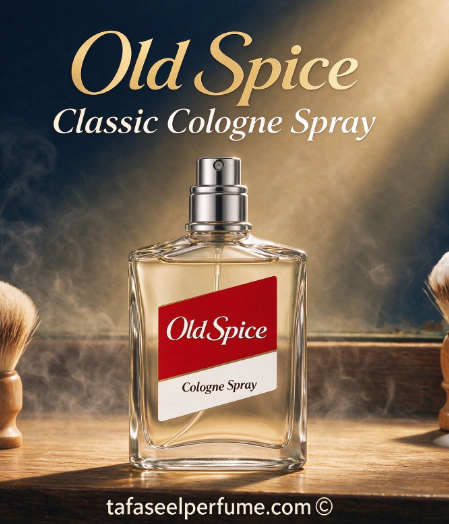
- Old Spice Classic Cologne Spray: The Complete Guide to the 1937 Original That Still Smells Like America: Quick Intro: Old Spice Classic Cologne Spray is not a body spray. It is not a deodorant. It is the direct descendant of a 1937 spicy-oriental formula that became the most recognizable men’s fragrance in America — a warm, powdery blend of clove, cinnamon, vanilla, and citrus that smells like a barbershop, a grandfather’s bathroom cabinet, and a version of masculinity that never needed to raise its voice.
Quick Intro: Old Spice Classic Cologne Spray is not a body spray. It is not a deodorant. It is the direct descendant of a 1937 spicy-oriental formula that became the most recognizable men’s fragrance in America — a warm, powdery blend of clove, cinnamon, vanilla, and citrus that smells like a barbershop, a grandfather’s bathroom cabinet, and a version of masculinity that never needed to raise its voice. If you have only met Old Spice through the blue-and-red body sprays of the 2000s, you have not met the Classic cologne.
Big Intro: The story begins with a women’s perfume. In 1937, William Lightfoot Schultz’s Shulton Company launched Early American Old Spice, a potpourri-inspired scent packaged in colonial-style trinket boxes. The men’s version followed in 1938 — tweaked, diluted, and poured into the now-iconic white buoy-shaped bottle — and it was an immediate commercial success. By 1939, Old Spice sales had reached $3.1 million, roughly $60 million in today’s money, largely because the marketing never called it a fragrance; it sold a clean, brisk, post-shave feeling at a time when perfume was still coded as feminine. Procter & Gamble acquired the brand in 1990 and renamed the original scent “Classic Scent” in 2008, but the juice inside the Classic Cologne Spray remains a properly constructed spicy oriental — not a cheap nostalgia act. It opens on orange, lemon, nutmeg, clove, star anise, clary sage, and aldehydes; the heart runs through cinnamon, carnation, geranium, jasmine, heliotrope, and pimento berry; the base settles into vanilla, cedar, frankincense, styrax, coumarin, oakmoss, and amber. What you actually smell is simpler and more evocative: a warm, powdery cloud of clove and cinnamon over sweet vanilla-amber, with a citrus brightness that burns off in minutes and leaves behind the archetype of “barbershop”. Allure once called it “the most classically manly scent on planet earth,” and that remains as good a one-line review as any. The catch — and it is a real one — is performance. This is an eau de cologne in the old tradition: low concentration, generous spray format, two to four hours of clear wear on most skin, then a faint powdery trace. It is not built to survive a fourteen-hour workday, and judging it against an eau de parfum misses the point. It is built to be re-sprayed, to be smelled up close, and to cost so little that you never hesitate to use it. For anyone building a men’s fragrance wardrobe that values character over projection, it belongs in the conversation. For anyone shopping for a perfume gift set that carries actual history, it is almost impossible to beat on sentiment-per-dollar. And for anyone who has only known the modern deodorant and antiperspirant aisle version, the Classic Cologne Spray is a reminder that this brand was once a fragrance house first and a body-spray machine second.
1. What Old Spice Classic Cologne Spray Actually Smells Like — A warm, powdery spice: clove and cinnamon over vanilla-amber, with a fleeting citrus top.
2. The 1937 Origin Story, Briefly Told — It started as a women’s perfume. The men’s version arrived a year later.
3. The Full Note Pyramid, From Top to Base — A genuinely dense composition hiding behind a drugstore price tag.
4. Cologne vs. Aftershave vs. Body Spray — They share a name. They are not the same product.
5. Performance: What to Expect and How to Work With It — Eau de cologne concentration means short wear and frequent reapplication.
6. How to Wear It Without Smelling Like a Caricature — Placement, layering, and the one-spray rule.
7. “Classic” vs. “Original”: The Reformulation Conversation — The formula has changed. That does not make the current spray unwearable.
8. Who It Is For — and Who Should Skip It — A spicy-oriental for people who like barbershop warmth, not fresh blue aquatics.
9. Old Spice Classic in the Context of Men’s Fragrance History — Why it outlasted almost every competitor from the 1930s.
10. Value, Bottle Formats, and What You Actually Pay For — The fragrance is cheap. The history is not.
11. How It Fits Into a Modern Layering Routine — Pairing it with unscented products and complementary textures.
12. Common Complaints and Whether They Are Fair — Short longevity, reformulation nostalgia, and the body-spray confusion.
What Old Spice Classic Cologne Spray Actually Smells Like
Short description: The opening is brighter than memory suggests; the dry-down is the part everyone recognizes.
The first spray is almost misleading. Citrus and aldehydes push forward — orange, lemon, a brief sparkle — and for a few minutes the cologne smells lighter and more “fresher” than the reputation implies. That brightness does not last. Within ten to fifteen minutes, the spice rack arrives: clove and cinnamon, with a powdery carnation-clove texture that is the olfactory signature of classic barbershop products. The vanilla and amber in the base round off the edges without turning the composition sweet. What remains on skin is a warm, creamy-spicy smell that reads as clean rather than gourmand — closer to a shaving soap than a dessert. Allure’s shorthand — “cool musk, bright citrus, and warm vanilla” — captures the three pillars, but the clove-cinnamon axis is what separates Old Spice from a generic vanilla-spice drugstore scent. It does not morph dramatically over its short life; after the first minute or so, the scent is “pretty linear,” which is a strength in a fragrance this inexpensive because it means the opening is not a bait-and-switch. If you have smelled the modern body sprays and found them sharp or chemical, the cologne will feel rounder and more “perfume-like” — because it is.
The 1937 Origin Story, Briefly Told
Short description: A women’s potpourri perfume became the most recognizable men’s scent in America within two years.
William Lightfoot Schultz did not set out to create a masculine icon. He set out to capitalize on a colonial-revival decorating trend, launching Early American Old Spice as a women’s fragrance in 1937, packaged in trinket boxes inspired by American colonial handicrafts. The men’s version arrived in 1938, reformulated and diluted, in the white buoy bottle that still signals the brand today. The timing was perfect. World War I had normalized at-home shaving for a generation of American men, and the rise of corporate culture created a market for a product that promised a clean, brisk, employable face. Shulton never marketed the scent as perfume; it marketed the post-shave feeling. “The ads were all about being brisk and manly,” P&G historian Lisa Mulvany told Town & Country. “They said, ‘This will make your day’.” By 1939, sales had hit $3.1 million, and Old Spice had become shorthand for an entire category of American freshness. The brand passed through corporate hands — Shulton, then Procter & Gamble in 1990 — and the original scent was renamed “Classic Scent” in 2008, but the cologne spray still descends from that 1938 men’s formula, not the body-spray line. You can browse the broader perfume articles and reviews archive for more histories of fragrances that survived their own hype cycles, but few stories are as unlikely as a potpourri perfume becoming the default grandfather smell of the American century.
The Full Note Pyramid, From Top to Base
Short description: For a drugstore cologne, the declared composition is unusually dense.
The published pyramid for Old Spice Classic is longer than most modern designer releases at ten times the price. Top: orange, lemon, nutmeg, clove, star anise, clary sage, aldehydes. Heart: cinnamon, carnation, geranium, jasmine, heliotrope, pimento berry. Base: vanilla, cedar, frankincense, styrax, coumarin, oakmoss, amber. Not every material is perceptible in the spray format — the aldehydes and citrus vanish quickly, and the oakmoss is a shadow of what 1930s concentrations would have allowed — but the overall architecture is legible: a spicy-floral heart suspended between a citrus-aldehyde opening and a resinous-vanilla base. This is why the cologne, despite its low price, does not smell “cheap” in the way a two-note body spray does. There is a middle and a bottom, not just a top. The clove-cinnamon-carnation trio is the engine; the vanilla-amber-oakmoss base is the chassis. If you are used to reading perfume ranking and top lists that treat note counts as a proxy for quality, Old Spice Classic is a useful corrective: a dense pyramid does not automatically make a masterpiece, but it does explain why this scent has lasted nearly a century without relying on novelty.
4. Cologne vs. Aftershave vs. Body Spray
Short description: The single most common purchasing mistake with this brand.
Three products share the “Old Spice Classic” name, and they are not interchangeable. The cologne spray is the fragrance product: higher fragrance-oil concentration than the aftershave, packaged in an atomizer, intended to be worn as scent. The aftershave splash is lower-concentration, higher-alcohol, and formulated for post-shave skin; it smells related but weaker and sharper, and it fades faster. The body sprays — the blue-and-red cans in the deodorant aisle — are a different, modern scent family entirely and should not be treated as a cheaper version of the cologne. If you want the 1937 experience, you want the word “Cologne” on the bottle, ideally the spray format. The aftershave is fine for what it is, but buying it by accident and then judging “Old Spice” on its performance is like judging a Ferrari on the basis of its keychain. The cologne is also the format most often discussed in fragrance guides that compare concentrations, and for good reason: it is the version that behaves like a fragrance rather than a grooming step.
5. Performance: What to Expect and How to Work With It
Short description: Two to four hours of clear wear. Plan accordingly.
Honest reviews converge on a narrow range. Parfumo reviewers report “about three and a half to four hours” before the scent becomes a skin-scent whisper, with “poor” projection after the first hour. Another reviewer gets “six to eight hours” from the current Classic version, though with the caveat that it does not last as long as the vintage original. The structural explanation is simple: this is an eau de cologne concentration in the old tradition, designed for generous spraying and frequent reapplication. It is not a failure of quality; it is a category difference. The practical workaround is to treat it as a “touch-up” fragrance: two sprays before leaving the house, one spray at lunch, one in the late afternoon. Because the bottle is inexpensive and the sprayer is functional, this is not an expensive habit. It also performs better on fabric and hair than on dry skin, so a single spray on a shirt collar or a brush through the hair extends the trace by an hour or two without turning the scent into a room-filler. If you expect a single application to survive an entire workday, you will be disappointed. If you accept the format, it is entirely serviceable.
6. How to Wear It Without Smelling Like a Caricature
Short description: This is a “one spray, placed well” fragrance, not a “cloud” fragrance.
Old Spice Classic is not offensive, but it is recognizable, and recognizable scents become caricatures when over-applied. The safest method is one spray to the chest, under the shirt, from roughly six inches away. The fabric traps the powder-spice dry-down and slows projection, which is exactly what you want from an eau de cologne that already struggles with longevity. A second spray to the back of the neck is acceptable if you plan to be in open air; a third spray is almost always a mistake. Do not spray it on your wrists and then rub — the friction kills the top notes and leaves only the clove-vanilla base. If you want the scent to last through a dinner, spray once on the inside of a jacket cuff or a scarf; the textile will hold the trace without broadcasting it. And if you are layering with an unscented moisturizer, apply the moisturizer first and the cologne second; hydrated skin holds fragrance longer than dry skin. These are not complicated rules, but they are the difference between “smells like a well-groomed adult” and “smells like the elevator after a department-store sample session.”
7. “Classic” vs. “Original”: The Reformulation Conversation
Short description: The current spray is lighter than vintage Shulton. That is real, and it is also normal.
The most persistent complaint in Old Spice reviews is that the current “Classic” is not the “Original” — that the Shulton-era juice was richer, spicier, longer-lasting, and more “opulent”. This is almost certainly true. A fragrance in continuous production since the 1938 men’s launch has been reformulated repeatedly, both for cost and for regulatory reasons: nitro musks and oakmoss at 1930s levels are not permitted in modern fragrance production, and the current cologne is a lighter, more powdery interpretation of the original architecture. Some reviewers insist Classic and Original are identical and blame older stock photos for the confusion; others say the original has a “deeper aroma” while the new version is more powdery. The most defensible position is that the skeleton is the same — clove, cinnamon, vanilla, citrus — but the flesh is thinner. This does not make the current spray unwearable. It makes it a different product from a 1970s bottle, and the difference is most obvious in longevity rather than in scent character. If you are chasing a memory of a specific vintage bottle, no current production will satisfy you. If you are coming to Old Spice Classic fresh, the current spray is a perfectly coherent, pleasant, inexpensive spicy-oriental that happens to share a name with something heavier.
8. Who It Is For — and Who Should Skip It
Short description: Buy it if you like barbershop warmth. Skip it if you need all-day projection or prefer fresh aquatics.
Old Spice Classic Cologne Spray is for the person who wants a warm fragrance: spice, powder, resin, vanilla, a hint of citrus that disappears. It is for the person who finds modern blue aquatic masculines interchangeable and wants something with a bit of texture and history. It is for the person who does not need a fragrance to announce itself from across the room and is content with a scent that lives within arm’s reach for a few hours. It is also, frankly, for the person who values price-to-character ratio over price-to-performance ratio: there are few fragrances under $20 that smell this specific and this rooted in a real tradition. Skip it if your baseline expectation is eight hours of projection — you will be reapplying by mid-morning and resentful by noon. Skip it if you dislike clove, cinnamon, or powder in fragrance; those notes are not background players here. Skip it if you are looking for a “modern” scent in the sense of 2020s freshness, because this is deliberately and proudly not that. And skip it if you have a strong emotional attachment to a vintage bottle, because the current juice will not match the memory. For everyone else, it is a low-risk, high-character addition to a men’s perfume collection that already has its fresh-and-loud bases covered.
9. Old Spice Classic in the Context of Men’s Fragrance History
Short description: It outlasted almost every competitor from the 1930s because it never pretended to be luxury.
Most men’s fragrances launched in the 1930s are either discontinued, available only as vintage decants at collector prices, or remembered primarily by fragrance historians. Old Spice survived because Shulton and later P&G positioned it as a grooming product rather than a luxury fragrance: it was sold in drugstores, priced for everyday use, and marketed on the feeling of a clean shave rather than on the prestige of the scent. That positioning insulated it from the boom-and-bust cycle of designer perfumery. It also meant that when the fragrance market shifted toward sweeter, louder, more expensive masculines in the 1980s and 1990s, Old Spice did not need to compete on those terms. It remained the affordable, recognizable, slightly old-fashioned option — and “slightly old-fashioned” turned out to be a durable identity. The 2000s body-spray rebrand made the name relevant to a new generation, even as it confused the fragrance itself with the deodorant aisle. The Classic Cologne Spray is the thread that connects the 1938 buoy bottle to the present. It is not a museum piece; it is a living product with a reformulated formula and a modern sprayer. But it carries more continuous history than almost anything else on the shelf at its price point, and that history is part of what you are buying. You can explore more houses and lineages in the perfume brands directory, but few brands have a single scent that has remained commercially available for this long without becoming a niche curiosity.
10. Value, Bottle Formats, and What You Actually Pay For
Short description: The liquid is cheap. The continuity is not.
Street prices for the 4.25 oz cologne spray typically sit between $10 and $17 depending on the retailer and pack size. The 6.37 oz format often lands around $13–$16, which works out to roughly $2.00–$2.50 per fluid ounce. For an eau de cologne that requires generous application, this is the correct pricing model: you are not paying for concentration, you are paying for a recognizable, historically grounded scent at a price that makes re-spraying feel normal. The bottle itself is utilitarian — a white plastic or glass cylinder with a red or navy cap depending on the production run — and the sprayer is functional rather than luxurious. What you are not paying for is niche-grade packaging or vintage-formula richness. What you are paying for is the 1937/1938 composition, the barbershop-spice dry-down, and the fact that this specific smell is woven into the personal histories of multiple generations of American men. If you want a gift set that carries that kind of weight, the Classic cologne is a stronger sentimental choice than most designer gift sets at twice the price. If you want pure performance-per-dollar, there are cheaper and louder options. If you want character-per-dollar, this is near the top of the category.
11. How It Fits Into a Modern Layering Routine
Short description: Layer it with texture, not with competing scents.
Old Spice Classic does not need to be layered, but it can be, provided you respect its character. The safest layering partner is an unscented or lightly spiced body lotion: the moisturizer gives the eau de cologne something to cling to and extends the dry-down by an hour or so without changing the scent. A matching deodorant in an unscented or neutral format is fine; a strongly scented deodorant in a different fragrance family will create a muddled cloud around the chest that defeats the purpose. If you want to add brightness, a single spray of a simple citrus cologne on the shirt collar — not on skin — can lift the top notes without altering the base. Do not layer Old Spice Classic with sweet gourmands or blue aquatics; the clove-cinnamon axis will either disappear under the sweetness or clash with the aquatic synthetics. The fragrance is already a complete composition, and its short lifespan actually makes layering easier than it would be with a 12-hour extrait: you are not committing to a day-long relationship, just a few hours of warm spice. Treat it as a finishing step rather than a foundation, and it behaves.
12. Common Complaints and Whether They Are Fair
Short description: Short longevity is structural. Reformulation nostalgia is real. The body-spray confusion is avoidable.
“It doesn’t last.” Fair, but category-appropriate. This is an eau de cologne; two to four hours of clear wear is the format working as intended, not a defect. If you want longer wear, you need a higher concentration, not a different bottle of the same concentration. “It’s not the same as the original.” Also fair. The current Classic is lighter and more powdery than vintage Shulton, and regulatory restrictions on oakmoss and nitro musks mean the old richness cannot be exactly reproduced. The skeleton is the same; the flesh is thinner. “It smells like my grandfather.” Accurate, and for many people that is the entire point. The brand’s own advertising leaned into the grandfather line for a reason. “The body spray smells different.” Correct — the body sprays are a separate, modern scent family and should not be used as evidence of what the cologne smells like. “It’s cheap.” It is inexpensive. Cheap and inexpensive are not synonyms. The composition is denser than most drugstore fragrances, the history is longer than most designer releases, and the price reflects a grooming-aisle distribution model rather than a lack of care in the formula. The complaints that matter are the ones about mismatched expectations, not the ones about the product failing to be something it never claimed to be.
FAQ
Is Old Spice Classic Cologne Spray the same as the body spray? No. The body sprays are a different, modern scent family sold in the deodorant aisle. The Classic Cologne Spray is the fragrance product descended from the 1938 men’s cologne.
How long does Old Spice Classic Cologne Spray last? Most wearers get two to four hours of clear scent on skin, with a faint powdery trace afterward. Some reviewers report up to six to eight hours from current production, but the format is designed for reapplication.
Should I buy the cologne or the aftershave? If you want a fragrance to wear, buy the cologne. The aftershave is a lower-concentration post-shave splash: weaker, sharper, and faster-fading.
Has Old Spice Classic been reformulated? Yes, repeatedly. The current spray is lighter and more powdery than vintage Shulton production, partly because modern regulations restrict materials like oakmoss and nitro musks.
Is Old Spice Classic a good gift? It is an excellent sentimental gift, especially for fathers or grandfathers, because the scent is tied to decades of American grooming history. It is also inexpensive enough to be a low-risk gift for someone exploring classic masculines.
Can I wear Old Spice Classic in summer? Yes, but it leans warm and spicy rather than fresh. In heat, apply less — one spray to fabric rather than skin — and expect the clove-cinnamon character to feel heavier than it does in cool weather.
Is it suitable for someone who usually wears modern fresh colognes? It is a deliberate departure. If you want to explore the spicy-oriental/barbershop family, it is a cheap and historically grounded entry point. If you dislike powder, clove, or cinnamon, it is not the right experiment.


