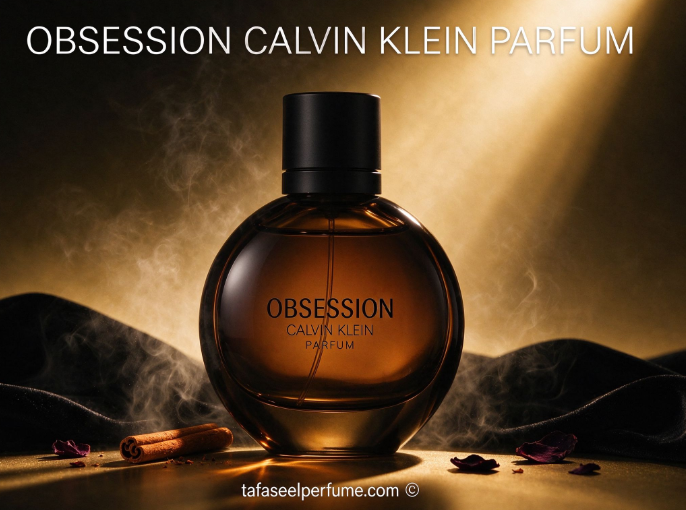
- Obsession Calvin Klein Parfum: The 1985 Oriental Icon That Still Refuses to Whisper: Obsession Calvin Klein Parfum is not a fragrance that asks for permission. Launched in 1985 for women and followed by a men’s edition in 1986, it arrived as a deliberate provocation — a dense, spiced, amber-resin statement built for a decade that wore its shoulders wide and its perfume louder.
Obsession Calvin Klein Parfum is not a fragrance that asks for permission. Launched in 1985 for women and followed by a men’s edition in 1986, it arrived as a deliberate provocation — a dense, spiced, amber-resin statement built for a decade that wore its shoulders wide and its perfume louder. Where many modern releases chase transparency, Obsession chose depth: dried vanilla, bitter spice, moss, musk, and a civet-tinged warmth that lingers on skin and fabric long after the first spray. It is the olfactory equivalent of a gold cuff and a closed door — elegant, excessive, and impossible to ignore.
This guide breaks down the Obsession Calvin Klein Parfum from every angle that matters: the note pyramid, the cultural moment that produced it, the real differences between the women’s and men’s versions, performance expectations, layering possibilities, and the long shadow it still casts over the oriental category. Whether you are discovering it for the first time or revisiting a bottle from decades past, the sections below offer a practical and historical map to one of Calvin Klein’s most divisive and enduring compositions.
The Note Pyramid: From Bitter Citrus to Resinous Amber
1985 and the Birth of a Powerhouse Oriental
Women’s vs. Men’s Obsession: Two Different Animals
Longevity, Sillage, and the Reformulation Question
How to Wear and Layer Obsession Without Drowning
Legacy, Dupes, and Why Obsession Still Matters
The Note Pyramid: From Bitter Citrus to Resinous Amber
The Obsession Calvin Klein Parfum for women opens with a top accord that is anything but simple citrus. Mandarin and bergamot provide the expected brightness, but they are immediately complicated by green notes, basil, peach, and a distinct vanilla signature that appears from the very first moments. This unusual decision — placing vanilla in the opening alongside hesperidic notes — gives Obsession a sweet-bitter tension that persists into the heart. Lemon and coriander add a sharp, almost culinary edge, preventing the fruit from becoming candied.
The heart is where the fragrance reveals its 1980s DNA. Jasmine, orange blossom, and rose are present, but they are not the soft, dewy florals of contemporary perfumery. They are pressed through exotic spices, sandalwood, cedar, and oakmoss, creating a floral-spice composite that feels dry rather than lush. Coriander and a cinnamon-adjacent warmth push the composition toward the oriental territory, while the mossy-green undertone keeps it from tipping into pure sweetness. For those who prefer exploring broader categories, the Women's Perfume collection offers useful context for how this style sits alongside other feminine releases.
The base is the reason Obsession became a signature for so many. Amber, musk, civet, vanilla, vetiver, and incense form a dense, animalic-resinous foundation. Civet — largely absent from modern mainstream perfumery — gives the drydown a lived-in, skin-like quality that reads as sensual rather than clean. Oakmoss and patchouli add an earthy weight, while benzoin and tonka-adjacent sweetness round the edges. The result is a base that does not so much “fade” as slowly lower its voice, remaining detectable on clothing for days. Reviewers consistently describe the drydown as “a big boom of musk that lingers forever,” and that persistence is a direct product of this material choice.
1985 and the Birth of a Powerhouse Oriental
Obsession for women launched in 1985, with model Josie Borain as the face of a campaign that matched Calvin Klein’s broader visual language of provocation and sensuality. The timing was deliberate. The early-to-mid 1980s had already seen the success of Opium, and the market was primed for another heavy, spice-laden oriental. But Obsession was not simply a follower. Perfumer Robert Slattery constructed a composition that took the amber-spice template and pushed it further into green, bitter, and animalic territory, creating something that felt more aggressive and more explicitly sexual than its predecessors.
Klein himself framed the name as cinematic: he told WWD that “Obsession” would be “big, like a movie poster for this era,” and the marketing lived up to that ambition. The women’s campaign imagery was shot by Richard Avedon in 1985, and a later iteration featured Kate Moss photographed by Mario Sorrenti in 1990. The men’s launch in 1986 was equally notable: its advertising was among the first in the category to place a woman at the center of a men’s fragrance campaign, reinforcing the idea that Obsession was never only about the wearer — it was about the tension between people. For readers interested in the broader arc of designer releases, the Perfume Brands archive provides a useful timeline of how Obsession sits within the Calvin Klein portfolio.
The cultural footprint was immediate. Obsession became the scent soundtrack of the 1980s — the olfactory partner to power shoulders, big hair, and the aesthetic of Dynasty. It sold strongly from its first years at retail and elevated Calvin Klein from a fashion name with underperforming fragrance ventures into a serious player in the beauty category. Decades later, the formula has been revisited and reformulated, but the original 1985 launch remains the reference point against which every subsequent version is judged.
Women’s vs. Men’s Obsession: Two Different Animals
The Obsession Calvin Klein Parfum for women and the Obsession for Men are often discussed as if they are two strengths of the same idea. In reality, they are distinct compositions that share a family resemblance rather than a blueprint. The women’s version is the more explicitly spiced, more floral, and more animalic of the two. Its heart is packed with exotic spices, jasmine, orange blossom, and oakmoss, and its base leans heavily into civet, amber, and vanilla. Longtime wearers describe it as “much more spicy and hard” than the men’s edition — a true powerhouse that can be overwhelming up close but devastatingly effective in its sillage trail.
The men’s Obsession, by contrast, is often described as softer, more modern, and more versatile. Its official note breakdown lists mandarin and bergamot at the top, lavender, myrrh, and spices in the heart, and musk, sandalwood, and patchouli in the base. The lavender gives it a fougère-adjacent cleanliness that the women’s version lacks, while myrrh adds a subtle resinous warmth. Some reviewers note that the men’s release actually contains more cinnamon-like warmth and less of the green, bitter sharpness found in the women’s opening. In broad classification terms, the women’s Obsession is an oriental floral woody, while the men’s is an oriental citrus woody — related, but not interchangeable.
This distinction matters for purchasing decisions. Those who want the full 1980s experience — the civet, the moss, the almost chewable density — should start with the women’s Eau de Parfum. Those who prefer a spiced-woody oriental with a cleaner lavender-myrrh opening and broader day-to-evening wearability will find the men’s EDT more approachable. The Men's Perfume section is a useful reference point for comparing Obsession for Men against other woody-spicy releases in the same register.
Longevity, Sillage, and the Reformulation Question
Performance is one of the most frequently discussed aspects of the Obsession Calvin Klein Parfum, and the conversation is split. Older bottles and vintage formulations are consistently described as having “bombastic sillage and longevity,” with a single application lasting all day on skin and remaining detectable on clothing for a week or more. The density of the amber-musk-civet base is the reason: these materials bind to fabric and skin and release slowly, creating the kind of scent trail that fills a room without requiring reapplication.
Contemporary bottles are a different story. A significant number of recent reviews report that the fragrance does not last as long as older versions, with some users describing the scent disappearing within hours or even minutes on skin. This is not unique to Obsession — reformulation pressure from ingredient restrictions and cost management has affected many 1980s orientals — but the gap between vintage and modern batches is particularly noticeable here because the original formula relied so heavily on materials that are now restricted or expensive. The men’s EDT is generally reported to have moderate longevity of around four to five hours with a softer projection after the first two hours, while the women’s EDP still performs above average when applied generously to pulse points and clothing.
The practical takeaway is to manage expectations and application. Modern Obsession rewards over-application relative to what many current fragrances require. Spraying on both skin and fabric — particularly the inner collar or a scarf — anchors the base notes and extends wear. Those who prioritize performance above all else may want to seek out older batches or decants, but for most wearers, the current EDP remains a long-lasting option within the oriental category. If longevity is a primary concern across your collection, the Perfume Ranking and Top Lists can help identify other releases known for strong projection and tenacity.
How to Wear and Layer Obsession Without Drowning
Obsession is not a fragrance that needs help being noticed. The first rule of wearing it is restraint at the point of application. Two to four sprays — depending on concentration and skin type — are sufficient for the women’s EDP; the men’s EDT can tolerate slightly more. Applying to pulse points (wrists, neck, behind the ears) warms the composition and accelerates the transition from the sharp, spicy opening to the resinous drydown. Applying from six to eight inches away prevents over-saturation in a single spot and encourages a more even distribution across skin and clothing.
Layering, however, is where Obsession becomes unexpectedly versatile. Experienced wearers describe it as an excellent base for other orientals, ambers, and woody compositions. A single spray of Obsession under a lighter amber or vanilla fragrance adds depth and a civet-musk undertone without dominating the combination. It also pairs well with rose-focused fragrances, where the spice and moss of Obsession contrast with the floral sweetness, and with citrus-forward colognes, where the bitter-green opening of Obsession amplifies the brightness of the partner scent. The key is proportion: Obsession should be the minority component when layering, typically one spray of Obsession to two or three of the companion fragrance.
For those who want to extend the experience beyond the parfum itself, matching body products are a practical route. A scented lotion or deodorant applied before the fragrance creates an additional layer that holds the scent closer to the skin and slows evaporation. The Perfume Gift Sets category often includes these companion formats, making it easier to build a full Obsession regimen without purchasing each component separately. And for readers who prefer to explore how layering works across different fragrance families before committing to a full bottle, the Perfume Articles and Reviews section contains practical guides on combining orientals with florals, woods, and citrus.
Legacy, Dupes, and Why Obsession Still Matters
Forty years after its launch, the Obsession Calvin Klein Parfum occupies an unusual position. It is simultaneously a vintage curiosity, a reference point for the oriental category, and — for a devoted cohort of wearers — a daily signature. The fragrance has been through multiple flankers, including Obsession Night and Secret Obsession, and Calvin Klein has revisited the original’s imagery and attitude in subsequent campaigns. But the core 1985 composition remains the anchor: a reminder of a moment when designer fragrances were willing to be heavy, strange, and unapologetically sensual.
The dupe market has responded accordingly. Perfume Parlour’s Anesse, Eden Perfumes’ No.254, and DUA Fragrances’ His Obsession all offer interpretations that aim to capture the original’s basil-civet-oakmoss character or the men’s spicy citrus-amber structure at lower price points. These alternatives are useful for testing whether the Obsession DNA suits your taste before investing in a full bottle, but they also underscore how difficult it is to replicate the original’s specific balance of animalic warmth and green bitterness. The civet and oakmoss materials that give Obsession its texture are precisely the ones that modern dupes struggle to reproduce faithfully.
For those building a collection around classic orientals, Obsession is less a “nice to have” and more a necessary reference. Wearing it alongside modern ambers and vanillas makes clear how much the category has shifted toward transparency and gourmand sweetness. It is a fragrance that documents a particular moment in taste history — and, for wearers who appreciate density, spice, and a base that stays on skin like a memory, it remains entirely wearable today. The Unisex Perfume and Mini Size & Gift Sets collections offer entry points for anyone curious about exploring this style without committing to a full bottle, while the Tafaseel Perfume Collection provides a curated view of how Obsession sits alongside other resinous and spice-driven compositions in the same retail landscape.
Obsession was never designed to be easy, and that is precisely why it has lasted. It is a parfum of excess, conviction, and a certain kind of 1980s confidence — and for the wearer who wants a fragrance that behaves like a statement rather than a suggestion, it still delivers exactly that.


