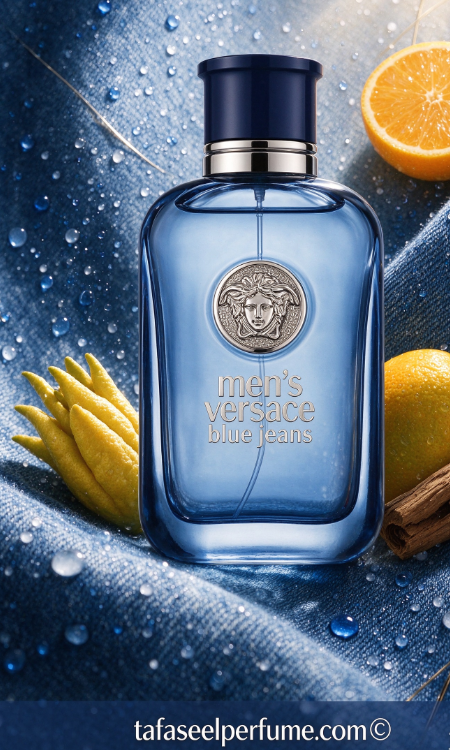
- Men’s Versace Blue Jeans: The Definitive Guide to a ’90s Fougère Icon: Short intro: Men’s Versace Blue Jeans is the blue-bottled fougère that proves a designer fragrance does not need a luxury price tag or a viral campaign to become a reference point. It is citrus at the opening, lavender and woods in the middle, and a soft vanilla-musk trail at the end — a formula that has outlasted most of its 1990s peers.
Long intro: When Men’s Versace Blue Jeans was released in 1994, the fragrance market was still rewarding clean, aromatic masculinity over niche experimentation. Jean-Pierre Bethouart, a perfumer with a portfolio spanning Givenchy, Burberry, and Boucheron, composed Blue Jeans as an aromatic fougère for the everyman — fresh enough for the office, sweet enough to feel approachable, and structured enough to avoid the sugar-bomb trajectory that many designer masculines would later take. Three decades later, it survives as a budget-friendly cult classic on discount shelves and fragrance forums alike, praised for its nostalgia and criticized for its modest projection in the same breath. This guide covers the full picture: the notes, the nose, the performance, the occasions, and the comparisons that matter, so you can decide whether the blue bottle deserves a place in your rotation. You can browse the full Men’s Perfume category for more fougère and aromatic options, or explore Perfume Articles and Reviews for deeper dives into the genres that shaped modern masculine fragrance.
Contents — jump to a section:
1. The Origins: How Men’s Versace Blue Jeans Became a ’90s Classic — the cultural and olfactory context behind the blue bottle.
2. The Scent Pyramid: Notes That Define Men’s Versace Blue Jeans — top, heart, and base accords, explained without the marketing language.
3. Jean-Pierre Bethouart: The Nose Behind the Blue Bottle — the perfumer’s career and what Blue Jeans reveals about his style.
4. Performance: Longevity, Projection, and Sillage in Real Life — what to expect on skin, clothes, and in different climates.
5. When and Where to Wear Men’s Versace Blue Jeans — seasons, dress codes, and the settings where it actually works.
6. Who Is It For? Age, Style, and Signature-Scent Potential — honest guidance on whether it fits your profile.
7. Blue Jeans vs. Red Jeans: Versace’s Denim Dynasty — the sibling rivalry that defined the line.
8. Packaging, Value, and the Case for the 75ml EDT — bottle design, pricing reality, and gifting logic.
9. Common Questions About Men’s Versace Blue Jeans, Answered — the queries that come up again and again.
1. The Origins: How Men’s Versace Blue Jeans Became a ’90s Classic
By 1994, Versace was already a fashion powerhouse, but its fragrance division was still building momentum under the Versace Jeans and Versus labels. Blue Jeans was not positioned as a prestige flagship the way the house’s couture-adjacent scents were. It was a democratic fragrance: accessible, unpretentious, and sold in volumes that made it a first “real” cologne for a generation of young men. That positioning matters because it shaped both the scent’s composition and its reputation. Bethouart was asked to create something clean, youthful, and immediately likable — not a statement piece, but a daily companion. The result was an aromatic fougère that borrowed the lavender-and-woods skeleton of traditional barbershop fougères and dressed it in a brighter, more citrus-forward opening than many of its contemporaries. For a deeper look at how Versace’s fragrance lines evolved from the 1981 debut through the Jeans era, the Brands archive is a useful reference point. The fact that Blue Jeans remains in production and continues to sell in 75ml and 2.5 oz formats is itself a testament to how well the brief was met: it never tried to be more than a well-made everyday fragrance, and that is precisely why it endured.
2. The Scent Pyramid: Notes That Define Men’s Versace Blue Jeans
The official note breakdown from retail listings is relatively compact, but wearers consistently report a more layered experience than the pyramid suggests. The top is built on bergamot, citrus, and lime in the most commonly cited version, with many fragrance databases adding basil, anise, juniper, and Brazilian rosewood for a greener, slightly spicy lift. The heart is where Blue Jeans becomes recognizable: freesia, patchouli, and vetiver form the core according to the Sephora breakdown, while community-maintained pyramids often include lavender, geranium, jasmine, rose, sage, and iris. The base is a warm, slightly sweet wood-musk-vanilla accord: sandalwood, oakmoss, and cedar are the official pillars, with tonka bean, amber, and vanilla rounding it out in most wearer descriptions. The practical takeaway is that Blue Jeans is not a linear citrus cologne. It opens bright and slightly fizzy, settles into a lavender-tinged aromatic heart, and finishes with a soft, powdery warmth that sits close to the skin. That arc — fresh to floral-aromatic to sweet woods — is the classic fougère skeleton, executed with a lighter hand than many heavier 1980s masculines. If you enjoy this structure, the broader Men’s Perfume collection includes several modern interpretations of the same theme.
3. Jean-Pierre Bethouart: The Nose Behind the Blue Bottle
Jean-Pierre Bethouart is not a household name in the way that Jacques Polge or Olivier Creed are, but his catalog is remarkably consistent. Born in Picardy and trained in chemistry before moving into perfumery, he worked at Givaudan and later became a senior perfumer at Firmenich, composing for brands ranging from Dior and Givenchy to Burberry and Versace. Blue Jeans sits comfortably among his notable works alongside Versace Red Jeans, Versace Dreamer, Burberry Touch for Men, and Givenchy Ange ou Demon. What Bethouart brings to Blue Jeans is structural clarity: the notes are legible, the transition from citrus to lavender to woods is smooth, and nothing feels bolted on for novelty. He is not chasing a trend here; he is building a fragrance that a young man in 1994 could wear to work, to a date, or to a family dinner without offending anyone. That restraint is a skill, and it explains why Blue Jeans still reads as “clean” rather than dated to many wearers. For context on how his work fits into the wider Versace fragrance archive, the Perfume Articles and Reviews section covers the house’s key releases and the perfumers behind them.
4. Performance: Longevity, Projection, and Sillage in Real Life
Performance is the most divisive aspect of Men’s Versace Blue Jeans, and the honest answer is that it is moderate and skin-dependent. A significant share of wearer reports place longevity at around four to six hours on skin, with projection that stays close for the first two to three hours before becoming a skin scent. Some users find it fades faster on dry or warm skin, while others report six to eight hours when sprayed on clothing or hair, and a minority of reviewers describe unusually strong performance on their chemistry. The practical implication is that Blue Jeans is not a “beast mode” fragrance. It is an EDT with a light-to-moderate sillage profile, designed for personal-space wear rather than room-filling projection. If you want more presence, the standard advice applies: apply to moisturized skin, spray on pulse points and a layer of clothing, and carry a travel atomizer for midday reapplication. For wearers who prioritize longevity above all else, the Perfume Ranking and Top Lists can point toward stronger-performing fougères and aromatic masculines in the same general style.
5. When and Where to Wear Men’s Versace Blue Jeans
Blue Jeans is at its best in daytime, casual-to-smart-casual settings. The citrus opening and lavender heart make it a natural fit for spring and early autumn, and it handles office environments well precisely because it does not project aggressively. It is also a reliable weekend fragrance: errands, brunch, a casual lunch date, or a daytime outdoor event. In high heat and humidity, the sweet vanilla-musk base can feel slightly heavier, so lighter application is advisable; in cold weather, it performs more like a quiet skin scent and may require layering or reapplication to remain noticeable. It is not a formal evening fragrance, and it is not the first choice for a black-tie event or a cold-weather night out — the composition lacks the density and darkness those settings often call for. Think of it as a daylight fougère with a nostalgic edge, not an all-occasion signature. If you are building a rotation around this style, the Men’s Perfume category includes fresher summer options and warmer evening alternatives that can sit alongside it.
6. Who Is It For? Age, Style, and Signature-Scent Potential
Blue Jeans is often described as a “young man’s first designer cologne,” and there is truth to that, but the profile is broader than the cliché. Its clean, slightly sweet, woody-citrus character makes it easy to wear for anyone who prefers aromatic freshness over heavy amber or oud. It suits a casual personal style — denim, knitwear, sneakers, unstructured tailoring — more naturally than a sharp suit, though it is inoffensive enough for most workplaces. As a signature scent, it has limitations: the moderate performance means it will not announce you from across a room, and the nostalgic association is strong enough that some wearers may find it less “modern” than newer fougères. But for a rotation scent, a gym bag fragrance, or a budget-friendly daily driver, it is difficult to fault. It also has a documented unisex appeal: Fragrantica reviewers note that it wears interestingly on women who prefer aromatic, lavender-tinged fragrances, which is why the Unisex Perfume section is worth browsing if you share bottles in a household. The safest conclusion is that Blue Jeans works best for wearers who value approachability and nostalgia over novelty and projection.
7. Blue Jeans vs. Red Jeans: Versace’s Denim Dynasty
Versace released Red Jeans for women in the same era, and the two are often discussed as a pair. Red Jeans is fruitier, louder, and more explicitly feminine in its marketing, but the underlying structure — a bright opening, a floral-aromatic middle, and a soft woody-musk base — shares DNA with Blue Jeans. For couples or households that enjoy matching fragrances, the pairing is logical: Blue Jeans for him, Red Jeans for her, and a shared aesthetic that does not require identical scent profiles. The comparison also clarifies what Blue Jeans is not: it is not the sweet, fruit-forward style that dominated feminine launches of the mid-1990s, and it is not as overtly “dressed up” as the Versace couture fragrances. It sits in the middle: masculine-coded but not aggressively so, casual but not sloppy. If you are shopping for a gift set or a coordinated pair, the Perfume Gift Sets category sometimes bundles these legacy releases, and the Women’s Perfume section covers the Red Jeans side of the family in more detail.
8. Packaging, Value, and the Case for the 75ml EDT
The bottle is part of the appeal. The thick blue glass, the white label typography, and the sturdy spray nozzle give Blue Jeans a tactile seriousness that belies its price point; it feels more expensive in the hand than many modern designer bottles with plastic caps and flimsy actuators. The 75ml EDT is the most common format, and discount retailers frequently price it well below the original suggested retail, making it one of the better value propositions in the designer fougère space. That value is a double-edged sword: the low price encourages over-spraying, which in turn amplifies the sweetness in the base and can make the fragrance feel cheaper than it is. Used with restraint — two to four sprays — it performs like a fragrance twice its price. For gifting, the Mini Size & Gift Sets category is a low-risk way to introduce someone to the scent without committing to a full bottle, and the Ranking section is useful for comparing Blue Jeans against other budget-friendly designer masculines in the same tier.
9. Common Questions About Men’s Versace Blue Jeans, Answered
Is Men’s Versace Blue Jeans still in production? Yes. It remains widely available through discount retailers and fragrance e-tailers, typically in the 75ml EDT format. Is it a safe blind buy? For most wearers, yes, if you enjoy fresh-aromatic fougères with a soft vanilla base. It is not polarizing in the way that heavy oud or animalic fragrances are. Does it smell “cheap”? The opening can read as sharp or synthetic to some noses, especially in the first few minutes, but the dry-down is generally considered pleasant and well-blended for the price. How many sprays should I use? Two to four is the practical range; more than that tends to emphasize the sweet base without improving projection. Is it a summer fragrance? It works in spring and moderate summer days with light application, but the vanilla-musk base can feel heavy in extreme heat. What is the closest alternative? The fougère genre is broad, but within Versace’s own line, Blue Jeans is the most casual and citrus-forward of the Jeans releases. For further reading on the house and its catalog, the Brands page and Perfume Articles archive provide additional context without the marketing gloss.


