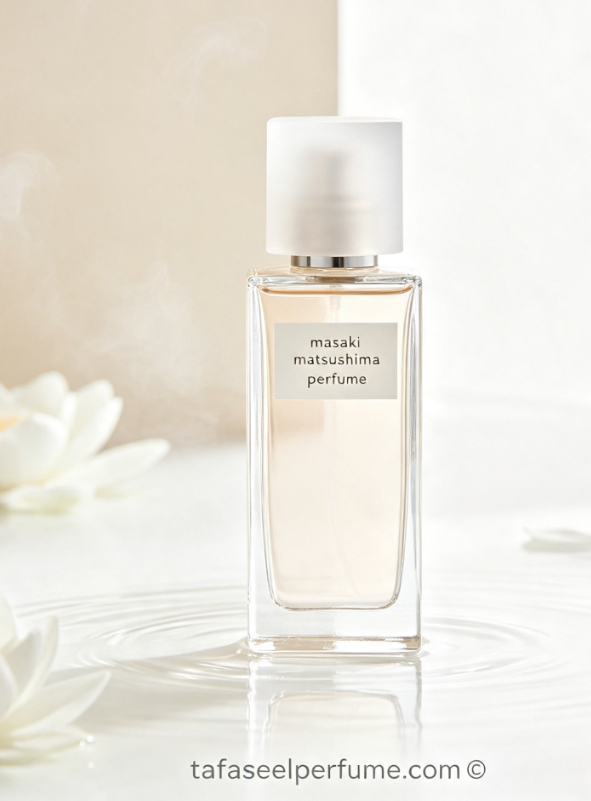
- Masaki Matsushima Perfume · The Velvet Architecture of Japanese Minimalism: Masaki Matsushima perfumes are architectural whispers — transparent, mineral, and soft as rain on concrete. This is not fragrance; it is the scent of light filtered through rice paper.
Masaki Matsushima is the quiet radical of Japanese perfumery. Born from the intersection of fashion, art, and olfactory purity, his fragrances reject the heavy baroque of western perfumery in favor of air, transparency, and unexpected texture. Each composition feels like a haiku: brief, layered, and infinitely evocative. With notes that play on the edge of skin — ozone, green tea, white woods, and mineral salts — Matsushima’s world is one where perfume becomes a second skin, a veil of ethereal intimacy. This article explores the philosophy, the cult creations, and the modernist soul behind the brand that redefined minimalism in a bottle.
Masaki Matsushima is not about being noticed; it is about being felt.
✧ contents
1. The architect of air 2. Minimalism that breathes 3. The cult of Mat; Masaki Matsushima 4. Transparency as a note 5. The Japanese olfactory palette 6. Unisex by nature 7. The bottle as sculpture 8. Beyond fragrance – the Matsushima aesthetic 9. Why Masaki Matsushima endures1. The architect of air
Masaki Matsushima began his career as a fashion designer, but his true medium soon became space — the negative space between body and cloth, the breath between skin and silk. When he turned to perfume, he did not design scents; he designed atmospheres. His first fragrance, Mat; Masaki Matsushima (2002), was a shock to the industry: a transparent, almost aqueous floral-mineral that smelled like nothing else. Where others built pyramids, Matsushima built floating gardens. The signature is an airy, ozonic top that dissolves into green tea, lotus, and white musk, leaving a trail that is less a statement and more a suggestion. It is the scent of a Tokyo morning after rain — clean, electric, and infinitely calm.
His approach is architectural: each note is a beam, a column, a pane of glass. There is no clutter. There is no excess. The perfume does not compete with the wearer; it collaborates. This is why Matsushima’s work is often described as “second-skin” — it amplifies rather than masks. For the modern minimalist, there is no greater luxury than this kind of olfactory silence.
Parfumerie en ligne · The Velvet Architecture of Infinite Scent — a parallel exploration of how structure meets scent.
2. Minimalism that breathes
Minimalism in Western perfumery often means a reduction to citrus, cedar, or iso e super. But Matsushima’s minimalism is organic and sensory. He uses notes that are almost imperceptible alone — lotus, bamboo, cucumber, white tea, and a molecule he calls “aquatic air” — and layers them in thin, luminous strokes. The result is a fragrance that changes with humidity, skin pH, and even the mood of the wearer. It is not static; it breathes. This is why his perfumes are often described as “meditative” or “translucent.” They do not shout; they hum.
The collection “Mat” remains the purest expression of this philosophy: a quartet of scents that explore the four elements through a Japanese lens. Mat; Very Male, for instance, uses ginger and incense, but with a lightness that feels like smoke rising from a temple. Mat; Femme uses rose and violet, but stripped of their sweetness, rendered as cool petals on wet stone. These are not gender-specific; they are mood-specific. And that is the genius of Matsushima.
Mohave Ghost · Ethereal Desert & Mineral Musk — another example of mineral transparency in modern perfumery.
3. The cult of Mat; Masaki Matsushima
The original Mat; Masaki Matsushima (often simply called “Mat”) has achieved cult status among perfume connoisseurs. It is not a bestseller in the traditional sense, but it is a reference point. Fragrance critics often compare it to the work of Comme des Garçons or Issey Miyake, but Matsushima’s voice is distinctly his own — softer, more poetic, less intellectual. The opening is a burst of calone and green apple, but it quickly settles into a heart of white flowers and green tea, with a base of white musk and amber. Yet the amber is not heavy; it is like the warmth of sunlight on paper.
What makes Mat so enduring is its paradoxical persistence. It is ephemeral, yet it lingers on clothes for days. It is transparent, yet it projects a quiet authority. It is unisex, yet it feels deeply personal. For those who wear it, Mat is not a fragrance; it is a state of being.
4. Transparency as a note
Matsushima once said, “Perfume should be like water — essential, but invisible.” This philosophy drives his use of transparent molecules such as Helional, Florol, and Iso E Super, but he does not rely on them. Instead, he uses natural essences in micro-doses: a whisper of jasmine, a breath of sandalwood, a flicker of cardamom. The transparency comes from the absence of heavy fixatives and the deliberate use of low-odor solvents. The result is a fragrance that does not announce itself; it is discovered.
This approach is radical in an industry that prizes projection and longevity. Matsushima’s perfumes are intimate; they are for the wearer and those who come close. They are the scent of trust and quiet intimacy. In a world of loud fragrances, this is a revolutionary act.
Burberry Perfume Mujer · British Floral Allure — a different take on floral architecture, yet complementary in spirit.
5. The Japanese olfactory palette
Matsushima draws deeply from the Japanese aesthetic tradition: wabi-sabi, ma (negative space), and shibui (understated elegance). His notes often include yuzu, hinoki, shiso, and green tea, but he uses them not as exotic markers, but as emotional colors. Yuzu is not just citrus; it is the brightness of a winter morning. Hinoki is not just wood; it is the silence of an old temple. Shiso is not just herb; it is the shiver of a cool breeze.
This palette is what sets Matsushima apart from other Japanese perfumers. He does not simply import Japanese ingredients; he interprets them through a modern, global lens. His fragrances are Japanese in spirit, but universal in appeal. They speak to anyone who has ever felt the beauty of restraint.
6. Unisex by nature
Long before unisex became a marketing category, Masaki Matsushima designed genderless fragrances. His belief was simple: scent does not have a gender, only a mood. His first three releases — Mat, Mat; Very Male, and Mat; Femme — were ostensibly gendered, but in practice, they blurred the lines. Very Male, with its spicy ginger and incense, is worn by women as often as men. Femme, with its soft rose and violet, is worn by men who appreciate its mineral freshness.
Today, the entire Matsushima line is considered unisex, and his newer releases are explicitly marketed as such. This is not a trend for him; it is a philosophical stance. Perfume is not about fitting in; it is about feeling true.
Unisex Perfume — explore more gender-fluid fragrances that share this philosophy.
7. The bottle as sculpture
The visual identity of Masaki Matsushima perfumes is as considered as the juice itself. The bottles are geometric, heavy, and cool — like blocks of ice or polished stone. The iconic Mat bottle is a cylindrical prism with a frosted glass finish, capped with a metallic disc. It feels substantial in the hand, yet its design is spare, almost severe. This is intentional: the bottle is a tactile haiku, a counterpoint to the ethereal nature of the fragrance.
Matsushima collaborates with architects and industrial designers for each launch, ensuring that the vessel reflects the spirit of the scent. The result is a collection that looks as good on a shelf as it feels on the skin — a true object of desire for the minimalist aesthete.
8. Beyond fragrance – the Matsushima aesthetic
Masaki Matsushima is not just a perfumer; he is a lifestyle philosopher. His brand extends to clothing, accessories, and even interior design, all governed by the same principles: lightness, purity, and function. His fashion collections are known for their fluid silhouettes and monochrome palettes, often featuring technical fabrics that feel like second skin. This synergy between fashion and fragrance is rare — most designers treat perfume as a licensing afterthought. For Matsushima, it is an extension of his artistic vision.
His boutiques in Tokyo and Paris are minimalist sanctuaries, with white walls, concrete floors, and soft lighting. The fragrance counter is not a counter but a low plinth, where bottles are displayed like sculptures. The experience of buying a Matsushima perfume is not retail; it is curatorial.
9. Why Masaki Matsushima endures
In an industry obsessed with novelty and flankers, Masaki Matsushima has remained consistent and true. His fragrances are not seasonal; they are permanent. They do not chase trends; they set a quiet standard. This endurance comes from his commitment to quality and authenticity. Every ingredient is sourced with care, every formula is tweaked to perfection, and every bottle is made to last.
But more than that, Matsushima endures because his perfumes connect on a human level. They are not about projection or seduction; they are about presence. They remind us that the most powerful things are often the most subtle. And in a noisy world, that is a gift.
Frequently Asked Questions · Masaki Matsushima Perfume
The signature is a transparent, ozonic-mineral accord that combines green tea, lotus, white musk, and a hint of aquatic calone. It is airy, clean, and almost ethereal — like rain on concrete.
Yes, absolutely. Matsushima designs fragrance for mood, not gender. Even his earlier “Very Male” and “Femme” are worn interchangeably today. All current releases are explicitly unisex.
They are moderate in longevity (4-6 hours) because they avoid heavy fixatives. However, they linger on fabric for days. The transparency is intentional — they are intimate scents, not room-fillers.
Start with Mat; Masaki Matsushima (the original). It is the purest expression of his aesthetic: green tea, lotus, white musk, and a mineral breeze. It is the quintessential Matsushima.
It is selectively distributed — mostly in niche perfumeries, concept stores, and his own boutiques in Tokyo and Paris. You can also find it online through curated retailers.
While brands like Comme des Garçons are avant-garde and conceptual, Matsushima is poetic and sensory. His focus is on texture and air, not shock value. It is minimalism that feels human.
Occasionally, he releases artisanal editions in collaboration with architects or visual artists. These are highly collectible and often feature unique bottle designs and rare ingredients.
Masaki Matsushima · the poetry of transparency


