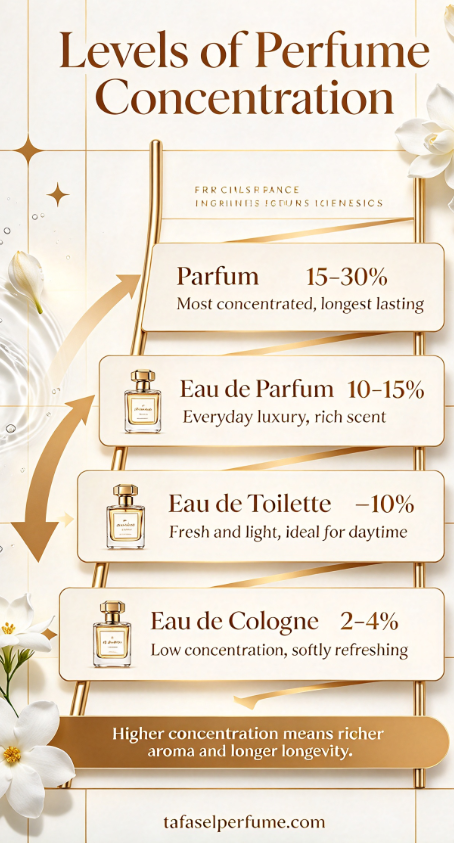
- Levels of Perfume Concentration: The Ultimate Guide to Fragrance Strength, Longevity, and Sillage: Quick intro: Understanding the levels of perfume concentration is the single most important step in choosing a fragrance that matches your lifestyle. From the lightest Eau de Cologne to the richest Parfum, each concentration tells you how much perfume oil is dissolved in alcohol — and that number changes everything about how a scent performs.
Big intro: When you shop for perfume, you will constantly see terms like Eau de Toilette, Eau de Parfum, Parfum, and Eau Fraîche. These are not random marketing words. They represent the levels of perfume concentration, a standardized scale that describes the percentage of aromatic compounds in a bottle. The higher the concentration, the stronger the scent, the longer it lasts, and the more it costs. But higher concentration is not always better — it depends on the occasion, the climate, and your personal chemistry. This guide breaks down every concentration level, explains how they affect projection and longevity, and helps you decide which one belongs on your vanity. Whether you are exploring unisex perfume or searching for the perfect men's perfume, knowing the concentration scale will transform the way you buy and wear fragrance.
1. What Are the Levels of Perfume Concentration?
2. Eau de Cologne (EDC): The Lightest Level
3. Eau de Toilette (EDT): The Everyday Favorite
4. Eau de Parfum (EDP): The Balanced Powerhouse
5. Parfum (Extrait de Parfum): The Highest Concentration
6. Eau Fraîche and Splash Concentrations: Beyond the Classic Scale
7. How Concentration Affects Longevity and Sillage
8. Choosing the Right Concentration for Climate and Occasion
1. What Are the Levels of Perfume Concentration?
The levels of perfume concentration refer to the ratio of fragrance oil to alcohol in a perfume solution. The most common scale includes five main categories: Eau Fraîche (1–3% oil), Eau de Cologne (3–5% oil), Eau de Toilette (5–15% oil), Eau de Parfum (15–20% oil), and Parfum or Extrait de Parfum (20–40% oil). Some houses add extra categories such as Eau de Parfum Intense or Elixir, but the principle remains the same. The higher the oil percentage, the richer the scent and the slower it evaporates on your skin. This is why a Parfum can last 8–12 hours or more, while an Eau de Cologne might fade in 2–3 hours. Understanding this scale helps you predict performance before you buy. It also explains why two fragrances with the same name — for example, a Eternity Eau de Parfum and an Eau de Toilette version — can smell noticeably different and last for different lengths of time.
2. Eau de Cologne (EDC): The Lightest Level
Eau de Cologne, often abbreviated as EDC, sits at the lower end of the levels of perfume concentration, typically containing 3–5% fragrance oil. Originally created in Cologne, Germany, in the 18th century, this style is famous for its fresh, citrus-forward character. Because the oil content is low, EDC is refreshing but short-lived — usually 2 to 4 hours on the skin. It projects gently and stays close to the body, making it ideal for hot weather, post-gym refreshment, or a quick spritz before a meeting. Many traditional colognes, such as Royall Cologne, are built on this concentration. If you love the ritual of reapplying fragrance throughout the day, EDC is a joy. However, if you want a scent that lasts from morning to night without a touch-up, you will need to move up the concentration ladder. EDC is also a wonderful choice for layering, because its light structure rarely clashes with other fragrances.
3. Eau de Toilette (EDT): The Everyday Favorite
Eau de Toilette is the most popular concentration in the world, containing roughly 5–15% perfume oil. It offers a beautiful balance: noticeable but not overwhelming, with a typical longevity of 4 to 6 hours. The levels of perfume concentration at the EDT stage are versatile enough for daily office wear, casual outings, and warm climates. Many designer and niche houses release their iconic scents as EDT first, then follow with EDP versions. For example, the Estée Lauder Cologne line and countless men's fragrances rely on the EDT structure to deliver freshness without heaviness. If you are new to fragrance, EDT is often the safest starting point because it is less likely to cause headaches or offend colleagues. It also tends to be more affordable than EDP or Parfum, making it a great way to explore a scent before committing to a higher concentration.
4. Eau de Parfum (EDP): The Balanced Powerhouse
Eau de Parfum is where the levels of perfume concentration begin to deliver serious performance. With 15–20% oil, EDP lasts 6 to 8 hours and projects confidently without being suffocating. This is the concentration most modern “signature scents” use, because it offers excellent value: you need fewer sprays, and the scent evolves beautifully over time. A great example is Diptyque Philosykos Fragrance, whose EDP version captures the creamy green fig with remarkable depth and staying power. EDP is ideal for evening events, cooler weather, and anyone who wants their fragrance to remain noticeable for a full workday. It also tends to have richer base notes, because the higher oil content allows resins, woods, and musks to unfold slowly. If you are torn between EDT and EDP, ask yourself how often you want to reapply — if the answer is “rarely,” EDP is your friend.
5. Parfum (Extrait de Parfum): The Highest Concentration
Parfum, also called Extrait de Parfum, sits at the top of the levels of perfume concentration, with 20–40% fragrance oil. This is the most intense, longest-lasting form of fragrance, often lasting 8 to 12 hours or more. Because the oil content is so high, Parfum usually comes in smaller bottles and is applied sparingly — one or two dabs are enough. The scent is richer, deeper, and often more linear than lower concentrations, meaning it stays closer to its original composition rather than shifting dramatically through top, heart, and base notes. Luxury houses frequently release Parfum versions of their bestsellers, such as Aura Lattafa and Signora Perfume. Parfum is best for special occasions, cold weather, and collectors who appreciate the artistry of a dense, resinous composition. It is also the most expensive concentration per milliliter, but because you use so little, a bottle can last for years.
6. Eau Fraîche and Splash Concentrations: Beyond the Classic Scale
Not every fragrance fits neatly into the five main levels of perfume concentration. Eau Fraîche, for instance, contains only 1–3% oil and is essentially a scented water — perfect for a momentary lift on a hot day. Splash colognes and after-shave lotions often fall into this category as well. Some brands also use terms like “Eau de Parfum Intense,” “Elixir,” or “Extrait” to indicate concentrations above 25%, though these are not officially standardized. For example, a YSL Illicit Green Review might describe an EDP that feels stronger than usual, while a Stronger With You Men flanker could be labeled “Eau de Parfum” but perform like an Extrait. The key is to read the oil percentage when available, and to trust your nose. Lighter concentrations are also common in body mists and hair perfumes, which are designed for gentle, all-over application.
7. How Concentration Affects Longevity and Sillage
The relationship between levels of perfume concentration and performance is not perfectly linear, but it is close. Higher oil content generally means slower evaporation, which translates to longer longevity. Sillage — the trail a fragrance leaves behind — also tends to increase with concentration, though application style matters just as much. A heavy-handed spray of EDT can project more than a single dab of Parfum. That said, if you want a scent that stays on your skin for 10 hours without reapplication, you should look at EDP or Parfum. If you prefer a scent that stays close and intimate, EDT or EDC may be more appropriate. Climate plays a role too: heat amplifies projection, so a heavy Parfum can become overwhelming in summer, while a light EDC may disappear instantly in cold, dry air. Understanding these dynamics helps you choose the right concentration for your body chemistry and environment. For more guidance, explore the Perfume Articles and Reviews section.
8. Choosing the Right Concentration for Climate and Occasion
There is no single “best” level among the levels of perfume concentration — only the best level for your situation. For hot, humid summers, reach for Eau de Cologne or Eau Fraîche. For spring and autumn days, Eau de Toilette is ideal. For winter evenings, formal events, or when you want to make a lasting impression, Eau de Parfum or Parfum is the way to go. Office environments often call for EDT or a light EDP, while date nights welcome the richness of Parfum. If you are building a wardrobe, consider owning at least one fragrance from each major concentration. You can also explore Perfume Gift Sets that include multiple concentrations of the same scent, allowing you to experiment. And remember: the same fragrance name can smell different across concentrations, so always test on your skin before buying. Whether you choose a women's perfume or a men's perfume, the concentration label is your most reliable guide.
Frequently Asked Questions About Levels of Perfume Concentration
1. What is the strongest level of perfume concentration?
Parfum, also called Extrait de Parfum, is the strongest level, typically containing 20–40% fragrance oil. It lasts the longest and projects the most intensely, though it is usually applied in very small amounts.
2. Is Eau de Parfum always better than Eau de Toilette?
Not necessarily. Eau de Parfum is stronger and longer-lasting, but Eau de Toilette is lighter, fresher, and often more suitable for daytime or hot weather. The “better” choice depends on your personal preference and occasion.
3. How many hours does each concentration last?
Eau Fraîche: 1–2 hours. Eau de Cologne: 2–4 hours. Eau de Toilette: 4–6 hours. Eau de Parfum: 6–8 hours. Parfum: 8–12+ hours. These are averages; skin type, climate, and application affect actual longevity.
4. Can I layer different concentrations of the same fragrance?
Yes, layering is a popular technique. Many people apply a matching body lotion or Eau de Toilette first, then top with Eau de Parfum or Parfum to boost longevity and depth. Just be careful not to overwhelm your senses.
5. Why is Parfum more expensive than Eau de Toilette?
Parfum contains a much higher percentage of fragrance oil, which is the most costly ingredient. The production process is also more concentrated, and the bottles are often smaller and more luxurious. You are paying for intensity and longevity.
6. Does higher concentration mean better sillage?
Generally, yes — higher concentration leads to stronger sillage. However, application matters: one spray of Parfum can project less than three sprays of Eau de Toilette. Climate and skin chemistry also play major roles.
7. Which concentration is best for summer?
Eau de Cologne, Eau Fraîche, and light Eau de Toilette are best for summer because they are fresh and less likely to become cloying in the heat. Save heavier Eau de Parfum and Parfum for cooler evenings.
8. Can I wear Parfum during the day?
Absolutely, but apply sparingly. One dab on the wrists or neck is usually enough. Parfum can be worn during the day if you prefer a scent that stays close and lasts until evening.
9. What does “Eau de Parfum Intense” mean?
It is not an official concentration level, but it generally indicates a higher oil percentage than a standard Eau de Parfum, often around 20–25%. It is stronger and richer than a classic EDP.
10. How can I tell the concentration of a perfume?
Check the label or the box. The concentration is usually printed near the brand name, such as “Eau de Toilette” or “Parfum.” If you are unsure, ask a sales assistant or look up the product online. For more tips, browse Beauty Tips and Guides.


