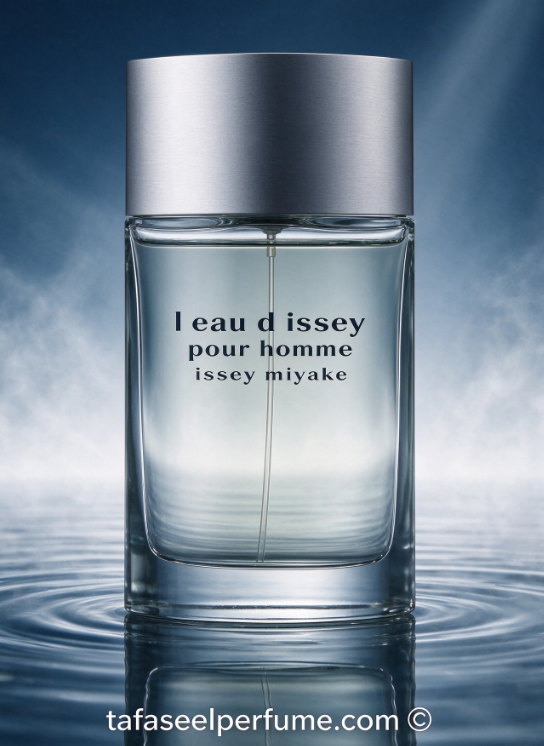
- L’Eau d’Issey Pour Homme by Issey Miyake: The Yuzu-Aquatic Blueprint That Outlasted the 1990s: Quick Intro: L’Eau d’Issey Pour Homme is not the loudest fragrance in the room. It is the one people lean closer to smell. Launched in 1994, it took the marine transparency of the early ’90s and gave it a Japanese citrus bite and a dry, woody spine. Nearly three decades later, it remains the reference point for “clean” masculine perfumery—a smell that reads as water, skin, and composure rather than cologne.
Long Intro: Issey Miyake’s first men’s fragrance arrived two years after the women’s L’Eau d’Issey reshaped what a “water” perfume could be. The brief fell to Jacques Cavallier Belletrud, who would later shape Louis Vuitton’s fragrance house. Cavallier built the men’s version around yuzu—a citrus that is sharper, more bitter, and more aromatic than lemon—then anchored it with calone’s melon-marine transparency, nutmeg’s dry spice, and a cedar–sandalwood base. The result was something unusual for its time: aquatic without being sporty, woody without being heavy, and transparent without disappearing. It belongs to the same late-’90s clean-fragrance wave that produced Cool Water and Acqua di Gio, but its temperament is quieter and more mineral. If you are exploring the broader category of transparent, everyday masculine scents, the Men’s Perfume collection is a natural next stop. For a fruit-forward fresh alternative that leans sweeter and bolder, Blueberry Perfume for Men offers a very different interpretation of “fresh.” And if you want to see how the aquatic idea collides with Arabian oud traditions, Bahar The Spirit of Dubai is the paradox worth reading. L’Eau d’Issey Pour Homme sits in the middle: less opulent than the Italian loud-luxury school covered in the Versace Perfume guide, and more refined than the budget aquatic standard-bearers it is often stacked against.
1. The 1994 DNA: Yuzu, Calone, and the Architecture of “Clean”
A short description of how L’Eau d’Issey Pour Homme redefined aquatic freshness with a Japanese citrus signature.
2. Notes and Performance: What This EDT Actually Smells Like on Skin
A breakdown of the top, heart, and base, plus a realistic look at longevity and sillage.
3. The Flanker Universe: Intense, Nuit d’Issey, Sport, and Wood & Wood
How the original’s DNA branches into warmer, darker, fresher, and woodier directions.
4. L’Eau d’Issey Pour Homme vs. Nautica Voyage and Cool Water
A direct comparison with the two aquatics shoppers most often weigh against it.
5. Who Should Wear It—and When It Falls Short
The skin types, climates, and occasions where this fragrance shines, and where it does not.
1. The 1994 DNA: Yuzu, Calone, and the Architecture of “Clean”
L’Eau d’Issey Pour Homme was launched in 1994, composed by Jacques Cavallier Belletrud. It was Issey Miyake’s first fragrance for men, following the women’s L’Eau d’Issey by two years. The timing matters. The early 1990s were the height of the marine-aquatic experiment in masculine perfumery, but most of those releases leaned on a salty, ozonic “sea breeze” effect. Cavallier did something different: he placed yuzu at the opening—a citrus with a green, bitter edge that smells closer to the zest of a Japanese fruit than to the sweet lemon-drop brightness common in Western colognes. The yuzu is supported by bergamot, lemon verbena, and a green tarragon note, but the calone molecule underneath gives the composition its translucent, almost wet-mineral texture. Calone is the same material that defined the era’s “aquatic” smell, but here it is restrained, woven into citrus rather than shouted over it. The heart introduces blue lotus, nutmeg, and a touch of saffron and cinnamon—spices that add dryness rather than heat. The base is where the fragrance proves it is not just an aquatic: Tahitian vetiver, cedar, sandalwood, amber, and a trace of tobacco give it a woody, slightly salty persistence that keeps the citrus from floating away. That structure—bright yuzu–calone top over a dry woody base—became a template, but few releases have matched its balance. The house’s broader design philosophy, which treats water as both material and inspiration, is visible in every facet of the composition: nothing is decorative, and every note serves the idea of clarity.
2. Notes and Performance: What This EDT Actually Smells Like on Skin
The official note pyramid reads like a citrus grove meeting a dry spice market. Top notes include yuzu, lemon, bergamot, lemon verbena, mandarin orange, cypress, calone, coriander, sage, and tarragon. The opening is sharp and aqueous at once—a burst of bitter citrus that smells cold and clean, with a faint greenness from the sage and tarragon. Within fifteen to twenty minutes, the calone and blue lotus soften the edges, and nutmeg begins to dry the composition out. The heart is where some wearers notice a subtle floral lift from lily-of-the-valley and mignonette, but it never becomes a floral fragrance; the spices and water lily keep it firmly in the aromatic-aquatic lane. The base is cedar, sandalwood, Tahitian vetiver, musk, amber, and tobacco. The tobacco is not a smoky pipe-tobacco presence; it reads more like a dry, hay-like sweetness that rounds the woods. On skin, the overall effect is “clean” in a way that is difficult to manufacture: it smells like skin after a cold shower, with a citrus peel left on the counter. Performance is the most debated point. Some retail descriptions promise “all day” wear, while more rigorous reviews place realistic EDT longevity at four to six hours with moderate sillage, extending longer on oily skin and in humid heat. In practice, this is not a projection monster. It sits close after the first hour and becomes a skin scent for the remainder. That is not a flaw; it is the nature of a transparent aquatic EDT. If you expect twelve-hour projection, you are looking at the wrong concentration. If you want a fragrance that feels intimate, office-appropriate, and refreshed rather than announced, the performance is exactly right.
3. The Flanker Universe: Intense, Nuit d’Issey, Sport, and Wood & Wood
The original’s success produced a family of flankers, each pulling one thread of the DNA in a different direction. L’Eau d’Issey Pour Homme Intense is the warmest and most ambered of the core line—Cavallier’s aquatic structure is still there, but the base is pushed toward resins, spice, and a rounder sweetness, making it a cold-weather alternative for people who like the original’s opening but want more body. Nuit d’Issey is arguably the best-composed flanker: it keeps a fresh opening but descends into smoky woods and darker spices, a legitimate evening scent that does not abandon the house’s transparency. L’Eau d’Issey Pour Homme Sport is the gym-bag version—fresher, more citrus-forward, and even more casual than the original. Wood & Wood pushes the woody axis harder, retaining freshness but adding a warmer, more textured timber feel that suits people who find the original too sheer. The newest additions, including L’Eau d’Issey pour Homme Eau Essentielle, continue the lineage with mineral-woody reinterpretations of the water concept. The important thing to understand is that the original remains the anchor: every flanker is a variation on its yuzu–calone–cedar skeleton, not a replacement. If you are building a wardrobe around this DNA, the original EDT is the default; Intense or Nuit d’Issey are the second bottle, depending on whether you want warmth or darkness.
4. L’Eau d’Issey Pour Homme vs. Nautica Voyage and Cool Water
The two fragrances most often mentioned in the same breath as L’Eau d’Issey Pour Homme are Davidoff Cool Water and Nautica Voyage, and the comparison is useful because it clarifies what the Issey is not. Cool Water, launched in 1988, is the older aquatic template: minty, lavender-tinged, and more aggressively “marine” in the traditional fougère-aquatic sense. Nautica Voyage, which arrived in 2006, is the budget aquatic gold standard—saltier, more melon-forward, and more overtly “sporty” than the Issey. L’Eau d’Issey Pour Homme sits between them in temperament but above them in refinement. Where Cool Water feels casual and slightly dated in its mint-lavender opening, the Issey’s yuzu is sharper and more modern; where Voyage can smell like a department-store freshie, the Issey’s nutmeg–cedar base gives it a dry, almost mineral dignity that reads more expensive than its price bracket. That is why one comparison describes the Issey as “fresh-and-refined” while Cool Water is “fresh-and-casual”. If you want the cheapest possible entry into the aquatic category, Voyage is the rational choice. If you want the version that smells like it was designed rather than assembled, the Issey is the step up. The trade-off is performance: Voyage projects more loudly in the first hour, while the Issey prioritizes texture and drydown over room-filling sillage.
5. Who Should Wear It—and When It Falls Short
This is a warm-weather fragrance first. The yuzu–calone opening is at its best in heat and humidity, where the citrus feels cooling and the woody base prevents it from turning sour. Spring and early autumn are also comfortable; deep winter can make the transparency feel thin, which is where Intense becomes the better choice. It is an office-safe scent by design: moderate sillage, no gourmand sweetness, and a clean skin-scent drydown mean it will not offend in close quarters. It also works as a post-gym fragrance because the calone–citrus combination reads as freshly washed rather than perfumed. The people who struggle with it are usually looking for one of two things it does not provide: projection or sweetness. If you want a fragrance that announces your arrival, this EDT will disappoint; its sillage is moderate at best and becomes intimate within two hours. If you want a sweet, attention-seeking freshie, the absence of amberwood sweetness or fruity syrup will feel austere. It also performs differently on dry versus oily skin: dry skin may get three to four hours, while oily skin can stretch to six or seven, especially if the fragrance is sprayed on moisturized skin and clothing. The bottle itself—a minimalist, transparent form with a grey-tinted liquid—reflects the same philosophy as the scent: functional, quiet, and deliberately unornamented. For anyone building a starter wardrobe around clean, versatile masculine scents, it is one of the few fragrances that earns the word “essential” without exaggeration.
FAQ 1: Is L’Eau d’Issey Pour Homme still worth buying in 2026?
Yes, if you value transparency, citrus-woody elegance, and office versatility over projection. It remains one of the most coherent aquatics ever made, and its yuzu–nutmeg–cedar structure has aged better than many louder 1990s releases. The formula has been stable for years, and the price-per-quality ratio is strong. The main caveat is performance: it is an EDT with moderate sillage, so if you expect all-day projection, you will be disappointed. If you accept it as a skin-close, refreshing scent, it is still a benchmark.
FAQ 2: How long does it last, and how many sprays should I use?
Realistic longevity is four to six hours on most skin, with moderate sillage that becomes a skin scent after the first hour. Oily skin and humid climates can push it closer to six or seven hours. Three to four sprays are sufficient for daytime wear: two on the neck or chest, one on each forearm. Over-spraying does not increase longevity in a meaningful way with this composition; it simply makes the opening louder for the first thirty minutes before settling into the same drydown. Moisturizing the skin beforehand helps extend wear.
FAQ 3: Is it suitable for women?
Yes. Despite being marketed as a men’s fragrance, the yuzu–calone–cedar structure is not structurally gendered. Many women wear it as a clean, citrus-woody scent, and its transparent character sits comfortably alongside unisex preferences. It reads more “fresh” than “masculine,” and the absence of heavy fougère or sweet amber notes makes it easy to cross over. If you enjoy citrus aromatics or mineral aquatics, the gender label is irrelevant.
FAQ 4: What is the difference between the EDT and the Intense version?
The EDT is the original 1994 composition: bright yuzu, calone transparency, dry spice, and a cedar–sandalwood base. Intense keeps the same general silhouette but pushes the base toward amber, resins, and a warmer, rounder sweetness. The result is a fragrance that performs better in cold weather and feels more “evening” than the original. If you love the original’s opening but want more density and warmth, Intense is the logical flanker. If you want the purest expression of the water concept, the EDT remains the reference.
FAQ 5: How does it compare to Nautica Voyage for someone on a budget?
Nautica Voyage is cheaper and projects more loudly in the first hour, but it smells more synthetic and more overtly “sporty.” L’Eau d’Issey Pour Homme costs more, but the quality of the citrus and the drydown is noticeably higher—the yuzu feels natural, the nutmeg adds dryness rather than sharpness, and the cedar–sandalwood base has a mineral elegance that Voyage cannot match. If budget is the absolute priority, Voyage is a reasonable entry point. If you can stretch to the Issey, you are buying a more refined composition that smells less like a “budget aquatic” and more like a designed object. For a broader look at how the Issey fits into the fresh-and-clean category, the comparison roundup on 360 White by Perry Ellis offers another angle on clean, transparent construction from a different corner of the fragrance world.


