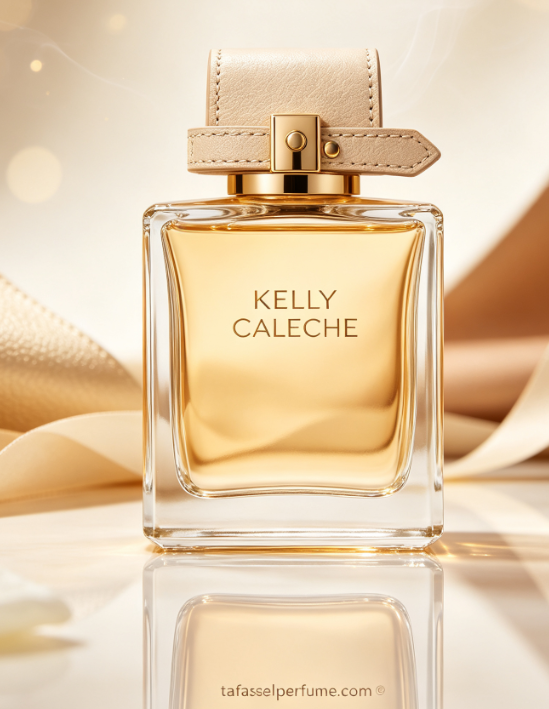
- Kelly Caleche: The Complete Guide to the Angel-Wing Leather Floral That Redefined Hermès Elegance: Kelly Caleche is not merely a fragrance—it is a whispered conversation between two of the most enduring symbols in luxury: the Kelly bag and the horse-drawn carriage that anchors the Hermès crest. Created in 2007 by master perfumer Jean-Claude Ellena, this leather-floral composition was designed to capture what the nose remembers when leather is worn close to the skin, softened by warmth and edged with petals. The result is a scent that feels simultaneously intimate and untamed: rose and mimosa
This guide explores every facet of Kelly Caleche, from its olfactory architecture and the two distinct concentrations available, to the stories embedded in its iconic lantern-shaped bottle and the reasons it remains a benchmark for women who prefer elegance over ornamentation.
Explore more fragrance guides:
Crystal Oud: The Complete Guide to the Radiant, Resinous Heart of Modern Perfumery
Versace Turquoise Dylan: The Ultimate Guide to the Fresh, Bold, and Unforgettable Fragrance
Coach Cologne for Women: The Ultimate Guide to Elegant, Fresh, and Timeless Scents
Table of Contents
1. The Origins of Kelly Caleche: Two Icons, One Scent
2. Olfactory Architecture: Rose, Mimosa, and the Ghost of Leather
3. Eau de Toilette vs. Eau de Parfum: Understanding the Two Interpretations
4. The Bottle as Object: Philippe Mouquet’s Lantern and Turn-Lock Design
5. Who Wears Kelly Caleche? The Archetype of Free-Spirited Elegance
1. The Origins of Kelly Caleche: Two Icons, One Scent
The name Kelly Caleche is a linguistic collision of two Hermès totems. Kelly invokes the leather handbag famously named after Grace Kelly, a symbol of poised femininity that has adorned the arms of discerning women for generations. Caleche refers to the horse-drawn carriage that appears in the house’s emblem, a reminder that Hermès began as a saddlery and harness workshop, not a fashion maison.
When Jean-Claude Ellena was tasked with creating a fragrance in 2007 that would honor both, he did not choose the path of literal replication. Instead, he drew on a memory: the experience of walking through the Hermès leather vaults, where the scent of freshly tanned hides mingles with the cool, mineral air of the storeroom. Ellena translated this tactile-olfactory impression into something he famously described as “a perfume of leather and flowers, as light as an angel’s wing”.
This was not the leather of a saddle or a pair of riding gloves, dark and assertive. It was the scent of leather worn next to the skin—warmed by body heat, softened by time, and edged with fresh petals that had somehow found their way into the folds of a handbag. The fragrance was dedicated to women whose elegance is “free-spirited,” whose equestrian style is worn lightly and “refuses to take itself too seriously”.
2. Olfactory Architecture: Rose, Mimosa, and the Ghost of Leather
Kelly Caleche is a study in restraint. Its structure does not shout; it reveals itself in layers, each one less obvious than the last.
The opening is often described as a citrus-tinged rose, though the citrus here is not the bright, juicy spray of an eau de cologne. Grapefruit and bitter citrus notes appear fleetingly, adding a tart edge that keeps the rose from becoming saccharine. Within minutes, the mimosa arrives—not the yellow, honeyed mimosa of a bouquet, but a powdery, almost violet-like mimosa that lends the composition a soft, sueded texture.
The heart is where Kelly Caleche becomes distinctive. A tender leather accord emerges, but it is not the animalic, barnyard-adjacent leather that divides fragrance lovers. This leather is supple, slightly sweet, and velvety, reminiscent of the inside of an expensive glove rather than the outside of a saddle. Reviewers frequently describe it as “sophisticated” rather than “heavy,” and many who ordinarily avoid leather fragrances find themselves drawn to Kelly Caleche precisely because the leather behaves like a soft undercurrent rather than a dominant theme.
The base rests on vetiver in the eau de toilette and benzoin in the eau de parfum, giving the two concentrations distinct final chapters. The vetiver adds a dry, slightly grassy elegance that extends the citrus-rose character, while benzoin introduces a warm, resinous sweetness that wraps the leather in a comfortingly ambered embrace. In both versions, the sillage is described as “ample and generous” despite the fragrance’s initial impression of lightness—a paradox that speaks to Ellena’s skill in constructing scents that project quietly but persistently.
3. Eau de Toilette vs. Eau de Parfum: Understanding the Two Interpretations
Hermès released Kelly Caleche in two concentrations, and the distinction is more than a matter of strength. They are, in effect, two readings of the same score.
The Eau de Toilette foregrounds rose, mimosa, and vetiver. It is the more transparent of the two, with a dry, spicy character that reviewers often describe as “watercolor-like” and “multi-faceted”. The citrus opening is brighter, the mimosa’s powderiness is more pronounced, and the leather hovers at the edges rather than occupying center stage. Some wearers find the EDT’s iris and mimosa notes evoke a “clean, well-groomed” sensation—the scent of a linen closet in a French country house. Its longevity is generally rated as moderate to good, with some finding it fades within a few hours while others report it lingering on fabric for days.
The Eau de Parfum, introduced slightly later, shifts the emphasis toward rose, benzoin, and vanilla. It is rounder, warmer, and arguably more “perfume-like” in the traditional sense. The rose feels deeper and more opulent, the leather more enveloping, and the benzoin base adds a sensual, resinous warmth that the EDT does not possess. Fragrantica reviewers often describe the EDP as the more “intense” and “evening-appropriate” version, though it retains the same essential character: elegant, restrained, and unmistakably Hermès.
Neither version is “better.” The EDT is for those who want the angel’s-wing lightness Ellena described; the EDP is for those who want that lightness grounded by a warmer, more persistent embrace.
4. The Bottle as Object: Philippe Mouquet’s Lantern and Turn-Lock Design
A Hermès fragrance is never only about what is inside the bottle. Designer Philippe Mouquet was tasked with creating a vessel for Kelly Caleche, and his solution is a quiet masterpiece of referential design.
The bottle’s silhouette is inspired by the lanterns that once hung from horse-drawn carriages—a direct nod to the “caleche” in the fragrance’s name. The glass is substantial but not heavy, and the pale pink hue of the liquid (in the EDT) offers a subtle counterpoint to the leather-and-flowers theme inside.
The most mischievous detail is the spray nozzle. Mouquet designed it to resemble the central components of the Kelly bag’s turn-lock clasp, complete with a metal plate and the characteristic rotating mechanism. It is a playful gesture—a reminder that Hermès, for all its heritage, has always enjoyed a certain wit. The bottle does not shout “luxury”; it simply sits on a vanity, waiting to be picked up, like an object that has always belonged there.
5. Who Wears Kelly Caleche? The Archetype of Free-Spirited Elegance
Hermès describes the Kelly Caleche woman as someone whose elegance is “free,” whose style blends masculine and feminine equestrian elements with a refusal to take any of it too seriously. In practice, the fragrance has attracted a wearer profile that Fragrantica reviewers have mapped with unusual precision.
She is not the woman who wears fragrance to be noticed. She wears it because she notices it herself—the way the leather note emerges after the rose has settled, the way the mimosa powder softens as the day wears on. Reviewers describe Kelly Caleche as “very fresh yet sexy,” “muted woodsy/leathery floral,” and “a classic beauty” that they “always come back to”. One reviewer captured the fragrance’s social signaling with striking clarity: it evokes “old money” rather than “new money,” the scent of someone who has nothing to prove and therefore dresses and smells exactly as she pleases.
It is equally at home in a boardroom and on a weekend drive to the countryside. It does not demand attention at a dinner party, but it will earn a quiet compliment from someone sitting close enough to catch its trail. The wearer is, in the most literal sense of Ellena’s intention, at ease in her own skin—and the fragrance is simply an extension of that ease.
More from our archive:
Ferragamo Perfume F: The Ultimate Guide to Italian Elegance, Modern Femininity, and Signature Scent
Frequently Asked Questions About Kelly Caleche
Is Kelly Caleche named after Grace Kelly?
Indirectly, yes. The name references the Kelly bag, which was renamed in honor of Grace Kelly after she was photographed using it to shield her pregnancy from paparazzi. The fragrance itself, however, is not a biographical tribute to the actress; it is a meditation on the leather and the carriage that the name evokes.
Is Kelly Caleche a leather fragrance or a floral fragrance?
It is both, but the leather is not the dominant note. Think of it as a floral fragrance with a leather undertone—or, more accurately, a leather fragrance that has been softened and lightened until it behaves like a second skin. Rose and mimosa lead; leather and vetiver (or benzoin) provide the foundation.
What is the difference between Kelly Caleche and the original Caleche?
The original Caleche, launched in 1961, is a classic aldehydic floral—think of the structured, powdery elegance of mid-century French perfumery. Kelly Caleche, created in 2007, is a modern reinterpretation that adds leather and a brighter, more transparent floral character. They share a name and a heritage, but they are entirely different compositions.
Does Kelly Caleche smell “old-fashioned”?
Some wearers perceive the mimosa and iris notes as evoking a vintage, powdery aesthetic, but most reviewers consider the fragrance timeless rather than dated. Its restraint and lack of trend-chasing sweetness make it feel more like a classic that has always been relevant than a relic of any particular era.
Which concentration should I choose, EDT or EDP?
If you prefer lighter, drier, more transparent florals with a crisp vetiver base, choose the Eau de Toilette. If you want warmer, more enveloping leather with a benzoin-vanilla softness and greater tenacity, choose the Eau de Parfum. Ideally, test both on skin before deciding—the EDT and EDP can behave very differently depending on body chemistry.
Is Kelly Caleche suitable for men?
While marketed as a feminine fragrance, Kelly Caleche’s leather-and-citrus structure has unisex appeal. Fragrantica’s user data shows a small but notable minority of men wearing it, and the fragrance’s equestrian, slightly austere character makes it entirely wearable for anyone who enjoys leather florals. The EDT, with its drier vetiver base, may be the more conventionally unisex option.
How long does Kelly Caleche last?
Longevity varies by concentration and skin type. The EDT is generally rated as moderate, lasting three to five hours on skin with closer projection. The EDP is rated moderate to long, often lasting six to eight hours. On fabric, both versions can linger for days. Users who find the EDT fades quickly sometimes apply it to hair or clothing for extended wear.


