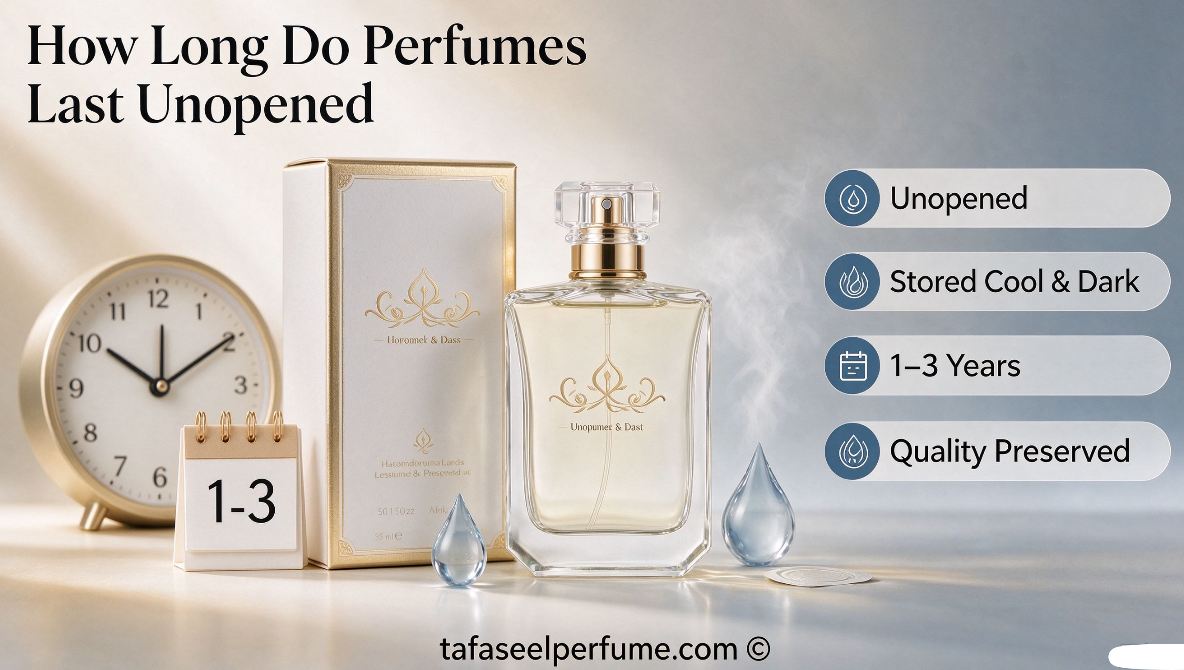
- How Long Do Perfumes Last Unopened? Shelf Life, Storage Tips, and Signs of Aging: How long do perfumes last unopened? Most unopened perfumes can remain in good condition for approximately three to five years, while some may retain their original scent for considerably longer when stored properly. The actual shelf life depends on the fragrance formula, ingredients, packaging, manufacturing quality, and storage environment. Keeping a perfume sealed and protecting it from heat, sunlight, and temperature changes can help preserve its original character.
Buying a perfume and saving it for a special occasion is common, especially when a fragrance is part of a gift collection, a seasonal purchase, or a personal fragrance wardrobe. However, perfume is not necessarily permanent simply because its bottle has never been opened. Over time, exposure to oxygen through packaging imperfections, temperature fluctuations, light, and chemical changes can affect the fragrance. Understanding how long unopened perfume lasts helps buyers make better decisions about collecting, storing, gifting, and using their favorite scents.
The shelf life of an unopened perfume is not determined by one universal expiration date. Different fragrances contain different combinations of aromatic materials, alcohol, water, stabilizers, and other ingredients. Some compositions are relatively stable, while others may gradually change in color, intensity, or scent profile. Citrus-heavy fragrances, for example, can be more sensitive to oxidation than certain compositions built around woods, resins, or heavier aromatic materials. Nevertheless, fragrance concentration alone cannot guarantee a particular lifespan.
Storage conditions are equally important. A sealed bottle kept in a cool, dry, dark cabinet may age more slowly than one stored in a sunny bathroom, near a heater, or inside a vehicle. Original packaging can provide an additional layer of protection from light and physical damage, although it cannot completely prevent every chemical change. Whether you own a designer fragrance, a niche perfume, a vintage bottle, or a gift set, understanding proper storage can help you preserve its quality for as long as possible.
Table of Contents
1. How Long Do Perfumes Last Unopened?
Learn the typical shelf-life range and why unopened fragrances can remain usable for different lengths of time.
2. What Determines the Shelf Life of an Unopened Perfume?
Explore the ingredients, formulation, packaging, and environmental factors that influence fragrance stability.
3. Does Perfume Expire If It Has Never Been Opened?
Understand why an unopened bottle can still change over time and what an expiration date really means.
4. How to Store Unopened Perfume Correctly
Discover practical storage methods that help protect fragrances from heat, light, and air exposure.
5. Does Keeping Perfume in Its Original Box Help?
Find out how original packaging can reduce light exposure and protect a fragrance during long-term storage.
6. Which Perfume Ingredients Last the Longest?
Compare fragrance families and ingredient characteristics that may influence how a perfume ages.
7. Can Unopened Perfume Change Color Over Time?
Learn why fragrance color may change and when discoloration deserves closer attention.
8. How to Tell If an Unopened Perfume Has Gone Bad
Identify potential warning signs involving scent, appearance, packaging, and product condition.
9. Does Perfume Concentration Affect Shelf Life?
Understand the differences between Eau de Toilette, Eau de Parfum, and Parfum without assuming concentration guarantees longevity.
10. How Long Do Different Types of Perfumes Last Unopened?
Explore how designer, niche, natural, vintage, and other fragrance categories may age.
11. Can You Use Perfume That Has Been Unopened for 10 Years?
Learn what to check before using an older bottle and why age alone does not determine quality.
12. Buying Perfume for Long-Term Storage
Understand how to evaluate packaging, authenticity, manufacturing information, and storage history.
13. Frequently Asked Questions About Unopened Perfume Shelf Life
Get practical answers about expiration, storage, unopened bottles, and fragrance preservation.
1. How Long Do Perfumes Last Unopened?
Unopened perfumes commonly remain in good condition for around three to five years, but this is a general guideline rather than a strict expiration rule. Some fragrances may maintain their original scent for much longer, especially when they are stored in stable conditions and protected from direct sunlight and excessive heat. Other perfumes may begin to change sooner because of their particular ingredients, packaging, or storage history.
The word unopened is important because a sealed bottle has generally experienced less direct contact with air than a bottle that has been repeatedly used. However, unopened does not necessarily mean completely isolated from the environment. Temperature changes, light exposure, imperfect seals, and the gradual aging of fragrance ingredients can still influence the liquid over time.
Many fragrance manufacturers provide a period-after-opening symbol or other product information rather than a universal expiration date for every bottle. The period-after-opening symbol indicates an expected usage period after the product has been opened. It should not automatically be interpreted as the exact shelf life of an unopened bottle. Buyers should check the packaging and manufacturer guidance for the specific product.
For people collecting fragrances, the practical approach is to store unopened bottles carefully and inspect them before use. A perfume that has been stored for several years may still smell excellent, while a newer bottle exposed to poor conditions may have deteriorated. Storage history can be more informative than age alone.
2. What Determines the Shelf Life of an Unopened Perfume?
Several factors influence how long an unopened perfume can maintain its original fragrance profile. The first is the formula itself. Perfumes contain combinations of aromatic compounds that can react differently to oxygen, light, and heat. Certain materials are relatively stable, while others may be more vulnerable to oxidation or other chemical changes.
The second factor is packaging. A well-designed bottle with a secure closure can reduce unwanted air exchange and protect the liquid from contamination. Dark or opaque packaging may also reduce exposure to light. However, not all bottles offer the same level of protection. Decorative caps, spray mechanisms, seals, and bottle materials can differ significantly between manufacturers and product lines.
The third factor is storage temperature. High temperatures can accelerate chemical reactions and may cause fragrance components to change more quickly. Repeated temperature fluctuations can also create unfavorable storage conditions. A perfume kept in a consistently cool indoor environment is generally better protected than one stored in a hot car or near a window.
Finally, manufacturing quality and supply-chain handling matter. A product that has been stored properly from the factory to the retailer may have a better chance of retaining its original characteristics. This is one reason buyers should consider the seller's reputation and storage practices when purchasing older or collectible fragrances.
3. Does Perfume Expire If It Has Never Been Opened?
Yes, an unopened perfume can eventually deteriorate, although it may remain usable beyond a commonly suggested shelf-life period. Fragrance ingredients are chemical materials, and their composition can gradually change over time. Sealing a bottle helps reduce exposure to air, but it does not stop every aging process. Heat, light, and the characteristics of the formula can continue to influence the fragrance.
It is useful to distinguish between a product's printed date, recommended usage period, and actual condition. A date may indicate a manufacturer's quality recommendation or a regulatory labeling requirement, depending on the market. It does not always mean that the perfume becomes unusable immediately afterward. Likewise, a bottle without a visible expiration date is not guaranteed to remain unchanged indefinitely.
When evaluating an older unopened bottle, consider its storage conditions, packaging integrity, and appearance. If the seal is damaged, the bottle leaks, or the liquid has developed an unusual appearance, further caution is appropriate. If the bottle appears normal, the fragrance can be evaluated carefully after opening, provided there are no obvious product-quality concerns.
People who own fragrances such as Versace Crystal Noir EDP or other designer scents should not assume that every bottle follows the same aging pattern. Different formulas and packaging designs can produce different results, even within the same broad fragrance category.
4. How to Store Unopened Perfume Correctly
Proper storage is one of the most effective ways to help preserve unopened perfume. The most important principle is to keep fragrance away from excessive heat and direct sunlight. A bedroom cabinet, closet shelf, or other stable indoor storage area is usually more suitable than a bathroom windowsill or a shelf near a radiator.
Choose a location with a relatively consistent temperature. Avoid storing perfume in places that become extremely hot during the day or cold at night. Vehicles are particularly unsuitable because interior temperatures can rise significantly in warm weather. Attics and garages may also experience wide temperature fluctuations depending on the climate and building insulation.
Humidity is another consideration, particularly for the external packaging. Excessive moisture can damage cardboard boxes, labels, and decorative materials. Although humidity does not affect every sealed fragrance in the same way, a dry indoor environment can help protect the complete product presentation.
It is also helpful to keep bottles upright and avoid unnecessary handling. Store them away from areas where they could fall or become damaged. If the perfume came in an original box, keep the box intact and use it as an additional protective layer. A simple storage routine can make a meaningful difference when maintaining a fragrance collection over several years.
5. Does Keeping Perfume in Its Original Box Help?
Keeping perfume in its original box can help protect it from light and physical damage. Many fragrance boxes are designed to hold the bottle securely and reduce exposure during transportation and storage. For bottles with transparent glass, the outer packaging provides an additional barrier between the fragrance and surrounding light.
Original packaging can also preserve product information, batch codes, labels, and presentation details. These details may be useful when checking the identity of an older fragrance or comparing it with information provided by a manufacturer or authorized retailer. For collectors, original boxes can also contribute to the value and completeness of a fragrance item, although collectible value depends on demand, condition, rarity, and authenticity.
However, a box cannot compensate for poor storage conditions. A perfume kept in its original packaging but exposed to extreme heat for extended periods may still deteriorate. The best approach is to combine original packaging with a cool, dark, and stable storage location.
Gift collections deserve similar attention. If you purchase a perfume gift set and plan to save it for a future occasion, keep the complete package away from sunlight and heat. Avoid placing heavy objects on top of the box, and check that the outer packaging remains dry and undamaged.
6. Which Perfume Ingredients Last the Longest?
Different fragrance materials have different chemical characteristics, which can influence how a perfume changes during storage. Heavier aromatic materials, including certain woods, resins, and balsamic notes, may be more persistent in a fragrance composition. Some citrus and delicate floral materials can be more sensitive to oxidation or other environmental influences.
However, it is not accurate to claim that every woody perfume lasts longer unopened than every citrus perfume. A fragrance is a complete formula rather than a single ingredient. The stability of the finished product depends on the quality and combination of its materials, the solvent system, stabilizers where used, packaging, and storage conditions.
Warm compositions containing amber, vanilla, woods, and resinous accords may develop differently from bright compositions dominated by citrus and fresh aromatic notes. A fragrance such as Replica Perfume Fireside illustrates the appeal of warm, smoky fragrance character, while fresh compositions often create a very different scent experience.
Natural ingredients do not automatically mean that a perfume has a shorter shelf life, and synthetic ingredients do not automatically guarantee greater stability. Both natural and synthetic aromatic materials vary widely. The finished formula and its storage conditions are more important than a simple natural-versus-synthetic distinction.
7. Can Unopened Perfume Change Color Over Time?
Yes, an unopened perfume can gradually change color as some of its ingredients age. A fragrance that originally appeared pale yellow may become darker, while certain compositions may develop a deeper amber tone. Color changes can result from oxidation, light exposure, ingredient interactions, or natural changes within the formula.
A slight color change does not automatically mean that a perfume is unusable. Some fragrances naturally deepen in color over time without developing an unpleasant smell. However, a dramatic or unexpected change may indicate that the product has experienced unfavorable storage conditions or deterioration.
Look at the complete condition rather than judging the fragrance by color alone. Check whether the liquid has become cloudy, whether visible particles have appeared, and whether the bottle or closure shows signs of leakage. Compare the liquid with reliable product photographs or manufacturer information when possible, while remembering that different batches and lighting conditions can affect how a perfume appears.
If the liquid looks significantly different from its expected appearance and the bottle has other warning signs, avoid applying it until its condition has been assessed. When there is uncertainty about product safety or quality, contacting the manufacturer or seller is a sensible step.
8. How to Tell If an Unopened Perfume Has Gone Bad
There is no single visual test that can determine whether every unopened perfume has deteriorated. A bottle may look completely normal while its scent has changed, and another may have darkened slightly without losing its recognizable fragrance character. A careful evaluation should consider packaging, liquid appearance, and scent after the bottle has been opened.
One potential warning sign is a noticeable change in smell. If the fragrance has developed a sharp sour, metallic, stale, or otherwise unpleasant odor that differs significantly from its expected profile, it may have deteriorated. Oxidation can affect the balance of aromatic materials, changing the way the fragrance smells when first applied and as it develops.
Other warning signs include unusual cloudiness, unexpected sediment, leakage, a damaged closure, or evidence that the seal has been compromised. These signs do not all have the same meaning, but they justify closer inspection. If the product appears contaminated or its packaging is damaged, it is better not to use it.
After opening an older bottle that appears intact, test a small amount cautiously and avoid applying it to irritated or sensitive skin. If the fragrance causes irritation, discontinue use. A perfume that smells noticeably different from its original character may no longer provide the experience intended by the manufacturer.
9. Does Perfume Concentration Affect Shelf Life?
Perfume concentration describes the proportion of fragrance materials in a formulation relative to its solvent and other components. Common categories include Eau de Cologne, Eau de Toilette, Eau de Parfum, and Parfum. These categories are associated with different concentration ranges, but exact percentages are not universally standardized across every brand.
A higher fragrance concentration does not automatically mean that an unopened perfume will last longer in storage. Shelf stability depends on the complete formulation, ingredient selection, packaging, manufacturing quality, and environmental conditions. Two Eau de Parfum products can age differently because their formulas may contain very different aromatic materials.
Likewise, an Eau de Toilette is not necessarily less stable than an Eau de Parfum. A lighter fragrance may retain its character for years when properly stored, while a richer composition may still change if exposed to heat and light. Concentration is useful when comparing fragrance strength and wearing characteristics, but it should not be used as the only indicator of shelf life.
When purchasing a fragrance for long-term storage, read the manufacturer's product information and examine the bottle design. If the manufacturer provides storage guidance or a recommended usage period, use that information as the primary reference.
10. How Long Do Different Types of Perfumes Last Unopened?
Designer perfumes, niche fragrances, natural perfumes, vintage fragrances, and limited-edition releases can all have different storage characteristics. Designer fragrances often use established manufacturing and packaging systems, but their shelf life still depends on the individual formula and storage history. A recognizable brand name does not guarantee that a bottle will remain unchanged indefinitely.
Niche perfumes may contain distinctive ingredient combinations and specialized formulations. Some may remain stable for many years, while others may evolve noticeably depending on their composition. Buyers should follow the storage instructions supplied by the brand rather than assuming that niche products have a longer shelf life than mainstream fragrances.
Natural perfumes can contain botanical materials that may be sensitive to light, heat, and oxidation. Their stability depends on the specific ingredients, extraction methods, formulation, and packaging. Some natural fragrance products may have more limited recommended storage periods than conventional alcohol-based perfumes, so checking the manufacturer's guidance is particularly important.
Vintage perfumes require additional care because their age and storage history may be uncertain. An unopened vintage bottle may retain an appealing scent, but it may also have experienced decades of temperature changes or packaging deterioration. Collectors should consider authenticity, bottle condition, batch information where available, and the seller's storage history before purchasing.
11. Can You Use Perfume That Has Been Unopened for 10 Years?
A perfume that has remained unopened for 10 years is not automatically unusable. Some fragrances can retain much of their original scent beyond the commonly suggested three-to-five-year guideline, particularly when stored in a cool and dark environment. Nevertheless, a decade is a substantial period, so the bottle should be inspected carefully before use.
Start by checking the packaging and bottle. Look for signs of leakage, a damaged cap, a compromised seal, unusual cloudiness, or unexpected particles. If the bottle is intact, open it carefully and evaluate the fragrance on a test strip before considering skin application. Compare the scent with reliable descriptions or, when possible, a known reference bottle of the same fragrance.
Pay attention to whether the fragrance has become unusually sharp, sour, flat, or unpleasant. Some aging may be subtle, while other changes can be immediately noticeable. If the scent has changed significantly or the liquid appears abnormal, it may no longer deliver the original fragrance experience.
For expensive or collectible bottles, avoid making assumptions based only on age. A vintage perfume may have collector interest even when it is not ideal for everyday wear. If authenticity or condition is uncertain, seek advice from a reputable fragrance specialist or the manufacturer where possible.
12. Buying Perfume for Long-Term Storage
If you plan to purchase perfume and keep it unopened for several years, consider both the product and the seller. Buy from reputable retailers that can provide clear product information and reasonable documentation. When purchasing discontinued or older fragrances, ask about storage conditions, packaging integrity, and the product's origin.
Check the bottle and outer box for visible damage. Look for signs of leakage, loose caps, broken seals, or damaged labels. If a seller provides batch information, retain it with your purchase records. Batch codes may help identify manufacturing information through appropriate brand or retailer channels, although not every public batch-code tool provides authoritative results.
Consider the purpose of the purchase. A fragrance intended for regular use may not need long-term storage, while a collectible bottle may require more careful preservation. If you are building a personal fragrance wardrobe, choose products that you genuinely expect to use rather than purchasing large quantities simply because a scent is temporarily available.
It can also help to explore different fragrance categories before making a long-term purchase. Guides to Polo Double Black Ralph Lauren and other fragrance profiles can help buyers understand the character of a scent before deciding whether it belongs in their collection.
13. Frequently Asked Questions About Unopened Perfume Shelf Life
How long do perfumes last unopened on average?
Many unopened perfumes remain in good condition for approximately three to five years, although some can last considerably longer. The actual period depends on the formula, bottle seal, packaging, and storage conditions.
Can unopened perfume last 10 years?
Yes, some unopened perfumes can remain usable for 10 years or more when stored properly. However, age alone cannot confirm quality. Check the bottle, liquid appearance, and fragrance character before use.
Does unopened perfume have an expiration date?
Some products display date information or a period-after-opening symbol, while others do not show a clear expiration date. The period-after-opening symbol generally refers to the recommended usage period after opening, not necessarily the exact shelf life of a sealed bottle.
Does perfume go bad if it stays in the box?
Perfume can still age inside its original box, but the box may reduce exposure to light and help protect the bottle. Keeping it in a cool, stable location provides additional protection.
Is it safe to use perfume that is 5 years old and unopened?
It may still be suitable for use if it has been stored properly and shows no signs of deterioration. Inspect the packaging and liquid, then evaluate the scent carefully after opening. Discontinue use if it smells unusual or causes irritation.
Does heat make unopened perfume expire faster?
Heat can accelerate chemical changes in fragrance ingredients and may shorten the period during which a perfume retains its original scent. Avoid storing bottles near heaters, in direct sunlight, or inside vehicles.
Should unopened perfume be stored in the refrigerator?
Refrigeration is not generally necessary for ordinary commercial perfumes. A consistently cool, dry, dark indoor location is usually more practical. Avoid extreme temperature changes and follow the manufacturer's specific storage instructions.
Can sunlight damage perfume inside an unopened bottle?
Yes. Some fragrance ingredients can be affected by light, even when the bottle remains sealed. Keeping perfume inside its original box and away from direct sunlight can help reduce exposure.
Does Eau de Parfum last longer unopened than Eau de Toilette?
Not necessarily. Concentration alone does not determine shelf stability. The formula, ingredients, packaging, and storage environment are more important factors when estimating how long an unopened fragrance may retain its original character.
Why does unopened perfume turn yellow or darker?
Color changes may occur because of oxidation, ingredient interactions, light exposure, or natural aging. A slight change does not automatically mean the fragrance is unusable, but dramatic discoloration or cloudiness deserves closer inspection.
Can an unopened perfume lose its smell?
Yes. Fragrance materials can gradually change over time, potentially reducing the original scent's freshness, balance, or intensity. A sealed bottle may slow some forms of deterioration but cannot prevent every aging process.
Is vintage unopened perfume worth buying?
It can be valuable to collectors, especially when the fragrance is discontinued or difficult to find. However, buyers should examine authenticity, storage history, bottle condition, and the possibility of scent changes before purchasing.
Does storing perfume upright help it last longer?
Keeping perfume upright is a sensible storage practice because it reduces unnecessary contact between the liquid and the closure or spray mechanism. It also makes bottles less likely to leak or become damaged.
Can perfume samples expire while unopened?
Yes. Small samples can age just like full-size fragrances. Their packaging may differ, so the quality of the vial, seal, and storage environment can influence how well the fragrance is preserved.
How can I tell whether an old perfume is still good?
Check for leakage, damaged packaging, unexpected cloudiness, unusual particles, and significant changes in scent. If the bottle appears normal, evaluate a small amount carefully. Avoid using the product if it smells unpleasant or causes skin irritation.
Does keeping perfume in a dark closet help preserve it?
Yes. A dark closet with a relatively stable indoor temperature can be a suitable storage location. It protects the bottle from direct sunlight and usually avoids the temperature fluctuations found in bathrooms, vehicles, and garages.
Should I throw away perfume after five years?
Not automatically. Five years is a useful general reference point, not a universal expiration deadline. Consider the manufacturer's instructions, storage history, packaging condition, and fragrance quality before deciding whether to continue using it.
Can unopened perfume be stored in a bathroom cabinet?
A bathroom cabinet is not always ideal because bathrooms can experience changes in temperature and humidity. A cool, dry bedroom cabinet or closet is generally a more stable option.
Does an unopened perfume bottle need to remain sealed?
Yes. Keeping the original seal intact helps protect the fragrance from unnecessary air exposure, contamination, and handling. Avoid opening a bottle simply to check its scent if you intend to preserve it for long-term storage.
What is the best way to preserve an expensive perfume?
Keep it in its original packaging, store it upright in a cool and dark place, avoid temperature fluctuations, and protect it from physical damage. Retain purchase information and follow the manufacturer's storage recommendations.
Conclusion: How to Make Unopened Perfume Last Longer
So, how long do perfumes last unopened? A period of approximately three to five years is a useful general guideline, but many fragrances can remain in good condition for longer when stored correctly. There is no universal expiration timeline because perfume formulas, ingredients, packaging, and storage environments differ from one product to another.
The most effective preservation strategy is straightforward: keep unopened perfume away from direct sunlight, excessive heat, and temperature fluctuations. Store bottles upright, retain their original packaging, and choose a cool, dry indoor location. When purchasing older or collectible fragrances, pay attention to the seller's reputation, product authenticity, packaging condition, and available storage information.
Ultimately, the condition of the fragrance matters more than its age alone. A carefully stored perfume may retain its original character for many years, while a bottle exposed to unfavorable conditions may change much sooner. With sensible storage habits and careful inspection, you can protect your fragrance collection and enjoy your favorite scents when the right occasion arrives.


