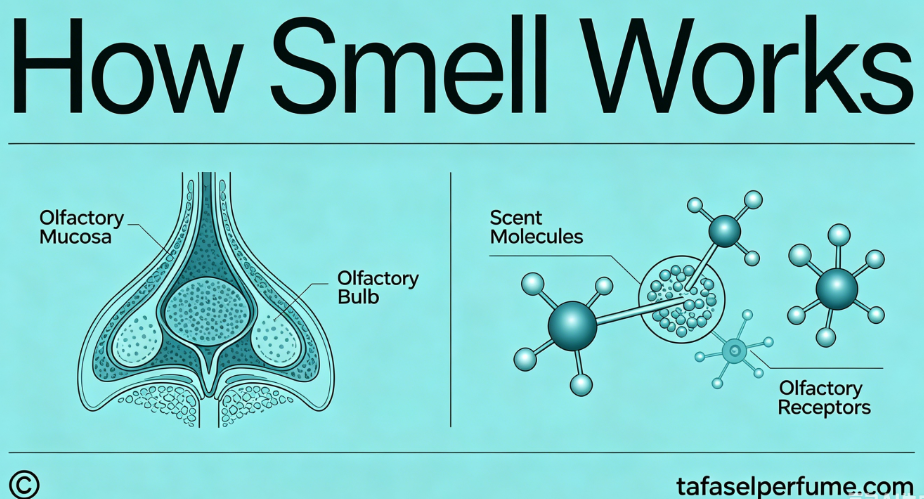
- How Do Scents Work? The Hidden Symphony of Smell, Memory & Emotion: Short intro: Scents work by sending chemical messages to your brain’s limbic system, instantly triggering emotions, memories, and even physical reactions. From perfume molecules binding to olfactory receptors to the way a single fragrance can transport you across time — the science of smell is both mysterious and magnificent.
Long intro: Have you ever wondered how do scents work on a biological and psychological level? Every time you inhale a fragrance — whether it’s fresh citrus, warm vanilla, or woody oud — microscopic odor molecules travel up your nasal cavity to a postage-stamp-sized region called the olfactory epithelium. There, they bind to specialized receptor neurons, sending electrical signals directly to the olfactory bulb. From there, signals race to the amygdala (emotion center) and hippocampus (memory hub), which explains why a particular perfume can feel nostalgic or deeply personal. The magic doesn’t stop at perception: scents can influence your mood, social attraction, and even cognitive performance. Understanding how do scents work unveils the artistry behind perfumery and the raw science behind every whiff.
Explore the science of scent:
- 1. The Olfactory Anatomy: Your Nose as a Chemical Lab
- 2. Lock & Key: How Odor Molecules Activate Receptors
- 3. From Nose to Brain: The Fastest Sensory Pathway
- 4. Why Smells Trigger Deep Memories (Proust Effect)
- 5. The Emotional Power of Scents & Pheromones
- 6. How Perfume Notes Work: Top, Heart & Base
- 7. The Science of Olfactory Fatigue & Adaptation
- 8. Scents & Behaviour: How Fragrance Shapes Attraction
1. The Olfactory Anatomy: Your Nose as a Chemical Lab
To truly grasp how do scents work, start with the architecture of smell. Inside your nasal cavity, the olfactory cleft houses millions of sensory neurons embedded in a yellowish patch of tissue. When you spray a perfume — let’s say a sophisticated floral blend — volatile molecules rise into the air and dissolve into the mucus layer covering these neurons. This process is silent yet explosive: each neuron expresses only one type of receptor protein, making them highly selective. Over 400 different olfactory receptor genes are active in humans, each tuned to specific molecular features. For an immersive fragrance experience, exploring curated scents deepens this understanding; brands like Unisex Perfume collections or Women's Perfume lines illustrate how diverse molecular profiles interact with our biology.
Interestingly, the olfactory system is the only sense that bypasses the thalamus — a central relay station — traveling directly to higher brain regions. That’s why a whiff of perfume feels immediate and unfiltered. The elegance of niche creations, such as those found in brands like Bond No 9 or Floris, demonstrates how varying molecular weights create distinct detection thresholds. Your nose truly functions as a real-time chemical spectrometer, decoding volatile organic compounds into perceptions of "rosy," "earthy," or "fresh." And this decoding happens in less than 200 milliseconds.
2. Lock & Key: How Odor Molecules Activate Receptors
The "lock and key" model explains much about how do scents work at the receptor level. Odorant molecules (keys) fit into olfactory receptor proteins (locks) embedded in the cilia of neurons. A perfect fit triggers a G-protein cascade, opening ion channels and generating an electrical impulse. However, modern science suggests a single odor can activate multiple receptors in unique patterns — forming a combinatorial code. This is why a perfume like Versace Versense Perfume for Women: Mediterranean Radiance & Timeless Elegance or Calypso Fragrance creates a complex profile of citrus, green and marine accords — each molecule contributing to a unique receptor activation fingerprint. Without this mechanism, we could not distinguish 10,000 different odors.
Moreover, the same molecule may smell differently based on concentration: indole in jasmine is floral at low levels but fecal at high doses. The versatility of olfactory receptors makes the perfume world endlessly fascinating. If you are curious about unisex olfactory designs, explore Unisex Perfume collections for molecules that transcend gender boundaries. Understanding lock-and-key dynamics also explains why genetic variations cause some individuals to perceive cilantro as soapy, or certain musks as odorless.
3. From Nose to Brain: The Fastest Sensory Pathway
Once olfactory receptors fire, signals travel along the olfactory nerve (Cranial Nerve I) to the olfactory bulb, which acts as a sorting station. From there, projections go directly to the piriform cortex (primary olfactory cortex), amygdala, and hippocampus. This near-instant connection — often within 100–150 milliseconds — is why a scent can alter your heartbeat or bring a tear before you consciously name the smell. For those seeking portable sophistication, Coach Travel Size Perfume: Portable Luxury & Timeless Elegance On-the-Go becomes a vehicle for rapid emotional shifts on daily commutes.
Brain imaging studies show that smelling a perfume strongly activates the orbitofrontal cortex, which encodes pleasantness and reward. This explains why a luxurious bottle like Bond No 9 Coney Island feels joyful — its salty-sweet carnival notes stimulate the brain’s pleasure centers directly. Unlike vision or hearing, olfaction is bilateral and ancient; it underlies much of our primal evaluation of food, danger, and mates. Understanding this neural shortcut reveals why perfumers blend molecules to craft “emotion in a bottle.”
4. Why Smells Trigger Deep Memories (Proust Effect)
The infamous Proustian memory effect — when a madeleine cake’s aroma triggers a flood of childhood recollection — is pure olfactory science. Because the olfactory bulb has direct reciprocal connections to the hippocampus and amygdala, scents act as potent memory anchors. This is why a specific fragrance like Special Moments Perfume: The Fragrant Diary of Your Most Cherished Memories becomes a personal time machine. When understanding how do scents work in memory, studies show that odors evoke more emotional and vivid recollections than images or words.
Perfumers leverage this by creating signature scents designed to encode positive life events. For young adults, exploring The Ultimate Perfume Guide for Young Ladies: Bloom with Confidence & Signature Elegance can help build olfactive memories linked to confidence. Even therapeutic applications exist: familiar pleasant scents can comfort dementia patients. The neural entanglement of smell and memory shows why your grandmother’s perfume or a vacation’s ocean breeze spray can feel achingly nostalgic years later.
5. The Emotional Power of Scents & Pheromones
Emotion and scent are inseparable. The amygdala — an almond-shaped cluster — processes fear, pleasure, and arousal, receiving dense olfactory input. That’s why lavender calms, peppermint energizes, and leather can evoke sensuality. For men’s grooming, fragrances like Hilfiger Men Perfume: Timeless American Spirit & Modern Masculine Elegance or Versace For Men Set are designed to project confidence and warmth, directly influencing mood perception of those nearby. While human pheromones remain debated, research suggests certain steroids (androstadienone) modulate mood and focus, adding another layer to how do scents work in social communication.
Retailers infuse ambient scent to boost sales — a floral-leather blend can increase luxury perception. On a personal level, a crisp deodorant such as Deodorant & Antiperspirant doesn’t just control sweat; it creates a subtle emotional halo of freshness. The bottom line: scent is the most direct route to influencing emotional states, making fragrance choices an underestimated wellness tool.
6. How Perfume Notes Work: Top, Heart & Base
The classic fragrance pyramid directly emerges from the physical chemistry of volatility — answering how do scents work over time. Top notes (citrus, light fruits) have small, light molecules that evaporate within 15 minutes. Heart notes (floral, spices) form the core after 20–40 minutes, while base notes (woods, amber, vanillin) are heavy molecules that can linger for hours. A perfect example is Floris Neroli Voyage: A Journey Through Citrus Elegance where neroli (heart) modulates between bitter orange top and musky base. For men’s long wear, Yves Saint Laurent for Men: The Ultimate Guide to Timeless Masculine Elegance balances aromatic top notes with deep woods.
When selecting a perfume, understanding evaporation rates helps you anticipate sillage (scent trail) and longevity. Gift sets like Perfume Gift Sets often contain layering products that intensify the pyramid’s evolution. Bottom line: each time you wear a fragrance, you’re experiencing a choreographed evaporation ballet determined by the molecular weight of hundreds of ingredients.
7. The Science of Olfactory Fatigue & Adaptation
Why does your own perfume seem to disappear after an hour? That’s olfactory adaptation (or fatigue). Your brain downregulates continuous signals to prioritize new or changing smells — a protective mechanism. This phenomenon directly relates to how do scents work in daily wear. The constant stimulation of the same receptor pattern leads to sensory-specific satiety. Many people overspray because they can't smell their own fragrance, but others perceive it strongly. For a balanced approach, exploring lighter options like Best Perfume Deodorant: The Ultimate Fusion of Fragrance & 24H Freshness can provide all-day freshness without overwhelming adaptation.
Adaptation happens on a cellular level: prolonged exposure reduces receptor sensitivity. However, if you leave the room and return, sensitivity rebounds. Perfumers use this to create "bloom" effects — certain ingredients like Iso E Super or hedione exhibit low sensory fatigue, allowing intermittent perception. The next time you feel your signature scent fades, ask a friend; they likely still smell it. This perceptual quirk is a masterpiece of neural economics.
8. Scents & Behaviour: How Fragrance Shapes Attraction
From romantic encounters to first impressions, fragrances wield social influence. Research shows that pleasant scents increase ratings of attractiveness and trustworthiness. In the context of how do scents work for attraction, certain ingredients — like clean musks, vanilla, and sandalwood — are cross-culturally preferred. For a flirty, youthful aura, Victoria's Secret Tease Perfume: The Ultimate Guide to a Flirty and Irresistible Fragrance captures sweet gourmand accords that signal playfulness. On the masculine side, aromatic fougères boost perceived competence. Even baby and children’s colognes (Children & Baby's Perfume) create comfort and safety cues.
Scents also influence our self-perception — wearing a high-quality fragrance increases confidence and reduces anxiety. For a distinctive signature, explore niche lines such as Promise Me Fragrance by Aeropostale. In social psychology, the "olfactory halo effect" means a good scent makes you appear more successful. So understanding the science helps you strategically select perfumes for job interviews, dates, or daily empowerment.
Discover more fragrance insights:
Frequently Asked Questions — How Do Scents Work?
Absolutely. Genetic variations in olfactory receptors (around 30% differ between individuals) mean one person may smell heavy patchouli while another detects only faint sweetness. Skin chemistry, temperature, and even prior exposure alter perception. That’s why testing a perfume like Coach Travel Size on your own skin is essential.
Olfactory adaptation plays a role, but also skin type: dry skin evaporates top notes faster, while moisturized or oily skin holds fragrance longer. Additionally, body temperature influences volatility. Using unscented lotion or fragrance primers — even exploring Spa & Fragrance products — can improve longevity.
As explained earlier, the olfactory bulb has direct access to the amygdala (emotion) and hippocampus (memory). This bypasses the thalamus, making scent-evoked memories feel more emotional and immediate than those triggered by sight or sound — the Proust effect.
Yes, significantly. Lavender and jasmine reduce cortisol, while citrus and peppermint enhance alertness. Scents literally change brainwave patterns. Calypso Fragrance blends uplifting marine and floral notes that promote relaxation — a form of aromachology.
Human pheromone research is still evolving. While some synthetic molecules (like androstenone) produce subtle mood shifts, most commercial "pheromone perfumes" lack robust evidence. However, smelling great boosts confidence, which indirectly influences attraction. You can’t go wrong with a well-crafted scent from prestige brands.
This stems from individual receptor genetics and learned associations. A negative past experience can cause an odor to trigger the insula (disgust center). Also, certain musky or heavy white floral notes contain indoles which, in high concentration, resemble fecal matter — some noses are highly sensitive to that aspect.
Deodorants rely on low molecular weight antimicrobial agents and light fragrances to mask odor, while fine perfumes use complex blends designed for drydown evolution. For fresh all-day protection combined with scent, try Deodorant & Antiperspirant formulas. Both work on the same olfactory principle, but performance and sillage differ.
Further reading & luxury collections: Enhance your olfactive knowledge through Perfume Articles and Tafaseel Signature Perfumes, where science meets artistry. Understanding how do scents work transforms every spray into a mindful experience.


