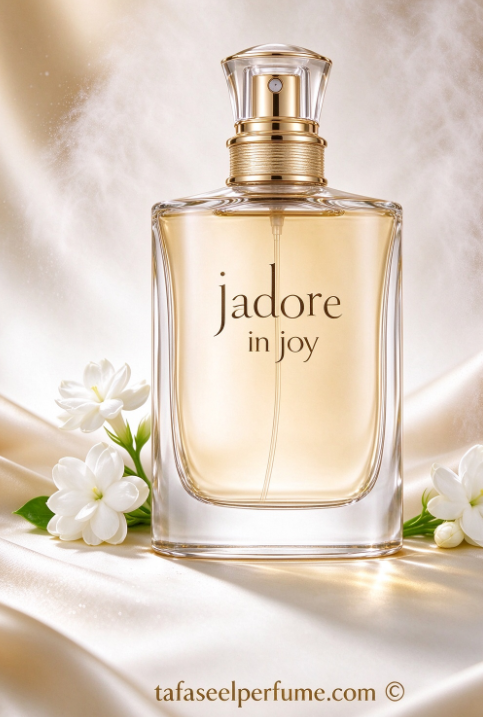
- J’adore in Joy by Dior — The Salt-Laced Floral That Taught a Classic to Smile: Short Intro: J’adore in Joy is the 2017 eau de toilette that took Dior’s golden bouquet and dipped it in fleur de sel. It is not a louder J’adore. It is a brighter, saltier, peachier one — a flanker that behaves less like a variation and more like a mood.
Extended Intro: When a fragrance house revisits its most famous floral, the temptation is to add sweetness or intensity. François Demachy did neither. For J’adore in Joy, the Dior perfumer-creator built the composition around an unusual fruity-salty accord, using fleur de sel as the opening gesture and a carefully selected Madagascan ylang-ylang heart to keep the white flowers luminous rather than heavy. The result sits at a curious intersection: it carries the recognisable jasmine-neroli-tuberose architecture of the J’adore lineage, but it replaces the original’s champaca richness with a breezier, more effervescent floral-fruity tone. On skin, it reads as clean, slightly saline, and quietly joyful — a fragrance that does not demand attention so much as invite a second sniff. For anyone exploring the softer, saltier side of modern white florals, it is a useful reference point, and it sits comfortably alongside other fresh-leaning feminine releases in the Women’s Perfume category. The following sections break down what J’adore in Joy actually smells like, where it fits, and why its strangeness is its strength.
1. The Scent Pyramid: Salt First, Flowers Second, Peach Last
J’adore in Joy does not begin with citrus or sugar. It begins with salt. Fleur de sel is listed as the top note, and on first spray it creates a mineral, almost skin-like freshness that feels closer to sea air than to perfume. This salty opening is the flanker’s signature move, and it is what separates the scent from every other J’adore on the shelf. The heart then unfolds into a white floral bouquet: Sambac jasmine, tuberose, neroli, and Madagascan ylang-ylang. These are not shy flowers, but here they are handled with restraint — the ylang-ylang in particular was chosen for its salty facet, so the floral core resonates with the opening rather than fighting it. The base is where J’adore in Joy becomes genuinely unusual. Instead of settling into woods or resins, it lands on peach: a soft, juicy, slightly powdery fruit note that extends the fragrance’s brightness and gives it a gentle, almost shampoo-like cleanliness. The overall effect is a floral-fruity-salt arc that feels less like a traditional pyramid and more like a single continuous gesture.
2. Fleur de Sel: The Accord That Makes J’adore in Joy Recognisable
The use of fleur de sel is not a gimmick, but it is the reason J’adore in Joy divides opinion. Demachy described the accord as a way to make white flowers shine, and in practice the salt does exactly that: it lifts the florals, prevents them from becoming syrupy, and gives the composition an airy, “smells of joy” quality that the perfumer explicitly intended. On some wearers, the salt reads as a clean, almost transparent freshness; on others, it is more pronounced and marine, evoking a salted breeze rather than a kitchen ingredient. This variability is part of the fragrance’s character. It is not a linear salt bomb, but a shifting saline floral that changes with skin chemistry and temperature. If you enjoy fragrances that sit close to the skin and feel more like a second skin than a statement, this is the axis on which J’adore in Joy delivers. It also makes the scent unusually wearable in warm weather, where heavier white florals can feel oppressive.
3. J’adore in Joy vs. Original J’adore: A Flanker That Stands Apart
Fragrantica reviewers frequently note that J’adore in Joy feels less like a version of J’adore and more like its own fragrance. The original is built around a rich, golden champaca-driven bouquet; in Joy, champaca is replaced by ylang-ylang and tuberose, and the composition gains a marine-peach overlay that the original never had. The result is lighter, more casual, and more overtly “fresh” than the classic. This is not a criticism of either scent — it is a clarification of purpose. Where the original J’adore reads as polished and evening-capable, Joy reads as daytime, warm-weather, and low-maintenance. If you already love the original’s floral architecture but want something less dense, Joy is the obvious flanker to test. If you are looking for a richer, more gourmand-adjacent interpretation of the J’adore idea, the broader Lancôme La Vie Est Belle guide covers a different, iris-gourmand route to the same white-floral territory.
4. Performance: Moderate Longevity, Intimate Sillage
J’adore in Joy is an eau de toilette, and its performance reflects that concentration. Community data on Fragrantica places longevity and sillage in the moderate range, with an average rating around 3.79 out of 5 across nearly two thousand votes. In practical terms, this means several hours of wear on skin, often longer on fabric, with a scent bubble that stays close rather than projecting across a room. Some wearers find it fades into a soft woody-peach skin scent after the first few hours; others report needing a midday reapplication. This is not a performance monster, and it was never designed to be. Its pleasure lies in the opening and the immediate drydown — the salted floral lift, the gentle peach hum — rather than in twelve-hour tenacity. For a fragrance that behaves this way, application to moisturised skin and a light layer on clothing will extend the experience without changing its character.
5. The Nose Behind the Salt: François Demachy’s Ylang-Ylang Obsession
François Demachy’s involvement is central to understanding why J’adore in Joy smells the way it does. The Dior perfumer-creator did not simply add salt to an existing formula. He sourced ylang-ylang essence specifically from Madagascar because that material carried a salty facet, then had it transported to Grasse for multiple distillations to obtain the exact “Ylang Heart” he wanted. This level of material specificity is unusual in a flanker, and it explains the coherence of the composition: the salt and the flowers are not layered on top of each other; they are chemically and olfactively intertwined. Demachy’s stated goal was an “original fruity-salty accord to make white flowers shine,” and the result is a rare flanker where the perfumer’s signature is legible in the wear rather than only in the marketing. For those who follow Demachy’s broader work, this sits alongside his other fresh-floral experiments as a study in restraint and material selection.
6. The Bottle: The Same Golden Drop, Now in Rosé
J’adore in Joy uses the same drop-shaped bottle as the classic J’adore, but the glass is tinted a soft rosé-pink rather than the original’s amber-gold. This is a small change with a significant visual effect. The bottle reads as lighter, younger, and more casual — which is exactly what the juice inside delivers. The tactile experience of the J’adore bottle remains one of the most distinctive in designer perfumery: the weight, the curve, and the gold collar all signal a certain kind of luxury. In Joy, that luxury is softened rather than diminished. It is a bottle that looks like it belongs on a dressing table in daylight, not only under evening lighting. This coherence between packaging and scent is not accidental; it is part of how flankers communicate their intent before the first spray.
7. When to Wear It: Warm Weather, Daytime, and Low-Stakes Joy
J’adore in Joy is at its best in conditions that match its temperament: warmth, daylight, and casual proximity. The salty opening feels alive in spring and summer, and the peach-tinged drydown keeps the fragrance from turning sharp in heat. Fragrantica wearers describe it as “appropriate everywhere and always” in warm weather, and the clean, almost shampoo-like quality makes it easy to wear to work, lunch, or a weekend errand without announcing itself. It is less suited to cold-weather evenings or formal settings where a denser, more resinous or gourmand composition would carry better. Think of it as a daytime signature for people who find classic white florals too heavy and aquatic freshies too thin. It occupies a middle ground: floral enough to feel feminine, salty enough to feel modern, and peach-soft enough to feel approachable.
8. Where J’adore in Joy Fits in a Modern Collection
A well-edited fragrance wardrobe benefits from contrast. If your collection leans heavily on sweet gourmands, dense orientals, or smoky woods, J’adore in Joy serves as a palate cleanser: a bright, saline floral that resets the nose without retreating into generic freshness. If your collection is already floral-heavy, it adds a salt-and-peach inflection that most white florals lack. It is also a useful reference point for anyone exploring the boundary between feminine and unisex territory — the saline facet gives it a transparency that some wearers find comfortably shared, even though it is marketed as a women’s fragrance. For a broader look at scents that cross that boundary, the Unisex Perfume selection offers context. J’adore in Joy is not a unisex fragrance by design, but its saltiness makes it legible to people who usually avoid sweet florals.
9. The Criticism: Linearity, Longevity, and the “Shampoo” Question
No honest account of J’adore in Joy can ignore its criticisms. Some wearers find the fragrance too linear, arguing that after the salty opening it settles into a predictable peach-floral hum without significant development. Others find the longevity insufficient for the price point, especially on skin that runs warm or dry. The “shampoo” comparison also appears repeatedly in community reviews — not as an insult, but as a description of the clean, fruity-floral softness that dominates the drydown. These are fair observations. J’adore in Joy is not a complex, evolving composition, and it does not pretend to be. Its appeal is atmospheric rather than structural: it creates a mood of lightness and cleanliness, and it does so with a specific, unusual salt-floral signature. If you value development and projection above all, this may not be the flanker for you. If you value a beautiful opening and an easy, skin-close drydown, the criticisms matter less than the pleasure of wearing it.
10. FAQ: J’adore in Joy
Is J’adore in Joy the same as J’adore? No. It is a flanker, not a repackaging. It shares the J’adore bottle and a white-floral lineage, but it replaces the original’s champaca richness with ylang-ylang, tuberose, and a fleur de sel accord. Most wearers describe it as lighter, saltier, and more daytime-friendly than the original.
What does fleur de sel smell like in this perfume? It reads as a mineral, slightly marine freshness rather than a literal salt note. On some skin it is subtle and clean; on others it is more pronounced and oceanic. It functions as a lifting agent for the white flowers rather than as a standalone salt bomb.
How long does J’adore in Joy last? Community data suggests moderate longevity — several hours on skin, often longer on fabric. It is an eau de toilette, so expect to reapply if you want the opening’s salty freshness to carry through an entire day.
Is it a safe blind buy? It depends on your tolerance for salt in fragrance. If you enjoy clean, saline florals and peach-soft drydowns, it is relatively low-risk. If you prefer dense, sweet, or resinous compositions, test first. The salt note is distinctive enough to be a dealbreaker for some noses.
Who is the perfumer? François Demachy, Dior’s perfumer-creator at the time of release. He built the composition around a specifically sourced Madagascan ylang-ylang essence with a salty facet, distilled in Grasse.
Is J’adore in Joy discontinued? Availability varies by market. It was launched in 2017 and remains in circulation through discounters and select retailers, but it is not always stocked alongside the core J’adore line. If you find a bottle you like, it is worth securing.
Can men wear it? It is marketed as a women’s fragrance, but the saline transparency makes it more shareable than many white florals. Wear what you enjoy; the salt note does not read as gendered.
What is the best season for it? Spring and summer, or any warm daytime setting where a light, clean floral-fruity scent feels appropriate. It is less suited to cold evenings or formal winter wear.


