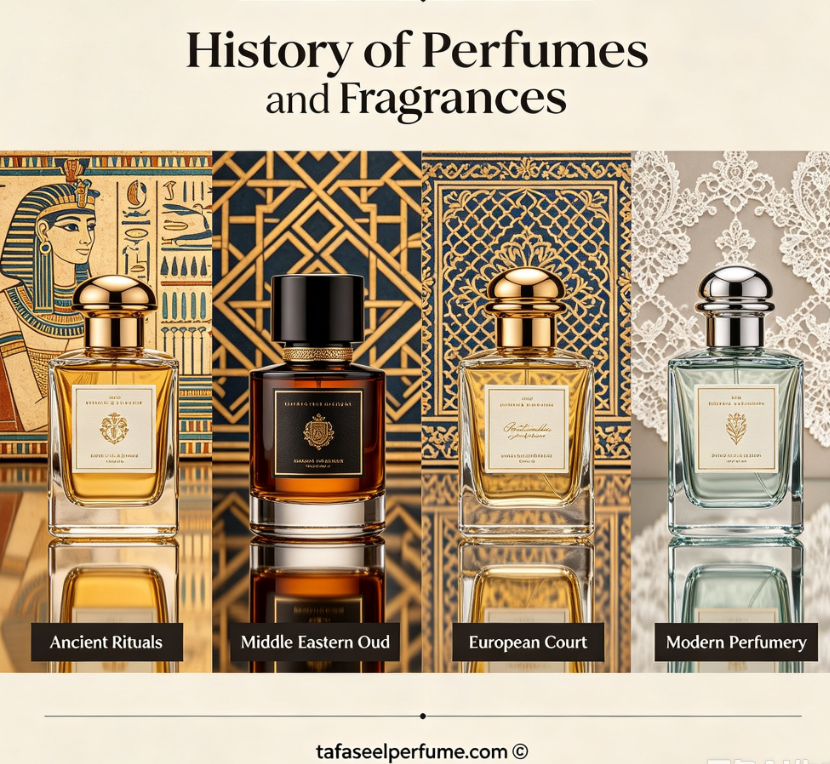
- From Sacred Smoke to Liquid Gold: The Epic History of Perfumes and Fragrances: Perfume is far more than a pleasant smell. It is memory, status, desire, and poetry bottled. For over 5,000 years, civilisations have distilled nature’s essence into wearable art – from Mesopotamian incense to modern niche perfumery. This is the story of fragrance, drop by drop.
The history of perfumes is entwined with trade routes, religious rites, medicine, and the pursuit of beauty. Ancient Egyptians used kyphi in temples; Greeks and Romans anointed themselves with exotic oils; the Islamic world perfected distillation; Renaissance Italy and France transformed perfume into a luxury industry. Today, perfumery is a multi-billion dollar universe, yet every bottle carries echoes of ancient recipes, royal courts, and the relentless human desire to capture the intangible. This long read explores the pivotal moments, ingredients, and cultures that shaped the scent world we know.
Chapters in fragrance history
1. Incense & antiquity 2. Egyptian kyphi & temple rituals 3. Greece: scented athletics & politics 4. Rome: rose petals & excess 5. The Islamic golden age of distillation 6. Alchemists & the birth of alcohol-based perfumes 7. Renaissance Italy: the Medici & glove-makers 8. France: Grasse & the cradle of modern perfumery 9. Synthetic molecules & the 19th century revolution 10. The 20th century: icons, couture & global brands 11. Niche, natural, and the future of fragrance 12. Perfume as cultural memory1. Incense & antiquity — the first sacred fumes
The earliest evidence of fragrance use dates back to the Bronze Age (c. 3000 BCE) in Mesopotamia, where clay tablets record recipes for aromatic resins. Incense burners have been excavated from the Indus Valley and ancient Sumer, suggesting that smoke was considered a bridge to the divine. Frankincense and myrrh were more valuable than gold, traded along the Incense Route from Arabia to the Mediterranean. These resins were not only used in temples but also to fumigate homes and clothing, creating the first “ambient” fragrances.
The Ebers Papyrus (c. 1500 BCE) lists dozens of aromatic compounds used in Egyptian medicine, revealing that perfume was intimately linked with healing. Priests were the earliest perfumers, guarding the sacred formulas. This era laid the foundation for the belief that scent could purify, protect, and elevate the soul — a belief that persists in many cultures today.
2. Egyptian kyphi & temple rituals
Kyphi is perhaps the most famous ancient Egyptian fragrance — a complex blend of sixteen ingredients including myrrh, frankincense, cinnamon, and honey. It was burned in temples at dawn and dusk, and its recipe was inscribed on temple walls at Edfu and Philae. Kyphi was also used in embalming, as the Egyptians believed that pleasant odours eased the deceased’s journey to the afterlife.
The Egyptians also pioneered the use of oil-based perfumes (unguents), macerating flowers and woods in animal fats. They stored these balms in alabaster jars, many of which were found in Tutankhamun’s tomb, still retaining faint traces of their original scents. This period firmly established perfume as a symbol of royal and divine power.
3. Greece: scented athletics & politics
The ancient Greeks embraced perfume with characteristic ardour. After bathing, athletes massaged their bodies with scented oils — not only for fragrance but also to keep muscles supple. Saffron, marjoram, and rose were among the most prized essences. Perfume was also used at symposia (drinking parties), where guests wore garlands and scented oils to enhance the sensory experience.
Theophrastus, a student of Aristotle, wrote “On Odours” (c. 300 BCE), one of the earliest systematic treatises on perfumery, classifying scents and describing extraction methods. The Greeks also linked fragrance to social status — the elite could afford exotic imports from Arabia and India, while cheaper oils were used by the masses.
4. Rome: rose petals & excess
Roman perfumery was extravagant, even decadent. Rose water and rose petals were used in fountains, baths, and even sprinkled at feasts. The Romans were also master blenders, mixing local herbs with imported resins. They popularized solid perfumes (pomades) and scented powders for the body.
Pliny the Elder documented the extensive trade in aromatics, noting that Rome consumed vast quantities of frankincense and myrrh. However, the early Christian church often viewed excessive perfumery as pagan and decadent, leading to a temporary decline in Western Europe after the fall of Rome. Yet, in the East, the art of perfumery continued to flourish.
Spa & Fragrance Body Art Nail Supplies
5. The Islamic golden age of distillation
Between the 8th and 13th centuries, Islamic scholars and chemists transformed perfumery. The invention of the alembic still by Jabir ibn Hayyan (Geber) allowed for the distillation of essential oils, producing purer and more concentrated extracts. Rose water became a signature of Islamic perfumery, and the use of alcohol as a solvent began to emerge.
The Kitab al-Asrar (Book of Secrets) and other texts detailed distillation methods, and the city of Kufa became a centre of fragrance production. Trade routes brought sandalwood, camphor, and musk from India and East Asia, enriching the olfactory palette. This period also saw the rise of attar — traditional hydro-distilled oils — which remain foundational in Eastern perfumery.
6. Alchemists & the birth of alcohol-based perfumes
The use of ethanol as a solvent for fragrance was a game-changer. While distilled alcohol had been known, it was in the late medieval period that European alchemists began creating “eau de toilette” – water of fragrance. Hungary Water (c. 1370) was one of the first alcohol-based perfumes, supposedly concocted for Queen Elizabeth of Hungary.
This innovation allowed perfumes to be lighter, more volatile, and easier to apply as a spray. It also paved the way for the modern perfume industry. The blending of essential oils with alcohol became the standard, enabling complex top, heart, and base notes — the structure we still use today.
7. Renaissance Italy: the Medici & glove-makers
In 14th-century Italy, especially in Florence and Venice, perfumery became intertwined with the leather and glove trade. Scented gloves, known as “gants parfumés”, were a status symbol. Catherine de’ Medici brought her personal perfumer to France in the 16th century, planting the seeds for French dominance.
Italian perfumers developed sophisticated techniques for extracting scents from bergamot, lemon, and jasmine. They also created the first “eau de cologne” (originally a light, citrusy unisex water) which would later become a global sensation. The Renaissance elevated perfume to an art form, with skilled artisans often holding court positions.
8. France: Grasse & the cradle of modern perfumery
By the 17th century, France had become the epicentre of perfumery, largely due to the town of Grasse in Provence. The mild climate and fertile land made it ideal for cultivating jasmine, rose, lavender, and tuberose. Grasse pioneered enfleurage, a cold-fat extraction method that preserved delicate floral notes.
The French court of Louis XIV and later Louis XV embraced perfume with unparalleled enthusiasm — the Palace of Versailles was known as the “cour parfumée” (perfumed court). In the 18th century, the first perfume houses, such as Houbigant and Guerlain, were founded, and perfume became a global luxury commodity. The French language and culture remain synonymous with fine fragrance.
9. Synthetic molecules & the 19th century revolution
The 19th century brought a seismic shift with the advent of synthetic chemistry. In 1868, coumarin (smelling of new-mown hay) was synthesised, followed by vanillin in 1874 and ionones (violet-like) in 1893. This allowed perfumers to create scents that did not exist in nature, such as Chanel No. 5 (1921), which famously used aldehydes to achieve a sparkling, abstract floral.
Synthetics also democratised perfume, making it more affordable and stable. The industry expanded rapidly, with iconic fragrances like Shalimar (Guerlain, 1925) and Joy (Patou, 1930) defining eras. The synthetic revolution is often seen as the turning point that transformed perfume from a craft into a global chemical industry.
10. The 20th century: icons, couture & global brands
The 20th century saw perfume become big business. Fashion houses like Chanel, Dior, and Yves Saint Laurent launched perfumes as integral parts of their brand identity. Celebrity endorsements, glossy advertising, and global distribution turned fragrance into a mass-market lifestyle product.
The 1950s to 1990s gave us enduring icons: Miss Dior (1947), Opium (1977), Obsession (1985), and Aqua di Gio (1996). Perfume also became more gendered, with aggressive marketing targeting men and women separately. Meanwhile, the rise of department store counters and “fragrance families” (floral, oriental, woody, fresh) helped consumers navigate the ever-expanding olfactory universe.
11. Niche, natural, and the future of fragrance
Since the 2000s, a niche perfumery movement has emerged, challenging the mainstream with artisanal, bold, and often unconventional scents. Brands like Diptyque, Byredo, Le Labo, and Frederic Malle champion creativity and rare ingredients. Simultaneously, there is a growing demand for natural and sustainable perfumes, using organic alcohol, ethically sourced botanicals, and biodegradable packaging.
Biotechnology is also entering the scene, with lab-grown sustainable musk and synthetic sandalwood reducing pressure on endangered species. The future of perfume may be as much about data and AI as about blossoms and resins — but the emotional core remains unchanged.
12. Perfume as cultural memory
Ultimately, the history of perfume is the history of human civilisation. Every scent carries memories — of a person, a place, a moment. From the incense of ancient temples to the synthetic molecules of tomorrow, perfume is a mirror of our desires, our technologies, and our collective imagination. It is liquid memory, and its story continues to be written with every new fragrance launched.
As we spritz, dab, or roll on our favourite scent, we are participating in a ritual that connects us to pharaohs, scholars, alchemists, and artists. Perfume is not merely about smelling good; it is about feeling alive.


