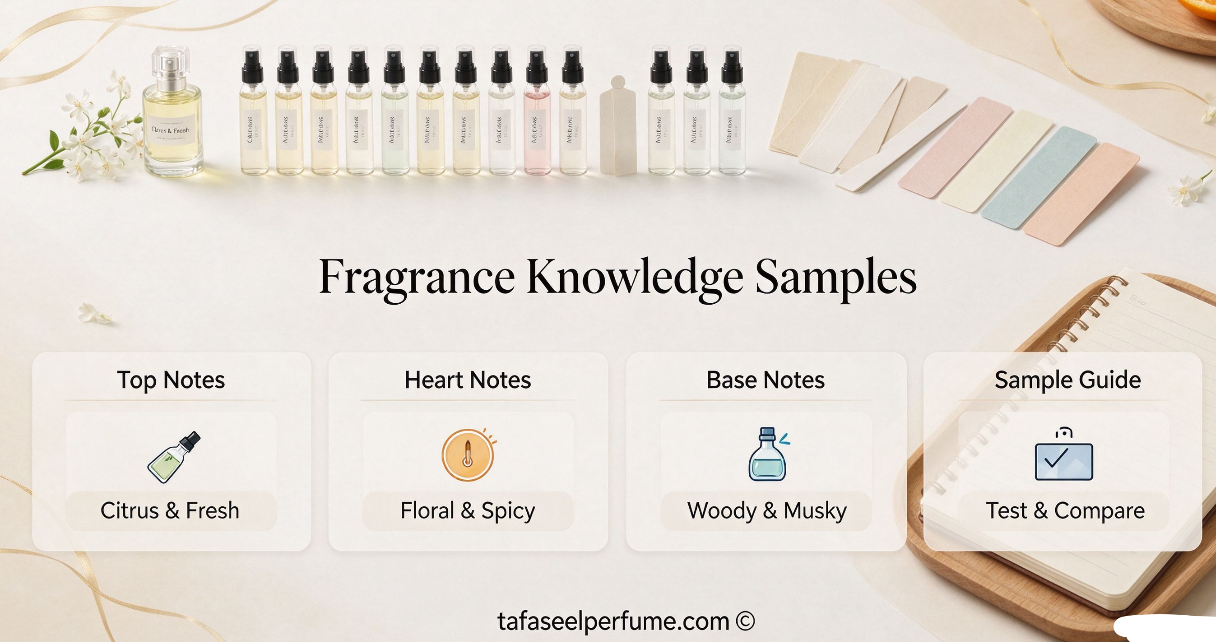
- Fragrance Knowledge Samples: A Complete Guide to Perfume Notes, Scent Families, Fragrance Testing, and Understanding Perfumes: Fragrance knowledge samples are an excellent starting point for anyone who wants to understand the world of perfumes, explore different scent profiles, and learn how to identify fragrance characteristics. Whether you are a beginner discovering perfume for the first time, a fragrance enthusiast comparing popular scents, or someone interested in learning about perfume ingredients, understanding fragrance samples can make the entire experience more enjoyable.
Perfume is more than a pleasant smell. It combines aromatic ingredients, creative composition, fragrance concentration, and individual skin chemistry to produce a unique sensory experience. From fresh citrus and delicate florals to warm woods, rich amber, and sweet gourmand accords, every fragrance family has its own personality. Fragrance samples allow people to explore these characteristics without immediately purchasing a full-size bottle.
This comprehensive fragrance knowledge guide explains how perfume samples work, how fragrance notes are structured, what different scent families smell like, and how to evaluate fragrance performance. It also covers perfume concentrations, sampling techniques, skin chemistry, fragrance storage, and practical tips for building a personal fragrance collection. By understanding these fundamentals, shoppers can make more confident decisions and discover scents that match their preferences.
Article Introduction: Whether you are researching fragrance knowledge samples for personal education, perfume shopping, or developing a deeper appreciation of perfumery, this guide provides practical explanations and examples. Explore the essential concepts behind fragrance composition, learn how to test perfumes correctly, and discover how different ingredients work together to create memorable scents.
Table of Contents
1. What Are Fragrance Knowledge Samples?
2. Why Are Perfume Samples Important for Fragrance Learning?
3. Understanding the Three Layers of Fragrance Notes
4. The Main Fragrance Families Every Beginner Should Know
5. Understanding Perfume Concentrations and Strength
6. How to Test Fragrance Samples Correctly
7. How Skin Chemistry Influences Fragrance Performance
8. Understanding Fragrance Ingredients and Aromatic Materials
9. How to Evaluate Perfume Longevity and Projection
10. Fragrance Knowledge Samples for Different Occasions
11. How to Build a Personal Fragrance Sample Collection
12. Common Mistakes When Testing Perfume Samples
13. How to Store Fragrance Samples Properly
14. How to Develop Your Fragrance Knowledge Over Time
15. Frequently Asked Questions About Fragrance Knowledge Samples
1. What Are Fragrance Knowledge Samples?
Fragrance knowledge samples are small perfume portions or educational examples that help people understand different aspects of perfumery. They may include miniature perfume bottles, sample spray vials, fragrance discovery sets, ingredient demonstrations, or scent reference collections. Their purpose is to make fragrance exploration more accessible and provide opportunities to compare different compositions.
A perfume sample usually contains a small quantity of the original fragrance, allowing someone to experience its opening notes, development, and dry-down before purchasing a larger bottle. Some samples are provided by fragrance brands, while others are included in discovery collections or purchased from authorized fragrance retailers.
Educational fragrance samples can also be used to study specific scent categories. For example, a collection might contain citrus, floral, woody, oriental-style, aromatic, and gourmand fragrances. Comparing these samples helps beginners recognize the differences between fresh, sweet, spicy, powdery, and earthy compositions.
One important advantage of fragrance sampling is that it encourages informed purchasing. Perfume can smell different on a testing strip compared with human skin, and a fragrance that initially seems attractive may develop differently after several hours. Sampling gives consumers an opportunity to understand these changes before making a full-size purchase.
For shoppers who want to explore a wider selection of scent styles, unisex perfume collections offer an interesting starting point because they include fragrances designed around scent preferences rather than traditional gender categories.
2. Why Are Perfume Samples Important for Fragrance Learning?
Perfume samples are valuable because fragrance appreciation develops through comparison and repeated exposure. Reading a list of ingredients can provide useful information, but actually smelling different compositions helps people understand how aromatic materials interact.
For example, someone who has never explored woody fragrances may find it difficult to understand the difference between sandalwood, cedarwood, vetiver, and patchouli through descriptions alone. Testing samples makes these distinctions easier to recognize over time.
Samples also help consumers identify their personal fragrance preferences. Some people naturally gravitate toward fresh citrus scents, while others prefer warm vanilla, soft musk, green botanical notes, or rich floral compositions. Testing several fragrance families can reveal patterns that are not immediately obvious.
Another benefit is cost management. Designer and niche perfumes can be expensive, especially when purchasing large bottles. Samples provide an affordable way to explore different fragrance houses and compositions before committing to a particular product.
Fragrance samples are also useful for comparing similar perfumes. Two fragrances may both be described as floral, but one might emphasize fresh jasmine while another features creamy white flowers and warm woods. Sampling makes these differences easier to appreciate.
For anyone developing a perfume collection, samples can serve as a practical learning tool and a way to avoid unnecessary purchases.
3. Understanding the Three Layers of Fragrance Notes
One of the fundamental concepts in fragrance education is the structure of perfume notes. Fragrances are commonly described using three layers: top notes, middle notes, and base notes. These layers help explain how a perfume changes from the moment it is applied until its later dry-down.
Top Notes: Top notes create the first impression of a fragrance. They are often fresh, bright, and immediately noticeable after spraying. Common examples include bergamot, lemon, orange, grapefruit, mint, and aromatic herbs. These materials can contribute a refreshing opening, although their presence and duration depend on the formulation.
Middle Notes: Middle notes, sometimes called heart notes, become more noticeable as the initial opening develops. Floral, fruity, spicy, and aromatic ingredients frequently appear in this part of a fragrance composition. Jasmine, rose, lavender, geranium, and cardamom are examples of materials that may contribute to a fragrance's heart.
Base Notes: Base notes provide depth and help establish the lasting character of a perfume. Common examples include sandalwood, cedarwood, vanilla, amber accords, patchouli, musk, and vetiver. These materials often create warmth, softness, richness, or an earthy impression.
Not every fragrance follows a perfectly separated three-stage structure. Modern perfumery can use linear compositions, where the overall scent remains relatively consistent, or complex compositions in which different ingredients emerge gradually.
When studying fragrance knowledge samples, observe how the scent changes over time instead of evaluating only the opening. This approach helps develop a more accurate understanding of perfume composition.
4. The Main Fragrance Families Every Beginner Should Know
Fragrance families provide a useful classification system for understanding perfumes. They group scents according to their dominant aromatic characteristics and help shoppers identify styles they may enjoy.
Floral Fragrances: Floral perfumes feature flowers as their main aromatic inspiration. Rose, jasmine, peony, orange blossom, and tuberose are common examples. Floral fragrances can be fresh, powdery, creamy, green, or intensely rich depending on the composition.
Citrus Fragrances: Citrus perfumes emphasize bright and refreshing ingredients such as lemon, bergamot, mandarin, grapefruit, and lime. They are often associated with clean, energetic, and uplifting fragrance experiences.
Woody Fragrances: Woody compositions feature materials such as cedarwood, sandalwood, vetiver, and patchouli. These fragrances can feel dry, creamy, earthy, smoky, or warm.
Oriental and Amber Fragrances: These fragrance styles often emphasize warmth, sweetness, spices, resins, and rich aromatic accords. Vanilla, amber, cinnamon, benzoin, and labdanum are common materials associated with this general direction.
Fresh and Aquatic Fragrances: Fresh compositions may include green notes, citrus, herbs, marine accords, and clean aromatic materials. Aquatic fragrances often attempt to evoke the impression of water, ocean air, or cool freshness.
Gourmand Fragrances: Gourmand perfumes feature edible-inspired characteristics such as vanilla, chocolate, caramel, coffee, almond, honey, and creamy accords. They are popular among people who enjoy sweet and comforting fragrance profiles.
For a practical example of gourmand fragrance characteristics, explore Fall Gourmand Perfume, which examines warm, sweet, and seasonal scent styles.
5. Understanding Perfume Concentrations and Strength
Perfume concentration describes the proportion of aromatic materials in a fragrance formula. Although concentration can influence intensity and longevity, it is not the only factor determining performance. Ingredient volatility, formulation, application, and environmental conditions also matter.
Eau de Cologne: Traditionally, eau de cologne refers to a lighter fragrance concentration, often associated with fresh citrus and aromatic compositions. The term can also have broader commercial meanings depending on the brand and market.
Eau de Toilette: Eau de toilette is a common fragrance category that generally offers a moderate concentration. It can be suitable for everyday wear and is available in fresh, floral, woody, and many other fragrance styles.
Eau de Parfum: Eau de parfum generally contains a higher proportion of aromatic materials than eau de toilette. It is frequently chosen by people who prefer a more substantial fragrance experience.
Parfum or Extrait de Parfum: These terms often describe more concentrated fragrance formats. Their formulas can provide an intense or rich scent experience, although actual performance varies between products.
Concentration ranges are not universally standardized across all fragrance brands. Therefore, shoppers should treat concentration labels as useful guidance rather than guaranteed measurements of longevity.
When comparing fragrance samples, it is helpful to test different concentrations within similar scent families. This makes it easier to understand how formulation changes can influence the fragrance experience.
6. How to Test Fragrance Samples Correctly
Testing perfume samples correctly is essential for understanding their real scent characteristics. A quick spray and immediate decision may not reveal the complete fragrance experience because many compositions develop gradually.
Begin by testing the fragrance on a clean smelling strip or blotter. Spray a small amount and allow the initial alcohol impression to dissipate. Smell the opening and record your first impression, including whether the fragrance feels fresh, sweet, floral, spicy, or woody.
If you like the initial result, test the perfume on a small area of skin according to the product instructions. Skin testing helps reveal how the composition develops under individual conditions. Avoid testing several strong fragrances on the same area because overlapping scents can make comparisons difficult.
Observe the fragrance at different intervals. The opening may feel bright and citrusy, while the dry-down may become warmer or more powdery. Recording these changes can improve your ability to identify individual fragrance characteristics.
It is also useful to avoid wearing too many different samples at once. A small number of carefully selected fragrances makes it easier to distinguish their differences and reduces olfactory fatigue.
Keep notes about the fragrances you test. Include the product name, fragrance family, first impression, development, longevity, and overall preference. Over time, these observations become a useful personal fragrance reference.
7. How Skin Chemistry Influences Fragrance Performance
Skin chemistry is an important consideration when evaluating perfume samples. The same fragrance can smell slightly different on different people because skin conditions and environmental factors influence how aromatic materials are perceived.
Skin hydration can affect the way fragrance develops and how long it remains noticeable. Dry skin may provide a different fragrance experience compared with well-moisturized skin. Temperature, perspiration, skincare products, and environmental humidity can also influence scent perception.
This explains why testing perfume only on paper is not always sufficient. A blotter provides a useful reference for the fragrance itself, but skin testing offers additional information about how the perfume performs in everyday conditions.
It is also important to understand that individual skin chemistry does not completely transform every fragrance. Differences can be subtle, and the underlying composition remains determined by the perfume formula.
When evaluating fragrance knowledge samples, test promising products on your own skin before deciding whether they deserve a place in your collection. This helps avoid purchasing a perfume simply because it smelled attractive on someone else.
8. Understanding Fragrance Ingredients and Aromatic Materials
Perfume ingredients can come from natural sources, synthetic aroma chemicals, or combinations of both. Modern perfumery uses a wide range of materials to create complex and balanced fragrance compositions.
Natural Essential Oils: Essential oils are aromatic materials extracted from botanical sources through methods such as steam distillation or cold pressing. Examples include lavender oil, bergamot oil, and various citrus oils.
Absolutes: Absolutes are concentrated aromatic extracts commonly produced using solvent extraction. Rose and jasmine absolutes are examples of materials used in fine fragrance compositions.
Synthetic Aroma Chemicals: Synthetic materials help perfumers create consistent scent effects, reproduce particular aromatic impressions, and develop accords that may be difficult to obtain from natural materials alone.
Fragrance Accords: An accord is a combination of aromatic materials designed to create a unified scent impression. For example, a perfumer may combine several ingredients to create an impression of fresh rain, warm amber, creamy woods, or soft powder.
Fixatives and Long-Lasting Materials: Some fragrance ingredients contribute to the persistence and structure of a perfume. Musks, woody materials, resins, and other low-volatility ingredients may help create a lasting fragrance foundation.
It is important to remember that natural ingredients are not automatically safer than synthetic ingredients. Both categories can contain substances that cause irritation or allergic reactions. Product formulation, concentration, and individual sensitivity all matter.
9. How to Evaluate Perfume Longevity and Projection
Longevity and projection are two different aspects of fragrance performance. Understanding the distinction makes perfume comparisons more accurate.
Longevity: Longevity describes how long a fragrance remains detectable after application. Some fragrances are noticeable for a relatively short period, while others remain detectable for many hours. Performance varies by formula, skin, weather, and application conditions.
Projection: Projection describes how far a fragrance radiates from the wearer. A perfume with strong projection may be noticeable from a greater distance, while a softer fragrance may remain closer to the skin.
Sillage: Sillage refers to the scent trail left behind as someone moves. Certain fragrances create a noticeable aromatic trail, while others produce a more intimate scent experience.
These three characteristics should not be confused. A fragrance may last a long time but have relatively soft projection. Another may project strongly during its opening but become quieter after a short period.
When testing samples, record these characteristics separately. This gives you a clearer understanding of whether a perfume is appropriate for work, social occasions, outdoor activities, or evening events.
For an example of a fragrance review that considers scent profile and performance, read Versace Crystal Noir EDP.
10. Fragrance Knowledge Samples for Different Occasions
Fragrance selection often depends on the occasion, environment, and desired impression. Building fragrance knowledge through samples helps consumers discover which scent profiles work best in different situations.
Office and Professional Environments: Light citrus, soft florals, clean musks, and subtle woody fragrances can be appropriate choices. Moderate application is especially important in enclosed spaces and shared workplaces.
Casual Everyday Wear: Fresh, aromatic, and lightly fruity compositions are popular options for everyday activities. These fragrances can provide a comfortable scent experience without requiring a formal occasion.
Evening Events: Warm amber, woods, spices, and richer floral compositions may be appealing for evening settings. Their character can create a more noticeable fragrance presence.
Summer Fragrances: Citrus, aquatic, green, and light aromatic profiles are frequently associated with warmer weather. Their fresh character can feel comfortable during daytime activities.
Autumn and Winter Fragrances: Vanilla, woods, amber, spices, and gourmand accords are often popular during cooler seasons because they create warm and comforting scent impressions.
Seasonal fragrance preferences are personal rather than strict rules. A person who enjoys a warm vanilla fragrance may wear it throughout the year, while someone else may prefer fresh citrus scents even during winter.
11. How to Build a Personal Fragrance Sample Collection
Building a fragrance sample collection is a practical way to develop a deeper understanding of perfumery. Instead of collecting random samples, consider organizing them by fragrance family, concentration, or personal preference.
Start with a balanced selection of scent categories. Include at least one citrus fragrance, one floral composition, one woody scent, one fresh or aquatic fragrance, and one warm amber or gourmand perfume. This provides a useful introduction to the major fragrance styles.
Next, include samples from different fragrance houses. Designer brands, independent perfume makers, and niche fragrance labels may approach similar scent families in different ways. Comparing their compositions helps reveal differences in materials, balance, and creative direction.
Keep the original labels whenever possible. Record the fragrance name, concentration, manufacturer, sample date, and personal observations. This information is particularly helpful when testing many perfumes over several weeks.
Sample discovery collections can also make excellent gifts for fragrance enthusiasts. They allow recipients to explore different scents without committing to a single full-size bottle. For more options, browse mini-size and gift sets.
As your collection develops, identify the fragrance characteristics you consistently enjoy. This information can help narrow future purchases and make fragrance shopping more efficient.
12. Common Mistakes When Testing Perfume Samples
Many beginners make avoidable mistakes when exploring fragrance samples. Recognizing these problems can improve the accuracy of perfume evaluations and make the sampling process more enjoyable.
Judging a Perfume Too Quickly: A fragrance may change significantly after application. Avoid deciding whether you like a perfume based exclusively on its opening notes.
Testing Too Many Scents at Once: Excessive fragrance exposure can lead to olfactory fatigue. Limit the number of samples you test during one session and take breaks between comparisons.
Ignoring Skin Performance: Paper strips are useful, but they cannot fully reproduce the experience of wearing perfume. Test promising fragrances on skin before purchasing.
Confusing Longevity With Projection: A perfume that remains detectable for many hours does not necessarily project strongly. Evaluate each performance characteristic separately.
Choosing Only by Popularity: A highly reviewed perfume may not suit your personal preferences. Fragrance selection should be based on individual taste rather than popularity alone.
Ignoring Product Authenticity: Purchase samples from reputable sources. Unclear labeling, suspicious packaging, and unusually low prices can create uncertainty about the product's origin.
Developing a consistent testing method helps prevent these mistakes and creates a more useful fragrance learning experience.
13. How to Store Fragrance Samples Properly
Proper storage helps preserve fragrance quality and reduces unnecessary changes caused by environmental conditions. Small sample vials may appear simple, but their contents can still be affected by heat, sunlight, and exposure to air.
Store fragrance samples in a cool, dry location away from direct sunlight. Avoid leaving them inside vehicles, near heating equipment, or on windowsills where temperatures can fluctuate significantly.
Keep sample containers tightly closed when not in use. Repeated exposure to air can contribute to fragrance changes, especially when a sample has a small amount of liquid remaining.
Organize samples in a box or drawer and keep their original labels intact. If you transfer samples into another container, make sure the new container is appropriate for fragrance storage and clearly labeled.
Pay attention to changes in smell, color, and appearance. Some natural materials may develop minor variations over time, but an unusual or unpleasant change can indicate that a product should no longer be used.
Always follow the manufacturer's storage instructions and keep fragrance products away from children and pets.
14. How to Develop Your Fragrance Knowledge Over Time
Fragrance knowledge develops through observation, comparison, and repeated experience. The more different compositions you smell, the easier it becomes to recognize individual scent families and understand how perfumes are constructed.
One effective method is to study individual fragrance materials. Begin with familiar ingredients such as lemon, lavender, rose, vanilla, cedarwood, and sandalwood. Learning their characteristic aromas can make perfume descriptions more meaningful.
Next, compare fragrances within the same family. For example, test several floral perfumes and identify which emphasize fresh petals, creamy white flowers, powdery notes, or green botanical characteristics. This process reveals how different perfumers interpret similar ingredients.
Read fragrance descriptions, product reviews, and ingredient information from reliable sources. Compare written descriptions with your own observations rather than accepting every marketing claim as a technical fact.
Explore both contemporary and classic fragrances. A traditional composition may use a different balance of aromatic materials from a modern fragrance, even when both belong to the same general family.
You can also study individual perfume reviews to understand how scent descriptions translate into real products. For example, Jo Malone Honeysuckle and Jasmine provides an example of exploring a floral fragrance through its scent character and performance.
Over time, maintain a personal fragrance journal. Record your impressions, favorite ingredients, preferred concentrations, and the occasions when you enjoy wearing particular scents. This creates a valuable reference for future fragrance purchases.
15. Frequently Asked Questions About Fragrance Knowledge Samples
FAQ 1: What are fragrance knowledge samples?
Fragrance knowledge samples are small perfume portions or educational scent examples used to explore fragrance ingredients, scent families, perfume compositions, and performance. They help beginners and enthusiasts understand different fragrance styles before purchasing full-size products.
FAQ 2: Why should beginners use perfume samples?
Perfume samples allow beginners to experience different fragrances without investing in expensive full-size bottles. They also help users identify personal preferences, compare scent families, and observe how fragrances develop over time.
FAQ 3: What are the three main fragrance notes?
The three commonly described fragrance layers are top notes, middle notes, and base notes. Top notes create the initial impression, middle notes form the heart of the fragrance, and base notes provide depth and a lasting foundation.
FAQ 4: What are the main perfume fragrance families?
Common fragrance families include floral, citrus, woody, amber, fresh, aquatic, aromatic, spicy, and gourmand. Each family has distinctive scent characteristics, although many modern perfumes combine several families.
FAQ 5: What is the difference between eau de parfum and eau de toilette?
Eau de parfum generally contains a higher proportion of aromatic materials than eau de toilette. However, concentration alone does not determine fragrance performance because formulation and ingredients also influence longevity and projection.
FAQ 6: How should I test a fragrance sample?
Begin by spraying a small amount onto a fragrance blotter. If you enjoy the scent, test it on a small area of skin according to the product directions. Observe the opening, development, and dry-down before making a final decision.
FAQ 7: How many perfume samples should I test at once?
Testing a small number of fragrances during one session is generally more effective than testing many scents simultaneously. This reduces olfactory fatigue and makes it easier to remember the differences between individual compositions.
FAQ 8: Why does the same perfume smell different on different people?
Skin hydration, temperature, environmental conditions, skincare products, and individual perception can influence fragrance performance. As a result, the same perfume may develop slightly differently on different people.
FAQ 9: What is perfume longevity?
Longevity refers to how long a fragrance remains detectable after application. It depends on the formulation, aromatic ingredients, skin conditions, environment, and application method.
FAQ 10: What is fragrance projection?
Projection describes how far a fragrance radiates from the wearer. A perfume with strong projection can be noticeable from a greater distance, while a softer fragrance may remain closer to the skin.
FAQ 11: What is fragrance sillage?
Sillage is the scent trail left behind by a person wearing perfume. It describes the fragrance impression that may remain in the air as someone moves through an environment.
FAQ 12: Are natural perfume ingredients better than synthetic ingredients?
Not necessarily. Natural and synthetic materials both have important roles in modern perfumery. Their suitability depends on formulation, quality, performance, sustainability considerations, and individual sensitivity.
FAQ 13: Can perfume samples expire?
Yes. Fragrance samples can change over time, particularly when exposed to heat, sunlight, and air. Proper storage can help preserve their quality, but users should follow product guidance and avoid using samples that develop unusual characteristics.
FAQ 14: How do I choose the right fragrance sample?
Start by identifying fragrance families you enjoy, such as citrus, floral, woody, fresh, or gourmand. Then compare different compositions within those categories and evaluate their development and performance on your skin.
FAQ 15: Are fragrance discovery sets worth buying?
Discovery sets can be useful because they provide multiple fragrances in one purchase. They are particularly valuable for people who want to compare different compositions before selecting a full-size perfume.
FAQ 16: What is the best way to learn perfume terminology?
Learn common fragrance terms such as top notes, base notes, accord, sillage, projection, longevity, and concentration. Combine reading with practical sampling to understand how these concepts relate to real fragrances.
FAQ 17: Can fragrance samples help me find my signature scent?
Yes. Testing different fragrance families helps identify ingredients and scent characteristics that consistently appeal to you. Keeping notes about your favorite samples can make finding a signature fragrance easier.
FAQ 18: Where can I find more fragrance knowledge and perfume guides?
You can explore perfume education articles, fragrance reviews, brand collections, and product comparisons through specialist fragrance websites. Reading detailed reviews alongside personal sample testing provides a more complete understanding of perfume.
Final Thoughts on Fragrance Knowledge Samples
Fragrance knowledge samples provide a practical introduction to the art and science of perfumery. They allow people to explore different scent families, recognize fragrance notes, compare concentrations, and understand how perfumes develop over time. Instead of choosing a fragrance based only on advertising or packaging, sampling encourages a more informed and personal approach to perfume discovery.
Understanding top notes, middle notes, base notes, longevity, projection, and skin chemistry can significantly improve fragrance appreciation. These concepts are useful whether you are exploring affordable everyday perfumes, luxury designer fragrances, niche compositions, or traditional classic scents.
The most effective way to develop fragrance knowledge is to combine education with experience. Test different samples, record your impressions, compare similar compositions, and gradually identify the ingredients and fragrance families you enjoy most.
Whether you are a beginner or an experienced fragrance enthusiast, every sample offers another opportunity to discover something new about perfumery. With patience and consistent exploration, fragrance knowledge can turn ordinary perfume shopping into a more rewarding and enjoyable experience.
Explore More Perfume and Beauty Resources: Discover additional fragrance reviews through our Perfume Articles, explore different scent categories in Perfume Brands, compare popular fragrance selections through Perfume Rankings, and find more personal care inspiration in our Beauty Guides.


