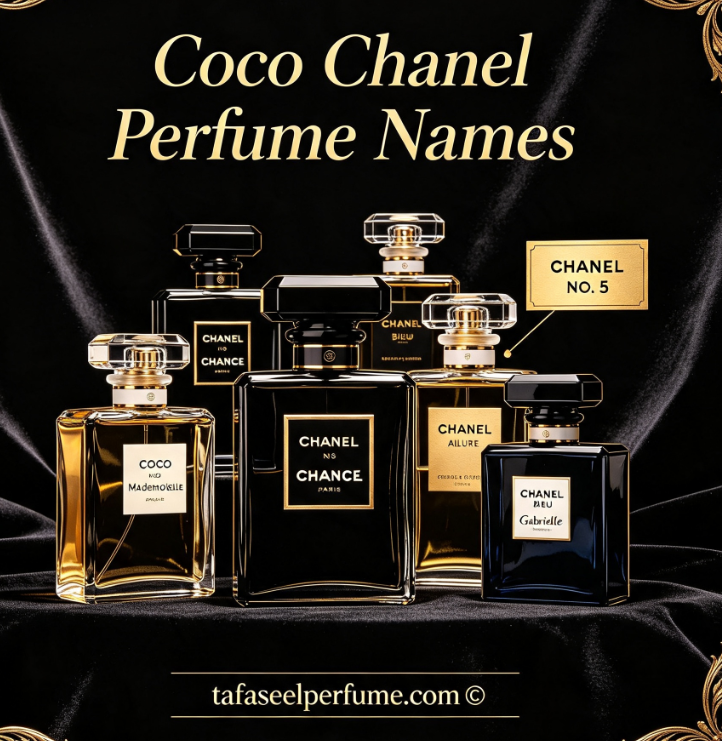
- COCO CHANEL PERFUME NAMES · THE VELVET ARCHITECTURE OF FRENCH ALLURE: Short introduction. The names of Coco Chanel perfumes are not mere labels — they are fragrant poetry, each syllable echoing the life of Mademoiselle Chanel. From the fierce independence of Chanel No. 5 to the midnight mystery of Coco Noir, every name carries a story, a colour, a silhouette. They are the velvet architecture of a house that rewrote the grammar of luxury.
Long introduction. When Gabrielle “Coco” Chanel launched her first fragrance in 1921, she defied the perfumery conventions of her era. Instead of a single floral note, she presented Chanel No. 5 — a name as abstract as the composition itself. That alchemy of naming continued for decades: No. 19 honoured her birthday, Coco paid tribute to her nickname, and Bleu de Chanel painted a masculine horizon. Each perfume name is a deliberate act of olfactory branding, weaving numerology, biography, and emotion into a few syllables. This article explores the entire galaxy of Coco Chanel perfume names, from the iconic to the limited-edition, revealing how a name can become a legend. Whether you are a collector, a curious nose, or a branding enthusiast, these names are the gateways to the Chanel universe.
In this article · The Chanel name atlas
1. Chanel No. 5 – the numeral that changed perfumery
2. Coco Mademoiselle – the modern rebel
3. Chanel No. 19 – the green birthday
4. Coco Noir – the dark side of elegance
1. Chanel No. 5 – the numeral that changed perfumery
Chanel No. 5 is the founding myth of the house. Launched in 1921, its name was chosen by Coco herself – she reportedly said, “I always launch my collections on the fifth of May, so I will call it No. 5.” But the number carries deeper resonance: the fifth sample presented to her by perfumer Ernest Beaux was the one she selected. The name is anti-romantic, almost clinical, yet it became the most romantic perfume in history. No. 5 is an abstract floral aldehyde, a bouquet that smells like no single flower. Its name defied the era’s trend of romantic, literal titles like Rose or Lily. Instead, Chanel chose a minimalist signature that elevated the fragrance to an idea. Today, No. 5 is not just a perfume; it is a cultural artifact, referenced in art, cinema, and fashion. The name itself is a statement of modernity, a number that whispers exclusivity and timelessness. Every bottle carries that iconic numeral, a branding masterstroke that remains as potent as ever. The olfactory architecture of No. 5 is built on ylang-ylang, neroli, and jasmine, but the name is the first note you perceive. It is the silent poetry of a woman who knew that less is always more.
For those who appreciate the intersection of minimalism and luxury, Chanel No. 5 is the ultimate reference. It has inspired countless imitations, but the name remains singular. As Coco said, “A woman who doesn’t wear perfume has no future.” And the future, for No. 5, is forever.
2. Coco Mademoiselle – the modern rebel
Introduced in 2001, Coco Mademoiselle is the younger, edgier sibling of the original Coco (1984). The name is a double tribute: to Coco herself and to the mademoiselle – the independent, unmarried woman who refuses to be defined by convention. This fragrance is an oriental citrus, vibrant with bergamot, orange, and patchouli, but its name captures a state of mind. It is the scent of a woman who is self-possessed, who walks into a room with quiet confidence. The name Coco Mademoiselle is playful yet sophisticated, a juxtaposition that mirrors the fragrance itself – fresh but deep, light but lingering. The velvet architecture of this name lies in its rhythm: the soft “Coco” followed by the crisp “Mademoiselle” creates a melodic tension. It is the perfume of a generation that grew up with Chanel but wanted their own interpretation. The bottle, clean and square, reinforces the minimalist ethos, while the name invites you into a world of possibility. Coco Mademoiselle is not a copy; it is a reinvention, and its name is the first clue.
In the pantheon of Chanel names, Coco Mademoiselle stands as a bridge between heritage and contemporary daring. It is the signature scent for many modern women, and its name has become synonymous with effortless chic.
3. Chanel No. 19 – the green birthday
Chanel No. 19, launched in 1970, is named after August 19 – Coco Chanel’s birthday. This fragrance is a green, powdery iris composition, a departure from the floral warmth of No. 5. The name carries a personal intimacy; it is a gift from the perfumer to the woman herself. No. 19 is often described as crisp, elegant, and unyielding – qualities that mirror Chanel’s own character. The name, like No. 5, is numerical, but this time it is a biographical marker. It invites the wearer to share in the private world of Coco Chanel. The perfume’s green notes of galbanum and hyacinth are sharp and refreshing, and the name enhances that freshness with a sense of precision. No. 19 is not a scent for the faint of heart; it is for the woman who knows her own mind. The name has become a code among perfume lovers – a reference to the most personal of Chanel’s creations. It is a quiet rebellion against the floral mainstream, and its name is a declaration of independence. The velvet architecture of No. 19 is built on contrast: the softness of iris against the sharpness of green, the warmth of birthday memory against the coolness of the bottle.
For collectors, No. 19 is a jewel – a name that tells a story of birth, legacy, and uncompromising taste. It remains one of the most distinctive fragrances in the Chanel line.
4. Coco Noir – the dark side of elegance
Coco Noir, launched in 2012, is the mysterious alter ego of Coco Mademoiselle. The name is a bold juxtaposition – the familiar “Coco” paired with “Noir,” the French word for black. It evokes night, shadow, and depth. This fragrance is a spicy oriental, with notes of grapefruit, rose, and patchouli, but the name suggests a darker narrative. Coco Noir is the scent of a woman who has secrets, who is intriguing and unreadable. The name plays on the duality of light and dark, day and night, the public persona and the private self. It is a velvet architecture of contrast, where the warmth of Coco meets the coolness of Noir. The bottle is a deep, midnight blue, reinforcing the nocturnal theme. The name invites you to explore the shadows of the Chanel universe, to discover a more complex facet of the iconic woman. Coco Noir is not a rebellion but a deepening – a layer of sophistication that only reveals itself over time. It is the perfume for the evening hours, for moments of introspection and allure. The name itself is a poetic twist, transforming a beloved name into something new and elusive.
In the landscape of Chanel names, Coco Noir occupies a unique space – it is both familiar and foreign, a dark jewel in the crown of French perfumery.
5. Bleu de Chanel – the masculine horizon
Bleu de Chanel, launched in 2010, is the quintessential masculine fragrance from the house. The name is a declaration of colour and space – “Bleu” evokes the sky, the ocean, and infinite freedom. It is a woody aromatic with notes of citrus, cedar, and sandalwood, but its name is a statement of modernity. Bleu de Chanel is the fragrance for the man who is self-assured, bold, and unconventional. The name breaks from the tradition of masculine names like “Pour Monsieur” or “Sport” – it is abstract, poetic, and visual. The “de Chanel” anchors it firmly in the house’s heritage, while “Bleu” gives it a universal appeal. The velvet architecture of this name lies in its simplicity – two words that paint a vast horizon. It is the scent of possibility, of a man who writes his own rules. The bottle, a deep blue with a magnetic cap, is as arresting as the name. Bleu de Chanel has become a contemporary classic, a name that is instantly recognisable and endlessly aspirational. It is the blueprint for modern masculine perfumery, a name that transcends gender and speaks to the free spirit in everyone.
For many, Bleu de Chanel is the gateway to the house, a name that promises sophistication without pretension. It is a modern masterpiece of naming and fragrance.
6. Les Exclusifs de Chanel – the private poetry
Les Exclusifs de Chanel is a collection of rare, artisanal fragrances that are only available in select boutiques. The name itself is a statement of exclusivity – “Les Exclusifs” means the exclusive ones, and “de Chanel” ties them to the house’s highest artistry. This is not a mass-market line; it is a private poetry of scent. The collection includes names like Coromandel (oriental), Bois des Îles (woody), and 31 Rue Cambon (the address of Chanel’s first boutique). Each name within the collection is a narrative – a place, a material, a memory. The overarching name, Les Exclusifs, creates a sense of belonging to an elite circle of perfume connoisseurs. It is the velvet architecture of mystery and desire, where each bottle is a treasure. The names are evocative without being literal; they invite interpretation and personal connection. For instance, Sycomore (a woody vetiver) is named after a tree, but it also evokes the strength and simplicity of nature. Les Exclusifs de Chanel is a testament to the house’s commitment to craftsmanship, and its name is a promise of an olfactory journey unlike any other. This collection is for those who seek depth, rarity, and authenticity in their fragrance.
Owning a bottle from Les Exclusifs is like holding a piece of Chanel history – a name that is whispered among true fragrance aficionados.
Explore other legendary fragrances: Lalique Perfume · The Crystal Art of French Haute Parfumerie, Tommy Hilfiger Cologne 3.4 oz, and Acqua di Gio Blue Edition.
For more on iconic scents, visit our Perfume Articles and Brands page. Discover the art of Unisex Perfume and Women’s Perfume collections.
Dive deeper with Couture Viva La Juicy, Black Opium Le Parfum, and Ralph Lauren Cologne for Woman.
FREQUENTLY ASKED QUESTIONS · COCO CHANEL PERFUME NAMES
1. What is the most iconic Coco Chanel perfume name?
Undoubtedly, Chanel No. 5 is the most iconic. Its name is a global reference for luxury perfume, and it has remained the best-selling Chanel fragrance for over a century. The numeral is instantly recognisable and has become synonymous with French elegance.
2. Why did Chanel name her perfume No. 5?
Coco Chanel chose the name because the fifth sample presented by perfumer Ernest Beaux was her favourite. She also launched her collections on the fifth of May, so the number held personal significance. It was a deliberate break from romantic floral names.
3. What is the difference between Coco and Coco Mademoiselle?
Coco (1984) is a warmer, more oriental fragrance with notes of amber and spices, while Coco Mademoiselle (2001) is a fresher, citrus-oriental with a modern, youthful edge. The names reflect their eras: Coco is classic, Coco Mademoiselle is contemporary.
4. Is Bleu de Chanel a men’s fragrance?
Yes, Bleu de Chanel is marketed as a masculine fragrance, but its woody aromatic composition makes it appealing to many women as well. The name suggests universality and is often worn by those who appreciate fresh, clean scents.
5. What are Les Exclusifs de Chanel?
Les Exclusifs is a premium collection of rare perfumes available only in Chanel boutiques. Each fragrance has a unique name (e.g., Coromandel, 31 Rue Cambon) and tells a story linked to Chanel’s heritage. They are crafted with exceptional ingredients.
6. Does Chanel No. 19 have a special meaning?
Yes, Chanel No. 19 is named after Coco Chanel’s birthday, August 19. It is a personal tribute and reflects her green, powdery taste. The name carries an intimate connection to the designer herself.
For further reading, explore Perfume Love in White, Burberry Brit for Her, and alrhair · The Velvet Architecture of Hair. Discover more in our Ranking and Beauty guides.
Related: Deodorant, Fragrance Gels, Spa & Fragrance, Body Art, Makeup Tools, Skin Care.


