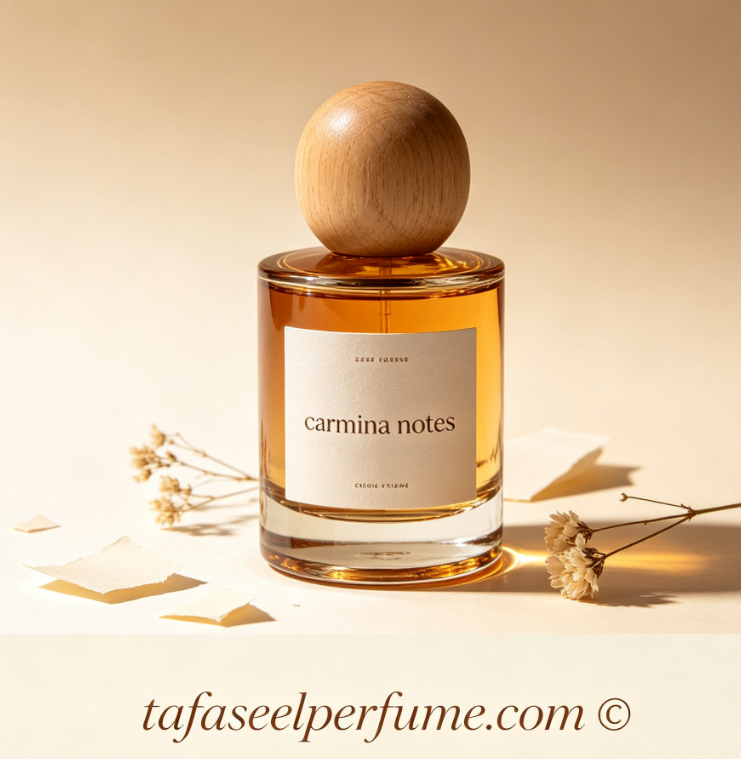
- Carmina Notes · The Velvet Architecture of Scent & the Sillage of Unspoken Grandeur: Carmina Notes is not merely a fragrance diary; it is the linguistic imprint of scent — the chords, whispers, and reverberations that perfumers leave behind. It is the art of translating olfaction into verses that linger longer than the perfume itself.
✧ larger introduction ✧
In the cathedral of perfume, Carmina Notes stands as both manuscript and melody. It is the architecture of accords, the poetry of top, heart, and base. More than a collection of fragrant adjectives, it is a living lexicon that binds the wearer to the intangible — memory, desire, nostalgia. Every spray is a verse; every dry-down, a chorus. This article explores the dimensions of Carmina Notes as a creative and sensory framework, weaving together the olfactory with the lyrical, and inviting you to read fragrance as you would a beloved poem.
contents · carmina notes
1. The origin of Carmina Notes · where lyric meets labdanum
2. The anatomy of a note · top, heart, and the velvet base
3. Carmina as memory · the sillage of nostalgia
4. The perfumer’s quill · writing with molecules
5. Carmina Notes in modern niche perfumery
6. The silent accord · skin, chemistry & the unwritten
7. Carmina Notes and the architecture of unspoken grandeur
8. Collecting verses · how to read a fragrance like poetry
9. The future of olfactory lyricism · AI, data & the soul of Carmina
1. The origin of Carmina Notes · where lyric meets labdanum
Carmina Notes is a term that evokes both the musicality of scent and the textual tradition of song. The word carmina — Latin for “songs” or “poems” — hints at the rhythmic quality of fragrance composition. In ancient perfume lore, ingredients were not merely blended; they were recited, incanted, and paired with verses. The earliest perfumers in Mesopotamia and Egypt documented their formulas on clay tablets, each recipe a carmen of resins, oils, and spices. Today, Carmina Notes refers to the narrative potential of a fragrance: the way a single accord can tell a story of place, person, or epoch. It is the recognition that every perfume is a poem, and every note, a syllable.
Consider the deep, balsamic resonance of labdanum — often described as “amber’s darker sibling.” In the carmina tradition, labdanum is not just a fixative; it is the chorus that anchors the verse, lending weight and gravitas. Perfumers who embrace this mindset think in stanzas, not just percentages. The carmina approach elevates the craft from mere chemistry to a form of lyrical architecture, where the dry-down is as poignant as the final couplet of a sonnet.
2. The anatomy of a note · top, heart, and the velvet base
To speak of Carmina Notes is to dissect fragrance into its temporal movements. The top notes — bright, volatile, like the opening line of a poem — are the first impression, a flash of citrus or green leaves. They are the exordium, meant to captivate. The heart, or middle notes, unfolds like a narrative arc: floral, spicy, or fruity, it carries the emotional weight. But it is the base notes — the velvet architecture of woods, musks, and ambers — that provide the sillage, the lingering echo that defines a perfume’s soul.
In the carmina framework, each layer is a verse with its own rhythm. The transition from top to heart is a modulation, a key change. The dry-down is the coda, where the perfume whispers its final secret. This tripartite structure is not just chemical; it is poetic. When you wear a fragrance, you are performing a poem in four acts — and the Carmina Notes are the libretto.
3. Carmina as memory · the sillage of nostalgia
Perhaps the most profound dimension of Carmina Notes is its relationship with memory. Proust knew this well: the scent of a madeleine unlocks a cathedral of recollection. Similarly, a fragrance built on carmina principles is designed to evoke — not simply to smell pleasant, but to transport. The note of violet, for instance, carries with it the ghost of 19th-century boudoirs; patchouli, the 1970s and counterculture; iris, the powder of grandmothers and the silence of paintings.
Carmina Notes are deliberately structured to trigger the limbic system, to weave olfactory threads into the fabric of personal history. This is why niche perfumers often speak of “memory notes” — ingredients that function as time machines. The sillage of a carmina-inspired fragrance is never just a trail; it is a narrative residue, a line of poetry left hanging in the air, waiting to be finished by the one who breathes it.
4. The perfumer’s quill · writing with molecules
A perfumer who works within the Carmina Notes philosophy is less a chemist and more a poet. The palette is vast: from the green bitterness of galbanum to the creamy sweetness of sandalwood, each material is a word, each blend a syntax. The perfumer’s quill is the pipette; the parchment, the blotter. But unlike a writer who works with linear language, the perfumer composes in four dimensions — time, evaporation, skin chemistry, and ambient temperature.
This is why Carmina Notes are often described as “liquid verses.” A master perfumer like Jean-Claude Ellena or Dominique Ropion operates with a lyrical intuition, knowing when a chord is too loud or when a silent accord speaks volumes. The process is iterative, a rewriting of the olfactory manuscript until every note aligns with the intended emotion — a melancholic waltz, a jubilant ode, or a quiet elegy.
5. Carmina Notes in modern niche perfumery
In the past two decades, niche perfumery has embraced the Carmina Notes ethos with fervor. Brands like Diptyque, Le Labo, and Byredo craft scents that are explicitly narrative, often accompanied by poetic descriptions that read like micro-stories. The rise of “literary perfumery” — where a fragrance is inspired by a book, a character, or a poem — is a direct descendant of the carmina tradition.
Take, for instance, a fragrance that opens with a sharp bergamot (the first line of a novel) and settles into a smoky vetiver (the denouement). Each spray is a page turned. The consumer is no longer a passive wearer but a co-author, interpreting the notes through their own emotional lens. This interactive poetry is what makes Carmina Notes so compelling in the modern olfactory landscape — it democratizes meaning, allowing each person to write their own verse.
6. The silent accord · skin, chemistry & the unwritten
One of the most fascinating aspects of Carmina Notes is the recognition of the “silent accord” — the influence of the wearer’s skin, microbiome, and even mood. A fragrance that sings on one person may whisper on another. This is the unwritten verse of the perfume poem, the blank space that invites interpretation. In carmina theory, the skin is the final editor, modifying the text in real-time.
This is why perfumers often advise to “test on skin” — because the true poem emerges only in dialogue with the body. The heat of the skin amplifies certain molecules, while the pH alters others. The Carmina Notes are thus never fixed; they are fluid, dynamic, and deeply personal. It is a reminder that fragrance is not a monologue but a duet between the composer and the wearer, a shared lyric that changes with every performance.
7. Carmina Notes and the architecture of unspoken grandeur
The phrase “unspoken grandeur” is central to the Carmina Notes aesthetic. It refers to the quality of elegance that does not shout but insinuates. A perfume that embodies this philosophy is never loud; it is measured, composed, and confident in its silences. Think of the restraint in a Chanel No. 5 or the quiet opulence of a Guerlain Shalimar — they are grand not because of volume but because of depth.
In architectural terms, Carmina Notes are the vaulted ceilings and the muted lighting of a cathedral. They create space for contemplation. The notes themselves are chosen for their ability to suggest rather than declare: a whisper of incense, a hint of rose, a shadow of leather. This is the art of the unsaid, the perfume equivalent of a haiku — minimal, resonant, and infinitely evocative.
8. Collecting verses · how to read a fragrance like poetry
To engage with Carmina Notes is to learn a new language of reading. Instead of asking “Do I like this?” the carmina reader asks “What story is this telling?” or “What emotion is this trying to articulate?” This shift from consumption to interpretation is the heart of the lyrical approach. It involves training the nose to discern not just notes, but intentions, contrasts, and harmonies.
A helpful exercise is to keep a scent diary: describe a fragrance as you would a poem, noting its rhythm, its imagery, its emotional arc. Over time, you begin to recognize the “signature” of certain perfumers, much as you would recognize the style of a poet. Carmina Notes become a lens through which the entire perfume world becomes a library of living verses, each bottle a book waiting to be opened.
9. The future of olfactory lyricism · AI, data & the soul of Carmina
As artificial intelligence enters the field of perfumery, the concept of Carmina Notes faces new frontiers. Algorithms can now generate novel scent combinations based on vast datasets of consumer preferences. But can an AI write a poem? This is the central question. While AI can mimic the structure of a fragrance, it often lacks the intentionality and emotional memory that defines carmina.
Yet, there is potential for a symbiotic future: AI can suggest unexpected accords, and the perfumer can infuse them with narrative soul. The Carmina Notes of tomorrow may be co-authored by human and machine, but the lyrical core — the desire to express the inexpressible — will remain distinctly human. The future of olfactory lyricism lies not in replacing the poet but in expanding the vocabulary of the poem.
❧ frequently asked questions about Carmina Notes
Carmina Notes refer to the narrative and poetic dimension of fragrance composition — the idea that each note carries emotional, historical, or lyrical significance beyond its olfactory function. It is a framework for reading perfume as poetry.
No, it is not a brand nor a single ingredient. It is a conceptual approach, a philosophy that emphasizes the storytelling potential of scent. Many niche perfumers adopt this mindset, but it is not proprietary.
Start by smelling fragrances without judgment and ask: “What does this remind me of?” “What atmosphere does it create?” Keep a journal. Over time, you will perceive not just notes but the emotional architecture behind them.
Some do, though often unconsciously. Designer fragrances may focus more on mass appeal, but many classic compositions (like Chanel No. 5 or Dior Sauvage) have a carmina-like structure — a clear narrative arc from top to base.
Absolutely. Whether it’s a fresh citrus, a woody oriental, or a floral chypre, any perfume can be analyzed through the carmina lens. It’s about perspective, not genre.
Memory is central. Carmina Notes are designed to evoke personal or collective memories, making fragrance a time machine. The note of lilac, for example, might recall a childhood garden, while the scent of leather might evoke a vintage car interior.
A review often describes a fragrance in terms of like/dislike or performance. Carmina Notes go deeper: they analyze the perfume as a text, looking at structure, symbolism, and emotional resonance. It’s literary criticism for the nose.


