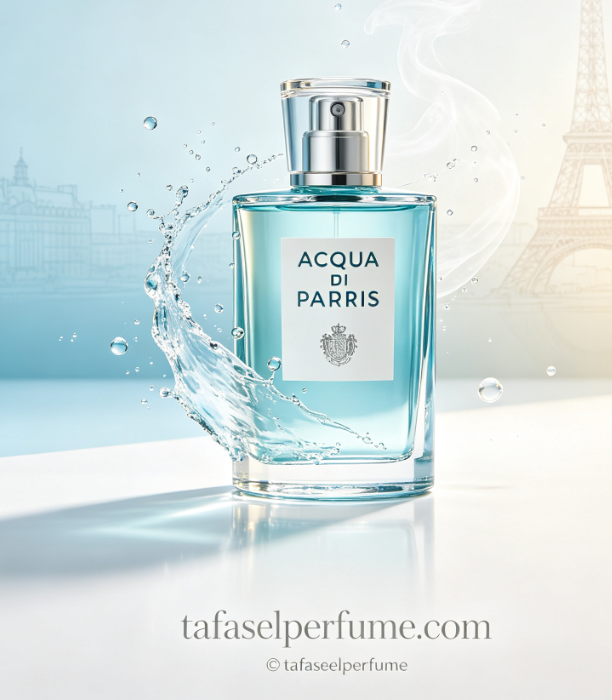
- Acqua di Paris · The Poetry of French Waters: ✦ A scent that captures the silver light of the Seine, the limestone warmth of Parisian courtyards, and the crispness of Île-de-France mornings.
navigate the essence
1. The mineral soul of Paris 2. Iris, bergamot and the art of restraint 3. From the Seine to the skin: a fresh signature 4. Acqua di Paris vs. classic eaux de cologne 5. Layering with luxury: the Parisian way 6. The bottle: a tribute to art deco fountains 7. When to wear Acqua di Paris — a seasonal guide1. The mineral soul of Paris
Acqua di Paris opens with a burst of Calabrian bergamot and pink pepper, but its true heart lies in the mineral notes—a signature that evokes the limestone façades of the Louvre and the rain-washed cobblestones of Montmartre. This is not a marine fragrance in the salty, oceanic sense; rather, it is a freshwater mineralité that recalls the clarity of the Seine as it flows through the city. The perfumer, Jacques Flori, spent three years studying the interaction between water hardness and floral molecules, resulting in a composition that feels both crystalline and soft. The mineral accord is achieved through a synthetic molecule called aquaflore, which mimics the scent of wet stone after a summer shower. When worn, it creates a cool aura that contrasts beautifully with warm skin, making it an ideal choice for transitional weather. For those who appreciate the elegance of simplicity, Acqua di Paris offers a refined alternative to heavier woody or gourmand fragrances. Its mineral backbone ensures longevity without overwhelming the senses, a true feat in modern perfumery.
2. Iris, bergamot and the art of restraint
At the core of Acqua di Paris lies a trio of iris, bergamot, and white tea. Iris, often associated with powdery opulence, is treated here with a light hand—its orris butter is diluted to a mere whisper, allowing the citrus to shine. Bergamot provides a sparkling top note that never turns sharp, thanks to a subtle green-tea modifier. This restraint is a nod to the Parisian aesthetic: elegance without excess, detail without clutter. The white tea absolute adds a delicate astringency that balances the creaminess of iris, creating a scent that evolves slowly on the skin. It is this very restraint that makes Acqua di Paris a versatile signature for both day and evening. In a world of loud, projection-heavy perfumes, Acqua di Paris invites intimacy—it is a fragrance to be discovered, not announced. Many compare it to a well-tailored blazer or a silk scarf: understated, yet unmistakably chic. For those seeking a olfactory counterpart to minimalism, this is the embodiment of quiet luxury.
3. From the Seine to the skin: a fresh signature
The freshness of Acqua di Paris is not borrowed from the sea but from the river that bisects the city. The Seine, with its gentle current and reflective surface, inspired the aquatic facet of this fragrance. Unlike oceanic scents that rely on calone and melon, Acqua di Paris uses a combination of lotus flower, water jasmine, and a dash of cucumber extract to evoke a sense of clean, flowing water. This aquatic profile is anchored by a base of transparent musk and cedarwood, which provides a dry-down that feels like sun-warmed skin after a dip in a freshwater lake. The perfume is particularly well-suited for those who work in enclosed spaces, as its sillage is moderate and never cloying. It has become a favorite among artists and writers in the 11th arrondissement, who appreciate its ability to refresh without distracting. Moreover, its unisex nature—neither overtly masculine nor feminine—makes it a true bridge between traditional perfume categories. It is the olfactory equivalent of a black turtleneck: timeless, effortless, and profoundly Parisian.
4. Acqua di Paris vs. classic eaux de cologne
While classic eaux de cologne rely on high concentrations of citrus oils and a short lifespan, Acqua di Paris challenges that tradition with a more structured longevity. Its Eau de Parfum concentration (15% oil) ensures that the fragrance lasts six to eight hours, while still retaining the luminous freshness of a cologne. The difference lies in the base: where traditional colognes fade into a simple musk or rosemary, Acqua di Paris develops into a warm, slightly creamy sandalwood and ambrette seed accord. This evolution mirrors the transition from a brisk Parisian morning to a golden afternoon. Furthermore, the inclusion of a patented fixative derived from oakmoss substitutes (without the allergen) gives it a tenacity that defies its airy character. For lovers of classic colognes who crave more staying power, Acqua di Paris offers the best of both worlds: the effervescence of a citrus splash with the depth of a modern floral-woody perfume. It is, in many ways, a tribute to the history of eaux de cologne while being resolutely contemporary.
5. Layering with luxury: the Parisian way
In Paris, perfume layering is an art form, and Acqua di Paris serves as an exquisite base layer. Its transparent mineral notes allow it to harmonize with richer scents such as amber, vanilla, or rose. Many Parisian perfume enthusiasts apply Acqua di Paris as a first spritz, followed by a single spray of a more opulent fragrance on the pulse points. The result is a bespoke aura that feels both fresh and deeply personal. For instance, layering it with a rose-centric perfume brings out the hidden floralcy of the iris, while pairing it with a smoky vetiver accentuates the mineral dryness. This practice is not about masking but about enhancing—each layer reveals a new facet of the Acqua di Paris composition. Department stores in the 8th arrondissement now offer layering workshops, where customers are taught to mix Acqua di Paris with other offerings from the same house. The beauty of this approach is that it transforms a single fragrance into a wardrobe of scents, adapting to mood, season, and occasion. It is a celebration of individuality within the framework of Parisian elegance.
6. The bottle: a tribute to art deco fountains
The visual identity of Acqua di Paris is as compelling as its olfactory profile. The bottle, designed by the French glassmaker Pochet du Courval, is a geometric homage to the Wallace fountains that dot the streets of Paris. Its faceted glass, reminiscent of an Art Deco skyscraper, catches the light in a way that echoes the glittering surface of the Seine. The cap, a deep cobalt blue, is weighted to mimic the cool heft of a river stone. Even the label is minimalist: a single silver line representing the river's flow, with the name etched in a custom serif font. This attention to detail extends to the packaging, which uses recycled paper and a linen texture that feels like old bookbinding. For collectors, the bottle is a piece of art in itself, often displayed on vanity tables rather than hidden in drawers. The design philosophy behind it is simple: the container should be as refined as the liquid it holds. It is a testament to the brand's commitment to French craftsmanship, from the juice to the glass, making Acqua di Paris a holistic sensory experience.
7. When to wear Acqua di Paris — a seasonal guide
One of the most remarkable qualities of Acqua di Paris is its year-round versatility, though it truly shines in spring and early autumn. In spring, its floral-mineral notes mirror the awakening of the Tuileries Gardens—daffodils, damp earth, and cherry blossoms in the air. Summer calls for a lighter application; two spritzes on the back of the neck create a cooling effect that combats the heat without becoming cloying. Autumn brings out the woody undertones, making it a perfect companion for crisp walks along the Canal Saint-Martin. Even winter, with its muted light, benefits from Acqua di Paris—its transparent musk and bergamot cut through the heavy air of heated rooms, offering a breath of freshness. Many Parisians keep a travel-size atomizer in their bag, ready to refresh their scent after a change in weather or mood. The fragrance adapts to the wearer's skin chemistry, ensuring that no two wearers experience it identically. This chameleon-like quality is perhaps its greatest strength, making it a staple in the wardrobe of any perfume connoisseur.


